Short answer: multiply each semester’s GPA by its credit units to get quality points, add all the points, then divide by the total credit units. Do not average the GPAs unless every semester had the same units.
Why You Cannot Simply Average Your GPAs
If you have your semester GPAs but not your CGPA, the tempting shortcut is to add them up and divide by the number of semesters. That works only when every semester had the same number of credit units. Otherwise it treats a light semester as equal to a heavy one, which gives the wrong answer. The fix is to weight each GPA by its credit units, and the easiest way to do that is through quality points. If you want the bigger picture first, see our guide on the difference between GPA and CGPA.
The Formula
CGPA = total quality points ÷ total credit units
A semester GPA is itself quality points divided by units, so multiplying it by the units gives the quality points back. This lets you rebuild your CGPA from GPAs and units alone. Our guide on how GPA is calculated explains where quality points come from.
Step-by-Step Example
A student on a 4.0 scale has four semesters of results.
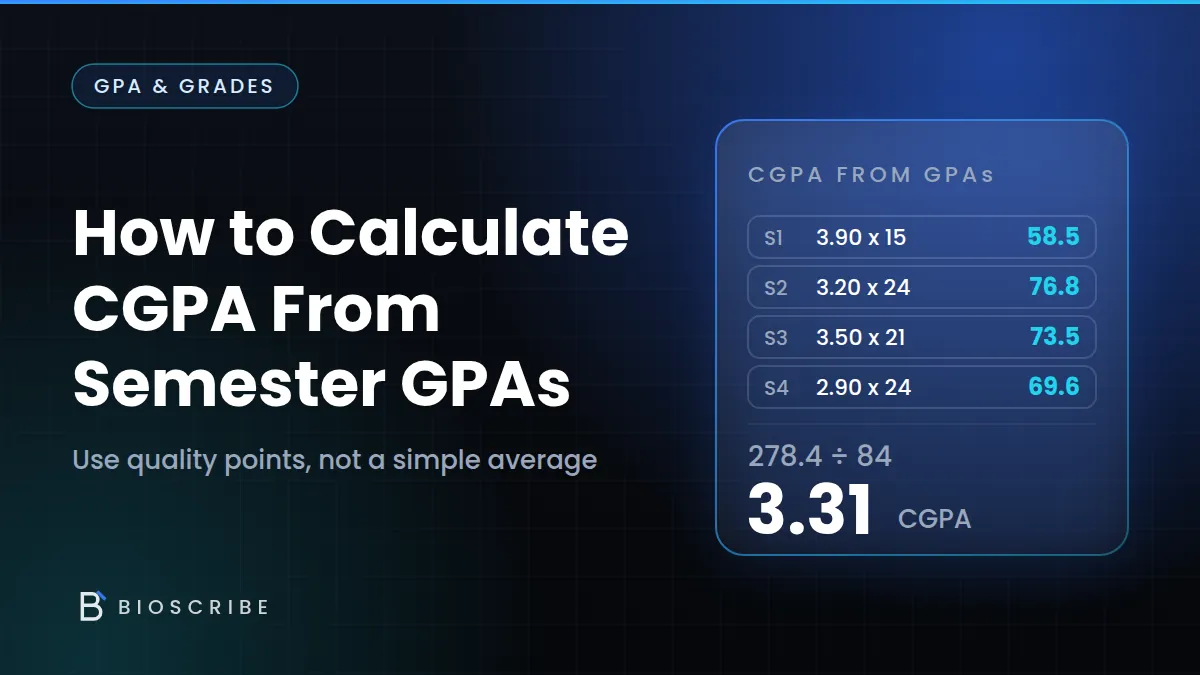
| Semester | GPA | Credit units | Quality points |
|---|---|---|---|
| 1 | 3.90 | 15 | 58.5 |
| 2 | 3.20 | 24 | 76.8 |
| 3 | 3.50 | 21 | 73.5 |
| 4 | 2.90 | 24 | 69.6 |
| Total | 84 | 278.4 |
- Multiply each GPA by its units: 3.90 × 15 = 58.5, and so on down the table.
- Add the quality points: 58.5 + 76.8 + 73.5 + 69.6 = 278.4.
- Add the credit units: 15 + 24 + 21 + 24 = 84.
- Divide: 278.4 ÷ 84 = 3.314, which rounds to 3.31.

How Far Off Is a Simple Average?
A simple average of the four GPAs is (3.90 + 3.20 + 3.50 + 2.90) ÷ 4 = 3.375, or 3.38. That is 0.07 higher than the correct 3.31, because the weakest semester also had the most units. The gap can be much larger. Imagine one semester with a 4.0 GPA over 6 units and another with 2.0 over 24 units. A simple average says 3.0, but the correct CGPA is (24 + 48) ÷ 30 = 2.4.
Check Your Answer
Two quick checks catch most mistakes. Your CGPA must lie between your lowest and highest semester GPA, which is 2.90 to 3.90 in the example. It should also lean toward the semesters with more units. If the answer falls outside the range, look for a multiplication error or a unit total that is wrong.
When Your GPAs Are Rounded
Transcripts often show GPAs to two decimal places. A GPA shown as 3.54 could be anywhere from 3.535 to 3.545, so over 21 units the quality points could be between 74.235 and 74.445. Across all your semesters the rounding error in your CGPA is at most 0.005. If your transcript lists quality points, use them directly, because they are exact. Otherwise the method above is accurate enough for planning.
Mixing Scales and Special Courses
Keep three cautions in mind. Do not combine semesters from different grading scales, because averaging a 4.0 GPA with a 5.0 GPA gives a meaningless number. Courses that are pass/fail or non-credit are often left out of the calculation, so check whether yours count. Repeated courses are handled differently by different institutions, so follow your own rules and adjust your quality points and units before you start.
Updating After a New Semester
You do not need to repeat the whole calculation. Keep a running total of quality points and credit units, then add the new semester. Say semester 5 has a GPA of 3.70 over 22 units, which is 3.70 × 22 = 81.4 quality points. The new totals are 278.4 + 81.4 = 359.8 points and 84 + 22 = 106 units. The updated CGPA is 359.8 ÷ 106 = 3.39.
Doing It in a Spreadsheet
Put the semester GPAs in column B and the credit units in column C. The formula =SUMPRODUCT(B2:B5,C2:C5)/SUM(C2:C5) multiplies each GPA by its units, adds the results and divides by the total units in one step. Add a row for each new semester and extend the ranges.
A Running CGPA After Each Semester
A running table shows how your CGPA developed. Using the four semesters above, the totals after each semester give these results:
| After semester | Total points | Total units | CGPA |
|---|---|---|---|
| 1 | 58.5 | 15 | 3.90 |
| 2 | 135.3 | 39 | 3.47 |
| 3 | 208.8 | 60 | 3.48 |
| 4 | 278.4 | 84 | 3.31 |
The big drop came in semester 2, when 24 units at 3.20 outweighed 15 units at 3.90. Semester 4 then lowered the CGPA again, because its 2.90 came with another 24 units.
A Second Example: Part-Time and Full-Time Semesters
Unit loads can differ a lot, for example when a student studies part-time in one semester. Suppose semester 1 is a 3.80 GPA over 12 units and semester 2 is a 3.00 GPA over 27 units. The quality points are 45.6 and 81.0, which total 126.6 over 39 units. The CGPA is 126.6 ÷ 39 = 3.25, while a simple average would claim 3.40. The semester with more units dominates, which is exactly what weighting is meant to do.
Reading Your Transcript
Look at what your transcript lists. Most show a GPA and credit units for each semester, and many also show quality points, which are sometimes called grade points or weighted points. A cumulative line normally gives your official CGPA. If your own result differs from the official one, check four things: repeated or replaced courses, courses excluded from the calculation, rounding, and a different scale. Matching your figure to the official record shows that you have the method right, and it makes later planning more reliable.
When a Simple Average Is Correct
There is one case where averaging works. If every semester has the same number of credit units, each GPA carries equal weight and the simple average is exact. Suppose the four semesters above each had 18 units. The quality points would be 70.2, 57.6, 63.0 and 52.2, which total 243.0 over 72 units, and 243.0 ÷ 72 = 3.375. A simple average of the four GPAs also gives 3.375. Check your unit loads before you take the shortcut, and use quality points whenever they differ.
Common Mistakes to Avoid
- Averaging GPAs without units. Always weight by credit units.
- Using a different scale for one semester. Keep all semesters on the same scale.
- Counting non-credit courses. Check which courses your institution includes.
- Rounding too early. Keep decimals until the final division.
- Ignoring repeat rules. Adjust points and units according to your institution’s policy.
Check Your Work With BioScribe
The BioScribe GPA & CGPA Calculator works out semester GPA and cumulative CGPA from your courses, credit units and grades, and includes target CGPA and what-if scenarios. Use it to check the 3.31 example above, then try your own results.
Frequently Asked Questions
Why not just average my semester GPAs?
Semesters usually have different numbers of credit units. A simple average treats a 6-unit semester the same as a 24-unit one, which gives the wrong answer unless the units are equal.
Can I calculate CGPA if I only know GPAs and not units?
Not accurately. You need the credit units for each semester. If every semester had the same units, a simple average would work.
Should I use GPA to two decimal places?
It is fine for planning, but quality points from your transcript are more exact. Rounded GPAs can shift the CGPA by at most 0.005.
Does CGPA include failed courses?
Usually yes, because an F earns zero points while its credit units still count. Some institutions have special rules for repeated courses, so check yours.
Can I combine semesters from different grading scales?
No. Calculate each scale separately according to your institution’s rules, because averaging a 4.0 GPA with a 5.0 GPA gives a meaningless number.
Conclusion
To get CGPA from semester GPAs, convert each GPA to quality points with its credit units, add the points and divide by the total units. Check that the answer sits between your lowest and highest GPA, and keep running totals so each new semester is a single update.