How to Calculate an Average: Mean, Weighted Average & Student Scores
An average sounds simple until you need it for a course: do all scores count equally, should totals matter, and is it the same as a GPA? The calculator above covers five situations. This guide explains the formulas and the differences with worked examples.
What Is an Average?
In everyday speech, an average is a typical value. In mathematics, the most common version is the mean:
Mean = Sum of Values ÷ Number of Values
Averages are useful for summarizing test scores, assignment results, survey answers, measurements and academic performance, and for comparing groups of numbers. An average is a summary, so it hides detail such as how spread out the values are.
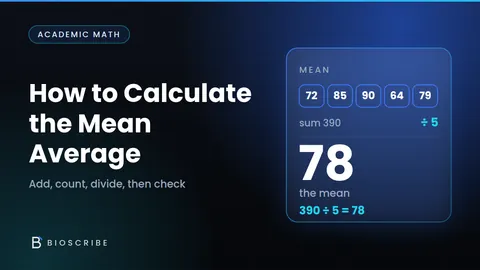
How to Calculate the Mean Average
Take the values 60, 70, 80 and 90. Step 1: add them, 60 + 70 + 80 + 90 = 300. Step 2: count them; there are 4. Step 3: divide, 300 ÷ 4 = 75. The average is 75. Try it in Simple Average mode, or read How to Calculate the Mean Average.
How to Calculate the Average of Test Scores
Add the scores and divide by how many there are. Four test scores of 65, 75, 85 and 95 add up to 320, and 320 ÷ 4 = 80. Be clear about what you are averaging. An average of raw scores, such as 14, 16 and 18 out of 20, gives 16 out of 20. An average of percentages first converts each score. The two agree when every test has the same total, but not otherwise. The Percentage Calculator converts scores to percentages, and How to Calculate Your Average Test Score covers more.
Average Score vs Overall Percentage
Averaging percentages is not always the same as adding all points earned and dividing by all points possible. Take Test 1: 9 out of 10 (90%) and Test 2: 50 out of 100 (50%).
Simple average of percentages: (90 + 50) ÷ 2 = 70%
Combined percentage: (9 + 50) ÷ (10 + 100) × 100 = 59 ÷ 110 × 100 = 53.64%
The results differ because the combined figure gives Test 2 more influence: it holds 100 of the 110 possible points. The simple average treats the two tests as equals. Neither is automatically correct. Your course rules decide which applies, and From Scores mode shows both.
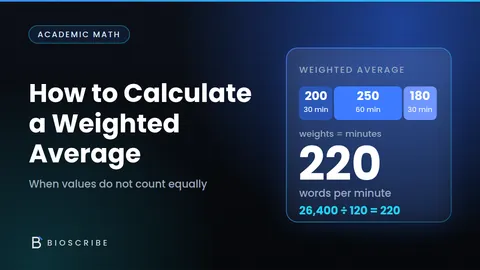
How to Calculate a Weighted Average
Weighted Average = Σ(Value × Weight) ÷ Σ(Weights)
Say an assignment scores 80% with a weight of 30%, and an exam scores 70% with a weight of 70%. Then 80 × 0.30 = 24 and 70 × 0.70 = 49. Add them: 24 + 49 = 73, and since the weights total 1 (100%), the weighted average is 73%. Weighted averages are common in education because assessments rarely count equally. The Grade Calculator applies this idea to a whole course, including the score you need on a final exam.
Weighted Average vs Simple Average
| Simple average | Weighted average | |
|---|---|---|
| Influence of each value | Equal | Depends on the weight |
| Formula | Sum ÷ Number of values | Σ(Value × Weight) ÷ Σ(Weights) |
| Typical use | Equal quizzes, repeated measurements | Assignments, tests and exams with different weights |
| Example (80 and 70) | 75 | 73 with weights 30% and 70% |
To know which one your course uses, check the syllabus. If it lists percentages for each category, use a weighted average. If it says all quizzes count equally, a simple average within that category is right. How to Calculate a Weighted Average offers more examples.
How to Calculate an Average Grade
Take Math 75, Biology 82, Chemistry 68 and English 90. The sum is 75 + 82 + 68 + 90 = 315, and 315 ÷ 4 = 78.75. That is a simple average of numerical grades. It is not automatically a GPA. If courses have different credit units, a credit-weighted average is more appropriate, and the calculator’s grades mode supports optional credits.
Average vs GPA
An average is the sum of numerical values divided by how many there are. A GPA is generally based on grade points and credit units under a particular grading system, so the same results can produce different GPAs at different institutions. Do not assume a universal scale. To work out a GPA or CGPA using your own scale, use the GPA & CGPA Calculator.
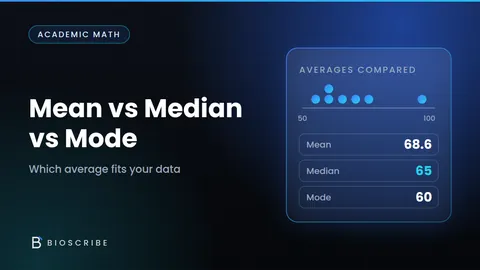
Mean vs Median vs Mode
- Mean: the arithmetic average.
- Median: the middle value after sorting.
- Mode: the most frequent value.
For 2, 3, 3, 5, 8: the mean is 21 ÷ 5 = 4.2, the median is 3 and the mode is 3. The mean is pulled upward by the 8, which is why extreme values affect it more than they affect the median. See Mean vs Median vs Mode: What’s the Difference? for more.
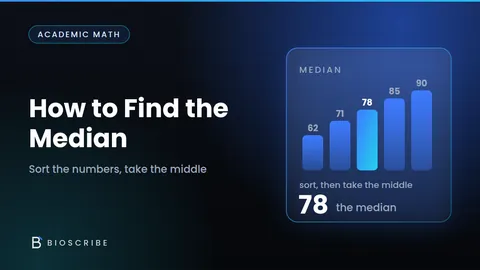
How to Calculate the Median
Sort the values from smallest to largest and pick the middle one. If there is an even number of values, average the two middle ones. For the odd list 3, 7, 9, the median is 7. For the even list 4, 6, 8, 10, the middle two are 6 and 8, so the median is (6 + 8) ÷ 2 = 7. The calculator shows the median alongside the mean, and How to Find the Median of a Set of Numbers has further examples.
How to Calculate a Weighted Academic Average
Courses often combine assignments, tests, projects and exams with different importance. Multiply each result by its weight, add the products and divide by the total weight. Suppose coursework is 85% with a weight of 40% and the exam is 70% with a weight of 60%: 85 × 0.40 = 34, 70 × 0.60 = 42, and 34 + 42 = 76%. The correct weights must come from your course or grading rules, not from an estimate.
Dropping the Highest or Lowest Score
Excluding a value is a simple recalculation. For 60, 70, 75, 80 and 100, the mean is 385 ÷ 5 = 77. Exclude the 100 and the remaining sum is 60 + 70 + 75 + 80 = 285, and 285 ÷ 4 = 71.25. Only exclude scores if your instructor or course policy allows it. The calculator treats this as arithmetic and does not know your rules.
How an Outlier Can Affect an Average
An outlier is a value far from the others. For 70, 72, 75, 74 and 150, the sum is 441, so the mean is 88.2, higher than four of the five values. The median, after sorting to 70, 72, 74, 75, 150, is 74, which describes the typical value better. When one number looks unusual, compare the mean and the median before drawing conclusions.
Common Average Calculation Mistakes
- Dividing by the wrong number of values: count carefully, including zeros you intend to include.
- Forgetting one score: list every value before adding.
- Adding values incorrectly: recheck the sum.
- Averaging percentages when a weighted calculation is required: use weights.
- Confusing average with GPA: GPA needs grade points and credits.
- Rounding too early: round only the final answer.
- Ignoring assessment weights: some results count more.
- Accidentally including an excluded score: check the list.
- Treating missing work as zero without checking the grading policy: policies differ.
- Assuming every course uses a simple arithmetic mean: read the syllabus.
Worked Student Examples
- Example 1, four quizzes: 14, 16, 18 and 12 out of 20. The sum is 60, and 60 ÷ 4 = 15 out of 20, or 75%.
- Example 2, five assignments: 82%, 90%, 76%, 88% and 94%. The sum is 430, and 430 ÷ 5 = 86%.
- Example 3, different weights: 85% at 40% and 70% at 60%. 34 + 42 = 76%.
- Example 4, different maximums: 18/20 (90%) and 36/60 (60%). The simple average is 75%, but the combined percentage is 54 ÷ 80 × 100 = 67.5%.
- Example 5, one permitted exclusion: 82, 74, 90, 58 and 86. All five give 390 ÷ 5 = 78. Excluding 58 gives 332 ÷ 4 = 83.
How to Use an Average to Track Academic Progress
Comparing your current average with an earlier one, or looking at results assessment by assessment, shows direction. Be careful with small differences: a gap of a point or two can come from a single question. An average is one summary measure. It may not capture difficulty, weighting, course credits, grading policies or improvement trends, so look at the individual results too.
When an Average Is Not Enough
Different questions need different tools. Use a weighted average when assessments have unequal importance, the Grade Calculator for a course grade or a required final score, the Percentage Calculator to convert scores, and the GPA & CGPA Calculator for grade points and credits. When one value looks extreme, the median can be more representative than the mean.