Short answer: GPA = total quality points ÷ total credit units. Multiply each course’s grade point by its credit units, add those results together, then divide by the total credit units you took.
What GPA Actually Measures
GPA (grade point average) squeezes a semester of results into a single number. It is a weighted average, not a plain one: a 4-unit course moves your GPA more than a 2-unit course, because it carries more of your workload. Most institutions first turn each letter grade into a grade point, and after that the arithmetic is the same everywhere.
The scale is the part that varies. Many universities in Nigeria use a 5.0 scale (A = 5, B = 4, C = 3, D = 2, E = 1, F = 0), while a 4.0 scale (A = 4, B = 3, C = 2, D = 1, F = 0) is common in the United States and elsewhere. Some institutions add plus and minus grades or use different cut-offs, so always use the scale printed in your own handbook.
The GPA Formula
GPA = sum of all quality points ÷ sum of all credit units
Quality points (some schools say “weighted points”) are the grade point multiplied by the course’s credit units. Credit units, sometimes called credit hours or credits, are the weight your institution gives each course.
Step-by-Step Example on a 5.0 Scale
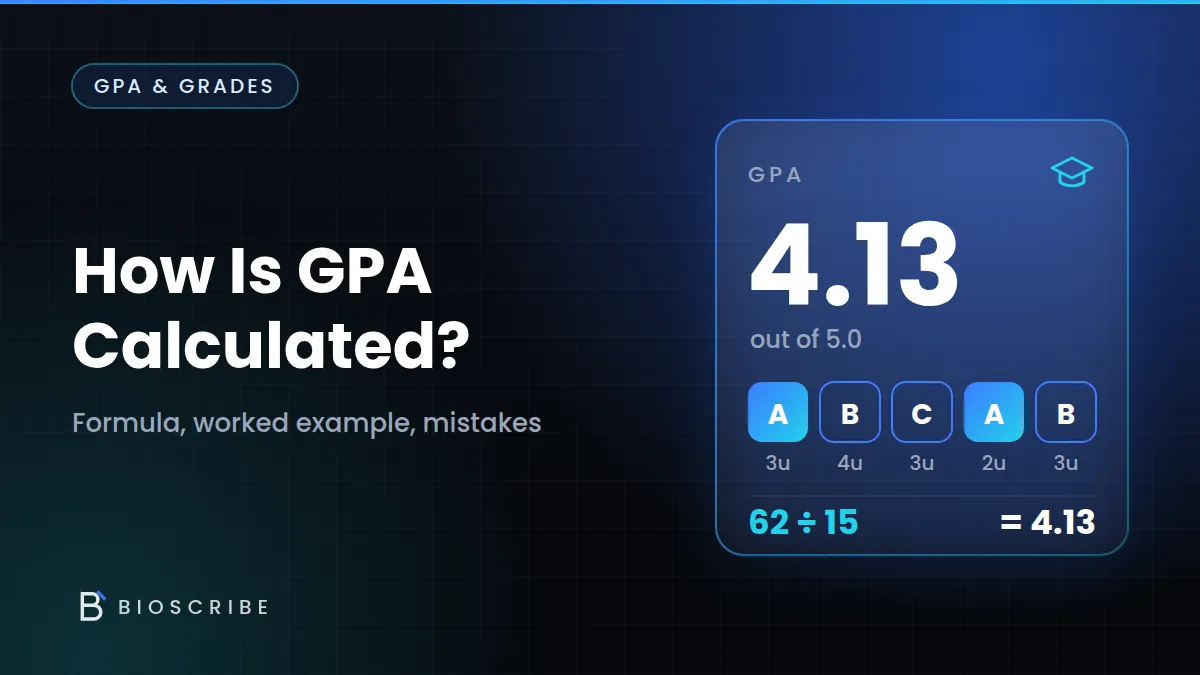
Take a first-semester student with five courses. The course codes are made up for illustration.
| Course | Credit units | Grade | Grade point | Quality points |
|---|---|---|---|---|
| MTH 101 | 3 | A | 5 | 15 |
| CHM 101 | 4 | B | 4 | 16 |
| PHY 101 | 3 | C | 3 | 9 |
| ENG 101 | 2 | A | 5 | 10 |
| BIO 101 | 3 | B | 4 | 12 |
| Total | 15 | 62 |
- Convert each grade to a grade point using your scale. An A becomes 5, a B becomes 4, and so on.
- Multiply by credit units. MTH 101 gives 5 × 3 = 15 quality points.
- Add the quality points: 15 + 16 + 9 + 10 + 12 = 62.
- Add the credit units: 3 + 4 + 3 + 2 + 3 = 15.
- Divide: 62 ÷ 15 = 4.133…, which rounds to 4.13.
Round only at the very end. Rounding each step can shift the final figure by a few hundredths, which sometimes matters at a grade boundary.

Why Credit Units Matter: Weighted vs Simple Average
A simple average of the five grade points would be (5 + 4 + 3 + 5 + 4) ÷ 5 = 21 ÷ 5 = 4.20. The correct weighted GPA is 4.13. It is lower because the 4-unit course earned a B, which is below the simple average, while the 2-unit course, which earned an A, carries the least weight. Ignoring credit units rewards or punishes you for the wrong courses.
The Same Method on a 4.0 Scale
Suppose a student takes four courses on a 4.0 scale: 3 units with an A (4 × 3 = 12), 3 units with a B (3 × 3 = 9), 4 units with a C (2 × 4 = 8) and 2 units with an A (4 × 2 = 8). That is 37 quality points over 12 credit units, so GPA = 37 ÷ 12 = 3.083…, or 3.08. Only the grade points changed. The method did not.
From GPA to CGPA
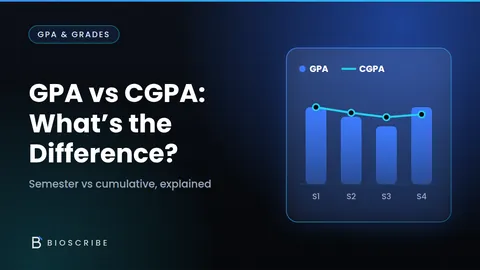
GPA covers one semester. CGPA (cumulative GPA) uses the same formula across every course you have taken so far. Do not average your semester GPAs, because semesters rarely have identical credit units. Say the semester above gave 62 points over 15 units, and a second semester gave 54 points over 18 units (a GPA of 3.00). The CGPA is (62 + 54) ÷ (15 + 18) = 116 ÷ 33 = 3.52. Averaging the two GPAs instead gives (4.13 + 3.00) ÷ 2 = 3.57, which is wrong because the heavier second semester should count for more.
Common Mistakes to Avoid
- Averaging grade points without credit units. Always weight by credit units.
- Using the wrong scale. An A is 5 on one scale and 4 on another. Check your handbook first.
- Rounding too early. Keep the full decimals until the final division.
- Counting courses your school excludes. Some institutions leave out pass/fail, audit or non-credit courses.
- Mishandling repeated courses. Policies on resits and replaced grades differ, so follow your institution’s rule.
- Mixing up GPA and CGPA. One is a single semester, the other is everything to date.
Check Your Work With BioScribe
The BioScribe GPA & CGPA Calculator lets you enter your courses, credit units and grades to work out your semester GPA and cumulative CGPA. It also offers target CGPA and what-if scenarios. Enter the example courses above, using the grade scale your institution follows, and compare the result with the working on this page.
Frequently Asked Questions
What is a good GPA?
It depends on your scale and your institution’s classification rules. On a 5.0 scale, many Nigerian universities set First Class at about 4.50 and above, but boundaries differ, so check your own handbook rather than relying on a general figure.
Does a failed course lower my GPA?
Usually yes. An F earns zero grade points, but its credit units still count in the total, so it pulls the GPA down. Some institutions have special rules for resits, so confirm how yours works.
How do I calculate GPA if I only have percentage scores?
First convert each percentage to a letter grade and grade point using your institution’s grading table. After that, apply the same quality points formula.
How many decimal places should I use?
Two decimal places is standard on most transcripts. Keep the full value while calculating and round only the final answer.
Conclusion
GPA is one division: total quality points over total credit units. Once you can do the five-course example by hand, you can check any transcript, spot an error and see how a single grade will move your result. When you want to experiment with different outcomes, use a calculator and keep the formula in mind so the numbers make sense.