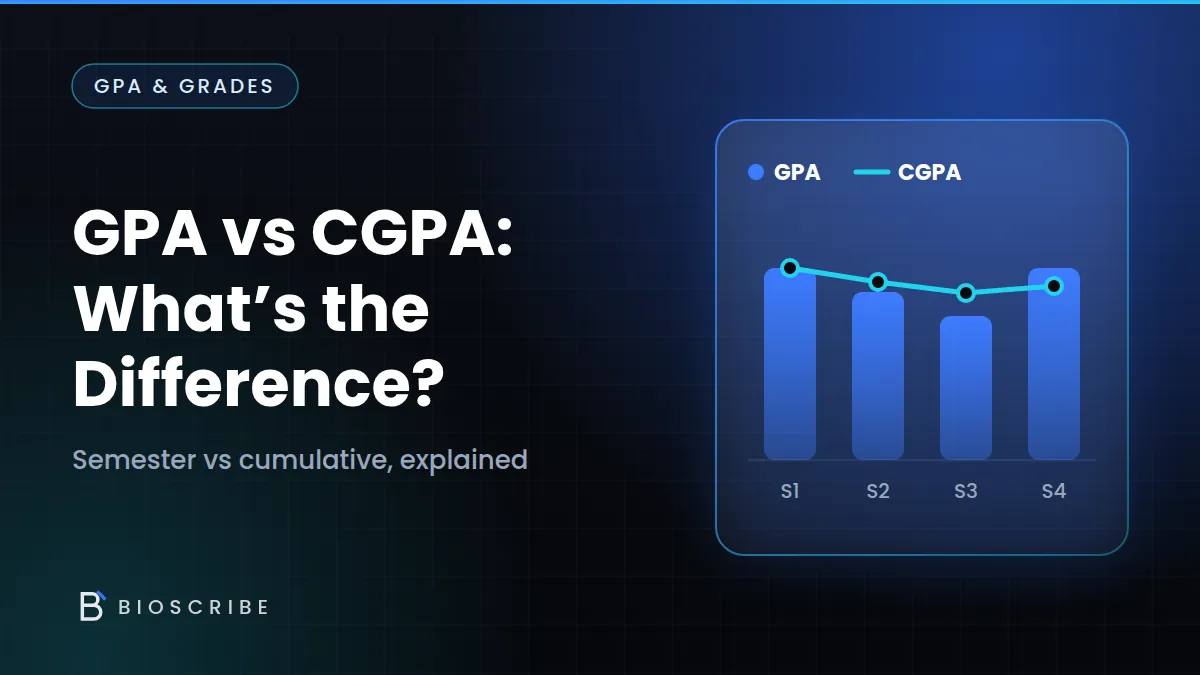
Short answer: GPA is your average for one semester. CGPA is the same calculation across every semester you have completed. Both equal total quality points ÷ total credit units.
The Difference at a Glance
| GPA | CGPA | |
|---|---|---|
| Covers | One semester or term | All completed semesters |
| Calculated from | That semester’s quality points and credit units | Total quality points and total credit units to date |
| How it behaves | Can swing a lot from one semester to the next | Moves slowly as units build up |
| Typically used for | Judging how a semester went | Graduation requirements, classification and applications |
The last row varies by institution, so check how yours uses each figure.
How CGPA Is Calculated
Use the running totals, not the semester GPAs. Here is a student on a 5.0 scale (the method is identical on a 4.0 scale).
| Semester | Credit units | Quality points | GPA | CGPA after |
|---|---|---|---|---|
| 1 | 18 | 72 | 4.00 | 4.00 |
| 2 | 24 | 84 | 3.50 | 3.71 |
| 3 | 20 | 60 | 3.00 | 3.48 |
After semester 2: (72 + 84) ÷ (18 + 24) = 156 ÷ 42 = 3.71. After semester 3: (156 + 60) ÷ (42 + 20) = 216 ÷ 62 = 3.48. Averaging the three GPAs would give 3.50, which is slightly off because the semesters carried different numbers of units.

Why CGPA Moves Slowly
In semester 3 the GPA fell by 0.50 (from 3.50 to 3.00), but the CGPA fell by only 0.23 (from 3.71 to 3.48). Each semester is a share of all your units, so as the total grows, any single semester has less pull. That cuts both ways: one bad semester will not ruin a strong record, and one excellent semester will not rescue a weak one. A higher CGPA is built over several semesters.
Planning a Target CGPA
The student above has 216 points over 62 units and wants a 3.60 CGPA after taking 20 more units. Total units become 82, so the points needed are 3.60 × 82 = 295.2. Subtract the 216 already earned to get 79.2, then divide by 20: the next semester must average 3.96. If the required figure is above your scale’s maximum, the target cannot be reached in one semester, and you should spread it over several.
Spreading a Target Over Several Semesters
Targets that look out of reach in one semester can become realistic over two. The same student, with 216 points over 62 units, wants a 3.60 CGPA after 40 more units, taken as two semesters of 20. Total units become 102, so the points needed are 3.60 × 102 = 367.2. Subtract the 216 already earned to get 151.2, then divide by 40 units: the average over the two semesters must be 3.78. That compares with 3.96 for a single semester, so a longer runway lowers the pressure on each term.
Updating Your CGPA With Running Totals
You do not need to re-enter every course each semester. Keep two running figures, total quality points and total credit units, and add each new semester to them. Say the student finishes semester 4 with 22 units and 88 quality points, a GPA of 4.00. The new totals are 216 + 88 = 304 points and 62 + 22 = 84 units, so the CGPA becomes 304 ÷ 84 = 3.62.
| Semester | Units | Points | Total units | Total points | CGPA |
|---|---|---|---|---|---|
| 1 | 18 | 72 | 18 | 72 | 4.00 |
| 2 | 24 | 84 | 42 | 156 | 3.71 |
| 3 | 20 | 60 | 62 | 216 | 3.48 |
| 4 | 22 | 88 | 84 | 304 | 3.62 |
A record like this also makes mistakes easy to spot, because the two total columns should only ever grow.
How Repeated Courses Can Change the Result
Institutions handle repeated courses in different ways, so this is one place where your handbook decides the answer. Two common approaches show how much the policy matters. Suppose a student has 150 quality points over 50 units, a CGPA of 3.00, and that total includes a 3-unit course failed with an F, which earned zero points. The student repeats it and earns a C, worth 3 grade points on a 5.0 scale, so 9 quality points.
- The new grade replaces the old one. The failed attempt is removed and the new one added: (150 + 9) ÷ 50 = 3.18.
- Both attempts count. The failed attempt stays and the new units are added on top: (150 + 9) ÷ (50 + 3) = 159 ÷ 53 = 3.00.
Under the second policy, passing the repeat leaves the CGPA unchanged in this case, while under the first it rises by 0.18. Find out which rule applies to you before deciding how much a retake is worth.
Where a Single Grade Moves Your CGPA the Most
Credit units decide how much one grade is worth. With 62 units behind a 3.48 CGPA, lifting one course by a full grade point, for example from a C to a B, adds quality points equal to that course’s credit units. In a 4-unit course that is 4 extra points, which raises the CGPA by 4 ÷ 62 = 0.06. In a 2-unit course it is 2 ÷ 62 = 0.03. High-unit courses carry the most weight, so protect them, but do not ignore the small ones. Every credit unit counts the same whenever it is earned, so there is no semester you can safely write off.
Which One Matters More?
Each answers a different question. GPA shows how the latest semester went and where to adjust. CGPA is usually what graduation requirements, scholarships and degree classes are based on, though the details depend on your institution. Track both.
Common Mistakes to Avoid
- Averaging semester GPAs. Add the quality points and the units, then divide.
- Mixing scales. Do not combine results from a 4.0 scale and a 5.0 scale in one CGPA.
- Ignoring repeat and carryover rules. Institutions treat resits differently, so follow yours.
- Expecting one semester to change everything. The more units you have, the slower CGPA moves.
- Using CGPA for a single-semester question. Use GPA when you want to judge one term.
Three Checks Before You Trust a CGPA
Before relying on any CGPA, run three quick checks. First, confirm the scale, because results from a 4.0 scale and a 5.0 scale cannot be combined. Second, confirm the totals: your total credit units should match the units on your result slips, and each course’s quality points should equal its grade point times its units. Third, confirm the figure is plausible. A CGPA is a weighted average of your semester GPAs, so it must sit between your lowest and highest semester GPA, and it can never exceed the top grade point on your scale. A number outside that range points to an arithmetic or data-entry error.
Check Your Work With BioScribe
The BioScribe GPA & CGPA Calculator works out semester GPA and cumulative CGPA, and includes target CGPA and what-if scenarios. Use it to test how different results next semester would change your CGPA, then compare with the working above.
Frequently Asked Questions
Can my GPA be higher than my CGPA?
Yes. If a semester goes better than your earlier results, that semester’s GPA will be above your cumulative average, and your CGPA will rise toward it.
Does CGPA include the current semester?
Once the results are final, yes. Before then you can only calculate a projected CGPA, which is an estimate based on the grades you expect.
What should I record after each semester?
Write down your total quality points and total credit units to date. To update your CGPA, add the new semester’s points and units to those totals and divide.
Is a 3.5 CGPA the same on every scale?
No. A 3.5 is 70% of the maximum on a 5.0 scale and 87.5% of the maximum on a 4.0 scale, so the same number means different things. Compare CGPAs only when they use the same scale.
Is there an official way to convert CGPA to a percentage?
There is no single universal formula. Institutions and credential evaluators publish their own conversion tables, so ask your school or the organization you are applying to which table they accept.
Conclusion
GPA is the semester view and CGPA is the long view, built from the same formula. Keep your total quality points and total units after every semester, and updating your CGPA becomes a single division.