Short answer: units needed = (target × current units − current quality points) ÷ (future GPA − target), rounded up. It only works when your future GPA is higher than the target.
Why Raising CGPA Takes More Than One Good Semester
Your CGPA is an average over every unit you have taken. The more units behind it, the more new units it takes to move it. A strong semester pulls the CGPA up, but only in proportion to how many units that semester adds to the total. If you want a CGPA of a particular value, the useful question is not how well you must do, but how well you must do over how many units. This guide answers that question with one formula.
The Formula
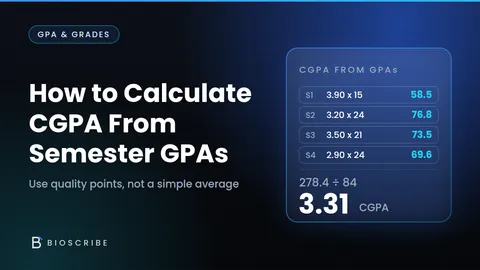
It comes from asking when (current points + future GPA × units) ÷ (current units + units) equals the target. The formula needs your future GPA to be higher than the target, because new units at or below the target can never lift the CGPA to it. This guide uses a 5.0 scale. The method is identical on a 4.0 scale. For how the starting numbers are built, see our guide on calculating CGPA from semester GPAs.
Step-by-Step Example
A student has 216 quality points over 62 units, a CGPA of 3.48. The target is 3.60, and the student expects to earn a 4.20 GPA on new units.
- Points needed at the target for current units: 3.60 × 62 = 223.2.
- Shortfall: 223.2 − 216 = 7.2.
- Gap between future GPA and target: 4.20 − 3.60 = 0.60.
- Divide: 7.2 ÷ 0.60 = 12 units.
Check it: 12 units at 4.20 add 50.4 points, giving (216 + 50.4) ÷ (62 + 12) = 266.4 ÷ 74 = 3.60.
How the Answer Changes With Your Future GPA
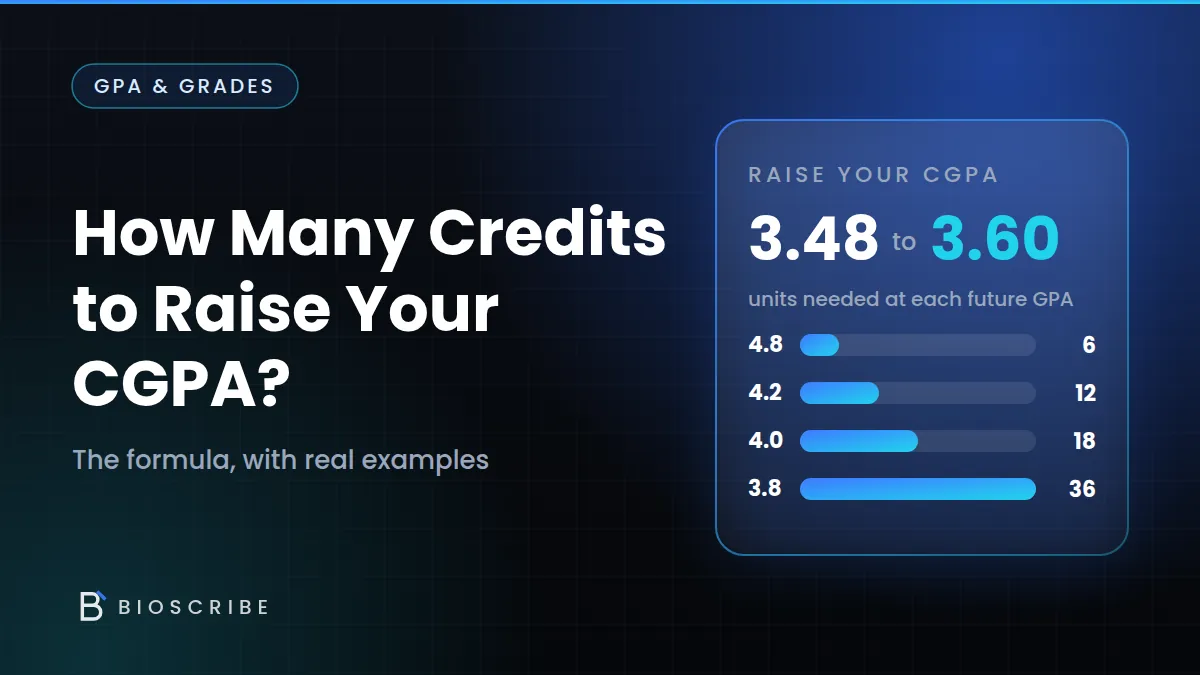
The same starting point gives very different answers depending on the GPA you can earn:
| Future GPA | Working | Units needed |
|---|---|---|
| 4.80 | 7.2 ÷ 1.20 | 6 |
| 4.60 | 7.2 ÷ 1.00 | 7.2, so 8 |
| 4.20 | 7.2 ÷ 0.60 | 12 |
| 4.00 | 7.2 ÷ 0.40 | 18 |
| 3.80 | 7.2 ÷ 0.20 | 36 |
The closer your future GPA is to the target, the more units you need. A GPA of 3.80 takes 36 units, six times as many as 4.80, because each unit adds only a small surplus above the target.

Always Round Up
You cannot take part of a unit, and falling just short does not reach the target. At a 4.60 future GPA the formula gives 7.2 units. With 7 units you reach (216 + 4.60 × 7) ÷ 69 = 248.2 ÷ 69 = 3.597, which misses 3.60. With 8 units you reach (216 + 36.8) ÷ 70 = 3.611. So the answer is 8, not 7.
When the Target Cannot Be Reached
If your future GPA is equal to or below the target, the formula breaks down, because the denominator is zero or negative. New units at that level can move the CGPA toward your future GPA but never to a higher target. The scale also sets a limit. With straight 5.0s, the example needs 7.2 ÷ 1.40 = 5.14, so 6 units: (216 + 30) ÷ 68 = 3.618. Anything that needs a future GPA above 5.0 on a 5.0 scale is simply not possible.
Raising Your CGPA by a Small Amount
For a smaller goal, such as reaching 3.58, the shortfall is 3.58 × 62 − 216 = 5.96. With straight 5.0s the gap is 5.00 − 3.58 = 1.42, so you need 5.96 ÷ 1.42 = 4.2, which rounds up to 5 units. Check: (216 + 25) ÷ 67 = 3.597 reaches the target, while 4 units give 236 ÷ 66 = 3.576, which does not.
Checking Against the Units You Have Left
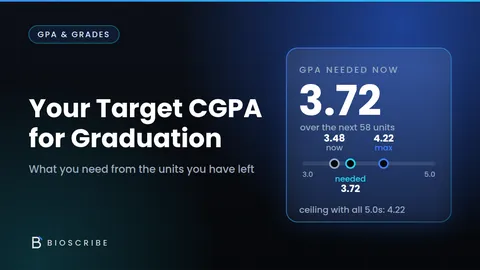
The formula tells you how many units you need, but you may not have that many left. If your programme has only 10 units left, you can work the other way round. The GPA required over 10 units is (3.60 × 72 − 216) ÷ 10 = 43.2 ÷ 10 = 4.32. Compare that with your best semester and decide whether it is realistic. Our guide on calculating your target CGPA for graduation covers this version in detail.
A Practical Plan
Pick the target, estimate a future GPA you can honestly achieve, and run the formula. Then compare the units needed with the units you will take each semester. If it takes 12 units and you take 20 a semester, one strong semester is enough. If it takes 36, plan for two or more. Recalculate after each set of results, using your new points and units, so the plan follows your real progress.
What One Course Can Do
You can use the same approach for a single course. Take the student with 216 points over 62 units. A 3-unit course with a grade point of 5 adds 15 points, giving (216 + 15) ÷ 65 = 3.55. If the same course earns a 3, it adds 9 points, giving (216 + 9) ÷ 65 = 3.46. The two grades are 0.09 of CGPA apart. One course rarely changes a CGPA by much, which is why steady results across several semesters matter more.
Retakes and Replaced Grades
A retake can change the answer if your institution replaces the old grade. Suppose the student failed a 3-unit course, which added zero points, and retakes it for a C (3 grade points, or 9 points). If the new grade replaces the old, the units stay at 62 and the CGPA becomes 225 ÷ 62 = 3.63. If both attempts count, it becomes 225 ÷ 65 = 3.46. The same retake gives very different results, so find out your institution’s policy before you plan around it.
Estimating Your Future GPA Honestly
The formula is only as good as the future GPA you put in. A reasonable starting point is your average over your last two or three semesters. Add a margin of safety for harder courses ahead, and remember that a future GPA just above your target needs many units. If the plan only works with a GPA that you have never reached, treat it as a stretch goal and have a second, more realistic target ready.
Common Mistakes to Avoid
- Expecting a future GPA below the target to work. It cannot raise the CGPA to the target.
- Rounding down. Always round the units up.
- Mixing scales. Use the same scale for your current points and future GPA.
- Using the wrong starting numbers. Check your quality points and units against your transcript.
- Forgetting the units you have left. The answer must fit within your programme.
Check Your Work With BioScribe
The BioScribe GPA & CGPA Calculator includes target CGPA and what-if scenarios. Enter your current points and units, then try different future GPAs to see how the CGPA moves.
Frequently Asked Questions
Can I raise my CGPA with only a few units?
Only by a small amount. With few units, even straight top grades move the CGPA slightly, so use the formula with your own numbers to see what is possible.
What if my future GPA is lower than my target?
Then your CGPA will move toward that lower GPA but never reach the target. Raising it needs a future GPA above the target.
Does it matter if I take the units in one semester or several?
The formula only cares about the total units and the average GPA on them. Spreading them over several semesters changes the planning, not the arithmetic.
How do repeated courses affect this calculation?
It depends on your institution’s policy. If a retake replaces the old grade, adjust your starting quality points and units before using the formula.
How often should I recalculate?
After each semester’s results. Update your total points and units, then run the formula again with your new CGPA.
Conclusion
To raise your CGPA, work out the shortfall at your target, divide by how far your future GPA is above it, and round up. High future GPAs need very few units, while GPAs close to the target need many, and a GPA at or below the target never works. Recalculate each semester, and check the answer against the units you actually have.