Short answer: required GPA = (target × total programme units − quality points so far) ÷ units remaining. If the answer is above your scale’s maximum, the target is out of reach.
Start With the End: Total Quality Points
Your final CGPA is total quality points divided by total programme units, so a target CGPA is really a target number of quality points. Multiply the target by the total units in your programme to get the points you need by the end. Subtract the points you already have, and what is left must come from the units still to take. Dividing that shortfall by the remaining units gives the average GPA you need from now on.
The Formula
All numbers come from your transcript and your programme handbook. This guide uses a 5.0 scale, and the method is identical on a 4.0 scale. For the version that asks how many units it takes at a chosen GPA, see our guide on how many credits you need to raise your CGPA.
Step-by-Step Example
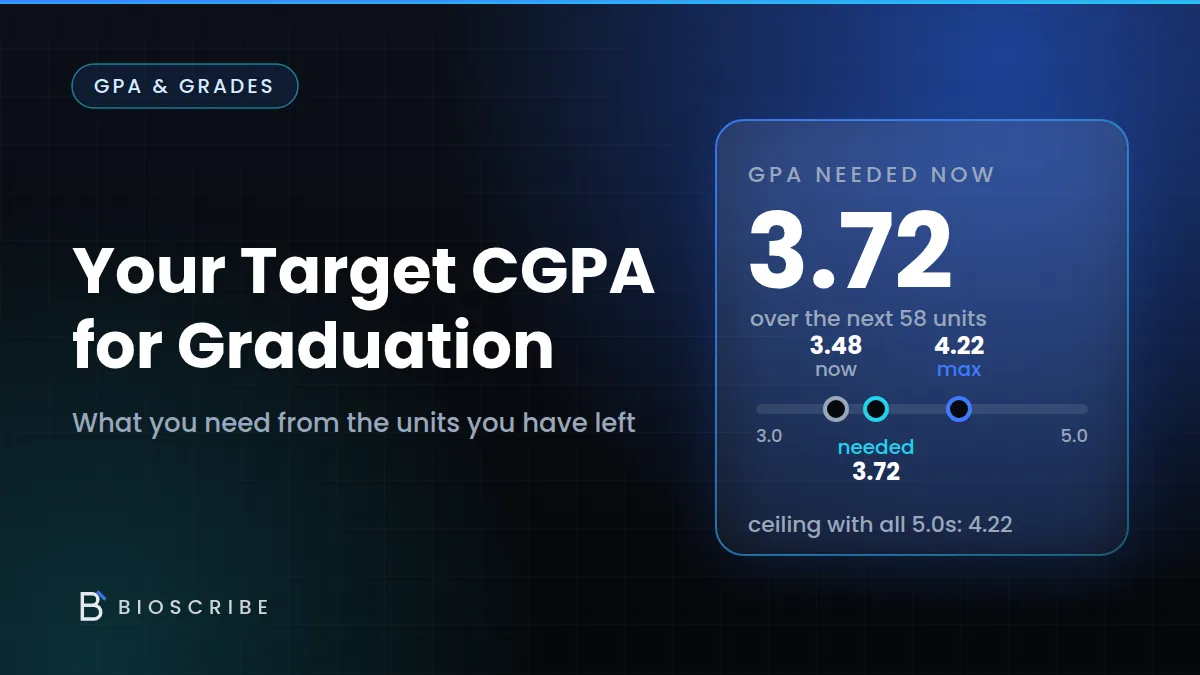
A programme has 120 units. The student has completed 62 units with 216 quality points (a CGPA of 3.48) and wants to graduate with 3.60.
- Total points needed: 3.60 × 120 = 432.
- Points still needed: 432 − 216 = 216.
- Units remaining: 120 − 62 = 58.
- Required GPA: 216 ÷ 58 = 3.72.
The student needs a 3.72 average over the remaining 58 units, which is higher than the current 3.48 because the earlier results have to be made up.
Different Targets, Different Demands
The same student faces very different requirements depending on the target:
| Target CGPA | Points needed overall | Points still needed | Required GPA over 58 units |
|---|---|---|---|
| 3.60 | 432 | 216 | 3.72 |
| 3.80 | 456 | 240 | 4.14 |
| 4.00 | 480 | 264 | 4.55 |
| 4.50 | 540 | 324 | 5.59 |
The last row is above the 5.0 maximum, so a 4.50 CGPA is not possible for this student. A table like this shows quickly which targets are realistic and which need a different plan.

The Ceiling: The Highest CGPA You Can Still Reach
You can find your best possible outcome by assuming a perfect GPA on the remaining units. With straight 5.0s over 58 units the student would add 290 points, for a final CGPA of (216 + 290) ÷ 120 = 506 ÷ 120 = 4.22. At the other end, straight 4.00s give (216 + 232) ÷ 120 = 3.73. Knowing the ceiling stops you from chasing a target that the arithmetic has already ruled out.
Spreading the Requirement Across Semesters
Suppose the remaining 58 units are split into semesters of 19, 19 and 20 units. A GPA of about 3.72 in each semester meets the requirement. In practice, results vary. If the first semester only reaches 3.50 on 19 units, the points it adds are 66.5. The remaining 39 units must then supply 216 − 66.5 = 149.5 points, which is 149.5 ÷ 39 = 3.83. A weaker semester raises the demand on the others, so recalculate after every set of results.
Is the Target Realistic?
Compare the required GPA with your history. If you have never reached the figure in a semester, aim for a target that you could. If your recent semesters are close to or above it, the target is realistic and the plan is about consistency. Also consider the courses ahead. Final-year projects and demanding electives can be harder to score on than the early courses, so a requirement that looks possible on paper may need extra planning.
Targets and Degree Classes
Many institutions award degree classes based on CGPA bands, and the bands differ. Some also weight the final years more than the first. The simple formula in this guide assumes that every unit counts equally. If yours does not, adjust the calculation to match, and check the exact band and rules in your handbook or academic regulations.
When Your Remaining Units Might Change
Electives, resits and changes of programme can change the total. If you take 56 more units instead of 58, the programme total is 118, the points needed for 3.60 are 3.60 × 118 = 424.8, and the required GPA becomes (424.8 − 216) ÷ 56 = 3.73. The change is small here, but redo the calculation whenever your total changes.
What If You Only Know Your CGPA, Not Your Points?
If your transcript gives a CGPA but no quality points, you can estimate them: 3.48 × 62 = 215.76. Using that figure, the required GPA over the remaining 58 units is (432 − 215.76) ÷ 58 = 3.73, compared with 3.72 when the exact 216 points are used. The difference is small, but it can matter at a boundary. Use the exact points from your transcript whenever you have them, and treat an estimate as approximate.
Planning With a Margin
Because results vary, it helps to aim a little above the requirement. If the student plans for 3.82 instead of 3.72, the remaining 58 units add 3.82 × 58 = 221.56 points, and the final CGPA would be (216 + 221.56) ÷ 120 = 3.65. That leaves a cushion if one semester comes in lower than hoped. A margin of about 0.10 is a reasonable starting point, and you can adjust it as you learn how your results behave.
If the Target Looks Out of Reach
If the required GPA is above anything you can realistically reach, do not give up on the whole plan. First, check whether a nearby target works, such as the next band down. Second, ask whether retakes replace earlier grades and whether any courses can be repeated. Third, think about which remaining courses carry the most units, because they have the most influence. Finally, talk to an academic adviser early, while there is still time to change your choices.
Checking Your Plan Each Semester
Treat the target as a plan to be updated, not a number to calculate once. After the first semester at 3.50 on 19 units, the student’s totals are 216 + 66.5 = 282.5 points over 81 units, a CGPA of 3.49. With 120 − 81 = 39 units left, the requirement becomes (432 − 282.5) ÷ 39 = 3.83. Updating after every set of results keeps the requirement visible while there is still time to respond to it.
Common Mistakes to Avoid
- Using the wrong total units. Use the programme total, not just the units you have left.
- Ignoring the scale maximum. A required GPA above it means the target is not possible.
- Using a rounded CGPA. Start from your quality points and units.
- Assuming every semester will match the average. Recalculate as results arrive.
- Forgetting special rules. Check how your institution weights years and treats retakes.
Check Your Work With BioScribe
The BioScribe GPA & CGPA Calculator includes target CGPA and what-if scenarios. Enter your points and units to compare the example above with your own figures.
Frequently Asked Questions
What if the number of remaining units changes?
Recalculate with the new total. Electives, resits or a change of programme alter the units left and the GPA you need.
Do all years count equally toward my CGPA?
In the simple formula, yes. Some institutions weight years differently for degree classification, so check how yours works.
What if the required GPA is above the scale maximum?
Then the target cannot be reached with the units you have left. Choose a lower target, or ask whether more units are available.
Should I aim above the required GPA?
If you can, yes. Aiming slightly higher leaves room for a weaker semester without losing the target.
Where do I find the target for my degree class?
In your institution’s handbook or academic regulations. Bands and rules differ, so use the official source.
Conclusion
To find your target CGPA for graduation, multiply the target by the total units, subtract your points so far, and divide by the units remaining. Check the answer against the scale maximum and your own history, and recalculate after each semester. The numbers will not change your results, but they will tell you early where you stand.