How to Count Down to an Exam and Build a Better Revision Plan
Knowing exactly how long you have is the first step of any revision plan. The tool above counts down to each exam you add. This guide explains how the numbers work and how to turn them into a realistic plan. Every schedule here is a planning framework, not a rule, so adapt it to your course.
What Is an Exam Countdown?
An exam countdown shows the time left until an exam, test or deadline and updates as time passes. A simple date reminder only tells you the date. A countdown tells you how many days, hours and minutes remain, which makes it easier to divide the time you have. It is a planning aid, not a guarantee of any result: it measures time, not preparation.
How to Calculate How Many Days Are Left Until an Exam
Days Remaining = Exam Date − Current Date
If today is 2 June and your exam is on 20 June, you have 20 − 2 = 18 days. That is a calendar-date calculation. When an exam has a start time, the exact time left also depends on the hour, which is why the tool uses the exact time you enter. You can also count periods between academic dates with the Academic Date Calculator.
Calendar Days vs Exact Time Remaining
Suppose it is 3:00 PM on 1 June and your exam starts at 9:00 AM on 16 June. By the calendar, that is 15 days away, because 15 midnights separate the two dates. By the clock, you have 14 days and 18 hours: 14 full days takes you to 3:00 PM on 15 June, and 18 more hours reach 9:00 AM on the 16th. Neither answer is wrong, but they answer different questions. The calendar figure helps with planning study days. The exact figure shows how much time you really have. Do not assume the number of days equals the number of midnights remaining.
How Many Days Should You Study Before an Exam?
There is no single correct number. Useful preparation time depends on subject difficulty, prior knowledge, exam scope, number of topics, available time, competing exams, study efficiency and assignment workload. These are general frameworks for different time spans:
- 30 days: time to cover the syllabus, practise and revisit weak areas.
- 14 days: enough to review everything once and practise, if you already know the basics.
- 7 days: prioritize the highest-value topics and practice questions.
- 3 days: focus on weak points and timed practice.
- 1 day: light review and exam-day preparation. Read How Many Days Should You Study Before an Exam? for more.
How to Make a 30-Day Exam Study Plan
- Days 30–22: understand the syllabus and identify weak areas.
- Days 21–15: work through the major topics and worked examples.
- Days 14–8: practice questions and active recall.
- Days 7–3: focus on weak areas and timed practice.
- Days 2–1: review summaries and key material without trying to learn the whole course from scratch.
Treat the day numbers as a starting point and shift them if a phase takes longer. The Study Schedule Generator can turn the phases into a calendar, and How to Make a 30-Day Exam Study Plan goes deeper.
How to Make a 7-Day Exam Revision Plan
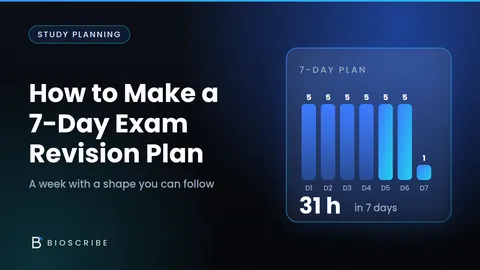
With a week left, be selective. On day 7, list the topics and rank them by importance and your confidence. Use days 6 to 4 for the priority topics, pairing short review with practice questions. Spend day 3 on timed practice, day 2 on the weak areas it revealed, and day 1 on light review and exam-day preparation. Keep sessions at a sustainable length with breaks, and protect your sleep: an exhausted mind recalls less. Avoid extreme study hours. See How to Make a 7-Day Exam Revision Plan for a fuller version.
How to Divide Study Time Between Multiple Exams
Consider days remaining, subject difficulty, your current confidence, the amount of material, exam weighting and estimated preparation time. Add up the hours you can realistically study, then share them out. Example: three exams in 10, 14 and 21 days, with 3 hours a day for 21 days (63 hours). Estimated needs are Mathematics 20 hours, Biology 18 hours and History 25 hours, since History involves heavy reading. One possible split: days 1–10, 2 hours Mathematics and 1 hour Biology daily (20 and 10 hours); days 11–14, 2 hours Biology and 1 hour History (8 and 4 hours); days 15–21, 3 hours History daily (21 hours). That gives 20 + 18 + 25 = 63 hours. Use the Study Time Calculator for the estimates and the Study Schedule Generator for the layout. How to Divide Your Study Time Between Multiple Exams covers other approaches.
What to Do When Two Exams Are Close Together
Avoid all-or-nothing focus on one subject. Assign study blocks to both, protect the preparation time of the nearest exam, and keep some contact with the later subject, such as a short daily recall session, so it does not go cold. Adjust the plan as each exam approaches, shifting more time to whichever date is closer.
How to Prioritize Topics Before an Exam
Rank each topic on five points: importance, difficulty, your current understanding, the time it needs, and how soon the exam is. Start with topics that are important and poorly understood. Use your syllabus, course materials and past assessment information where available, and remember that no one can promise a topic will or will not appear. If grades matter, the Grade Calculator shows how much an exam can change your final grade.
What to Do the Day Before an Exam
Review key concepts rather than trying to relearn the whole course. Organize your materials, check the exam time and location, and prepare what you need to bring. Get a reasonable amount of rest. Light practice on questions you have already seen can build confidence. What to Do the Day Before an Exam offers a checklist.
How to Use an Exam Countdown Without Becoming Overwhelmed
A countdown is a planning reference, not a source of pressure. Convert “30 days remaining” into “What should I complete this week?” and then “What should I complete today?” Small, specific tasks are easier to start than a large number on a screen. If the number feels heavy, close the page and work from your list.
Exam Countdown and Study Time
A countdown becomes more useful when paired with an estimate of the study time you need. Say an exam is in 14 days and you estimate 28 hours of revision. Then 28 ÷ 14 = 2 hours a day. Real plans should allow for rest days, other subjects and existing commitments, so 2 hours a day on paper may mean 2.5 on the days you can study. The Study Time Calculator helps you work this out.
Exam Countdown and Study Schedule
The three tools answer three questions. The countdown tells you how much time remains. The Study Time Calculator estimates how much study time may be required. The Study Schedule Generator turns the time available into a practical schedule. Together they move you from “when is it?” to “how much?” to “what, and when?”
Common Exam Countdown and Planning Mistakes
- Waiting until the final few days: early weeks are the cheapest time to learn.
- Treating all subjects as equally difficult: give harder material more time.
- Ignoring other exams: a plan for one exam can starve another.
- Creating an unrealistic timetable: a plan you cannot follow is worse than a modest one.
- Counting hours rather than meaningful tasks: track topics covered, not time sat.
- Spending too much time on comfortable topics: revisiting what you know feels productive but adds little.
- Ignoring practice questions: practice shows what you can actually recall.
- Forgetting deadlines besides exams: assignments and projects compete for the same hours.
- Assuming the countdown itself is a study plan: it only measures time.
- Constantly changing the schedule without evaluating progress: review weekly, then adjust deliberately.
Worked Exam Planning Examples
Example A: 30 days remaining. At 2 hours a day, you have 60 hours. Allocate 18 hours to days 30–22 (syllabus and weak areas), 14 hours to days 21–15 (major topics), 14 hours to days 14–8 (practice and recall), 10 hours to days 7–3 (weak areas and timed practice) and 4 hours to days 2–1 (review). The phases add up to 30 days and 60 hours.
Example B: 7 days remaining. Day 7, rank topics. Days 6–4, priority topics with practice questions. Day 3, a timed paper. Day 2, weak areas. Day 1, summaries and preparation. Sleep is part of the plan.
Example C: three exams. Mathematics in 10 days, Biology in 14, History in 21. One sensible approach is the 63-hour split above. Another is to give Biology more early time if it is your weakest subject. There is no perfect allocation, only a defensible one you review each week.
Example D: exam tomorrow. Prioritize key formulas and definitions, summaries, and the weak points you already know about. Skip new material, check the time and location, and rest.