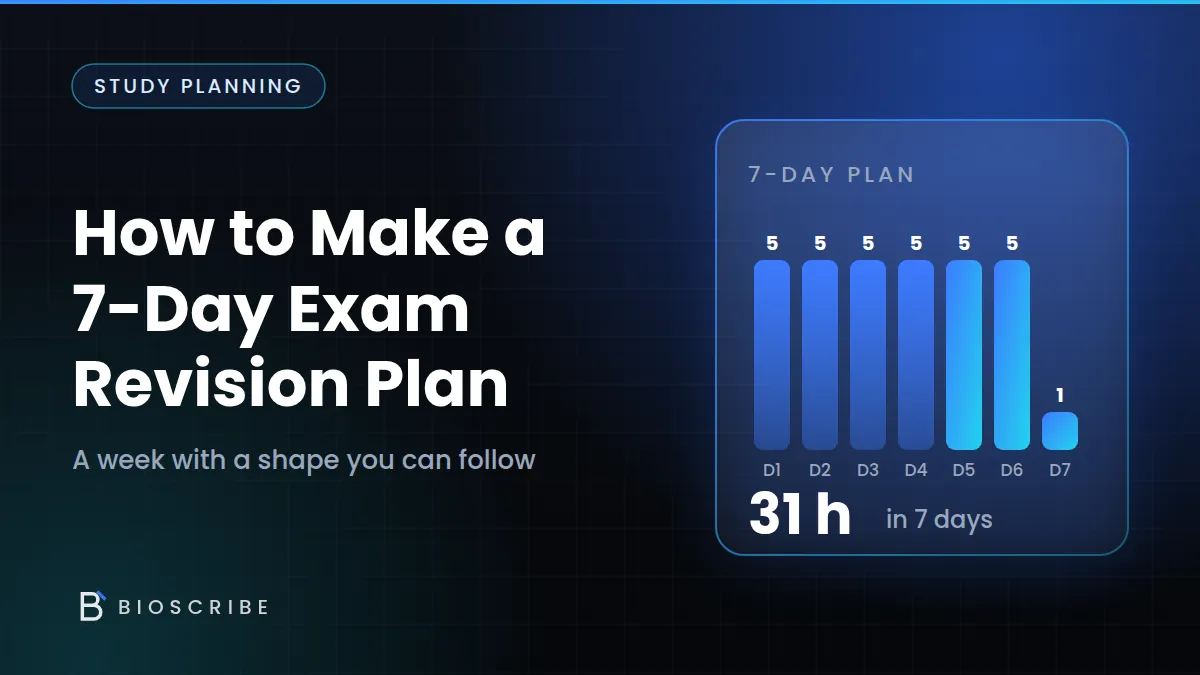
Short answer: spend the first four days learning two topics a day, use day 5 for recall and a first timed paper, day 6 for weak spots and a second paper, and day 7 for a light review. That is about 31 hours.
When a Week Is All You Have
Seven days is not much, but it is enough to make a real difference if you stop trying to do everything. A good one-week plan decides what to leave out. It gives most of the time to the topics that carry the most marks, builds in practice under exam conditions and keeps the last day light. The plan below is for one subject with eight topics. You can adapt the numbers to your own course.
Step 1: Set Your Hours
Decide how many hours you can honestly study each day. A workable week is 5 hours a day on days 1 to 6 and a light 1 hour on day 7. That is 6 × 5 + 1 = 31 hours. If you cannot manage 5 hours, lower the daily figure and drop the lowest-ranked topics rather than stretching the plan beyond seven days.
Step 2: List and Rank Your Topics
List the eight topics and rank them by marks and weakness. If you need a method, use the priority score in our guide to building a revision timetable you can actually follow. Put the highest-ranked topics on the first days, while your energy is highest, and make sure the lowest-ranked topics are the ones that can be skimmed if time runs out.
Step 3: Fix the Shape of the Week
Divide the week into four kinds of day. Learning days introduce or reinforce topics. A recall day tests what you have learned without notes. Practice days are for timed past papers and fixing mistakes. A light day is for review and rest. With eight topics and four learning days, you cover 8 ÷ 4 = 2 topics a day, which is about 2.5 hours per topic at 5 hours a day.
The Plan Day by Day
| Day | Focus | Hours |
|---|---|---|
| 1 | Learn topics 1 and 2 | 5 |
| 2 | Learn topics 3 and 4 | 5 |
| 3 | Learn topics 5 and 6 | 5 |
| 4 | Learn topics 7 and 8 | 5 |
| 5 | Recall topics 1 to 8 (2 h), timed past paper 1 and marking (3 h) | 5 |
| 6 | Fix weak spots from paper 1 (2 h), timed paper 2 and marking (3 h) | 5 |
| 7 | Light review of your mistake list, then rest | 1 |

How Each Day Is Structured
Split a 5-hour day into three sessions, for example 2 hours in the morning, 1.5 hours in the afternoon and 1.5 hours in the evening, with breaks between them. For a learning topic, spend the first part reading or watching and writing short notes, the middle part on practice questions, and the last 15 minutes recalling the topic without looking. Practice questions and recall are usually a better use of time than rereading, because they show what you cannot yet do.
If You Have More Than Eight Topics
With 12 topics and the same 4 learning days, you need 12 ÷ 4 = 3 topics a day. A 5-hour day then gives 5 × 60 ÷ 3 = 100 minutes per topic. That is workable for familiar topics but tight for new ones. If a topic needs more, trim a lower-priority topic to a short summary, or move one of the practice papers to a shorter exercise. The aim is to cover the whole syllabus once and spend the later days testing.
If You Fall Behind
Suppose that after day 2 you have only finished three of the four topics planned. Do not extend every later day. Look at your ranking, skim or drop the lowest-ranked topic, and carry on. Cutting one of eight topics leaves seven, which is 3.5 topics a day across the remaining two learning days. Alternatively, shorten the second practice paper to a half paper. A plan that bends keeps you moving, while a plan that demands a perfect week usually breaks on day 2.
Revising for More Than One Subject
If you have two subjects, share the same 31 hours between them. Alternating subjects across the day, for example one in the morning and one in the afternoon, keeps each one fresh and avoids a long gap. If the exams are on different dates, put the earlier subject first and give the later one short recall sessions in the meantime. Be realistic about how much can be covered, and rank the topics across both subjects together.
Sleep, Breaks and the Last Day
A week of long days only works if you protect sleep and take proper breaks. Keep a regular bedtime and stop at a fixed time each evening. Use day 7 to look over your mistake list, check the exam time and place, and rest. Our guide on what to do the day before an exam covers the final day in more detail.
A Sample Day in Detail
Here is how day 1 could look, with two topics and 5 hours in three sessions.
| Session | Time | Task | Length |
|---|---|---|---|
| 1 | 8:30 to 10:30 am | Topic 1: learn, write notes, do questions | 2 h |
| 2 | 2:00 to 3:30 pm | Topic 2: learn and write notes | 1.5 h |
| 3 | 6:30 to 8:00 pm | Topic 2 questions, then recall topics 1 and 2 without notes | 1.5 h |
The sessions add up to 2 + 1.5 + 1.5 = 5 hours. Keep the evening recall short and honest. Write what you remember, check it against your notes and mark the gaps for tomorrow.
How to Mark a Practice Paper
A paper is only useful if you learn from it. Mark it with the mark scheme, then tally the marks lost by topic. Suppose you score 68 out of 100, so you lost 32 marks. If 12 were lost on topic 3, 9 on topic 6, 6 on topic 1 and 5 on everything else, then 27 of the 32 lost marks, about 84%, came from three topics. Those three are your priorities for the weak-spots session, and the other topics can wait.
Common Mistakes to Avoid
- Trying to cover everything equally. Rank topics and protect the top.
- Rereading instead of practising. Questions and recall show what you do not know.
- Leaving past papers until the end. Do the first one by day 5.
- Planning every hour with no slack. Keep room for catching up.
- Studying late into the night. Protect your sleep.
- Starting new topics on the last day. Use it to review.
Check Your Work With BioScribe
BioScribe’s Study Schedule Generator builds a personalized study schedule around your subjects, priorities and exam dates. Enter your topics and exam date to turn the plan above into a schedule.
Frequently Asked Questions
Is one week enough to revise for an exam?
It depends on how much you already know. A week works best for refreshing material you have seen before. If most topics are new, a longer plan is safer.
How many hours a day should I study in the last week?
Choose a figure you can keep up, such as 4 to 6 hours, with proper breaks and sleep. A plan you can finish beats a bigger one you drop.
Should I do past papers early in the week?
Do the first one by around the middle of the week, so that you still have time to fix what it shows. Do a second one under timed conditions before the last day.
What if my exam is in less than seven days?
Keep the same shape but compress it. Drop the lowest-ranked topics, do one timed paper, and keep the last day light.
Can I use this plan for more than one subject?
Yes. Share the hours between subjects, alternate them through the day, and rank all topics together so that the highest-value ones come first.
Conclusion
A 7-day plan works when it has a shape: four days of learning, a recall and paper day, a weak-spots and paper day, and a light last day. Rank your topics, protect practice and sleep, and be ready to drop the lowest-priority material if you fall behind. For a longer runway, see our guide to the 30-day exam study plan.