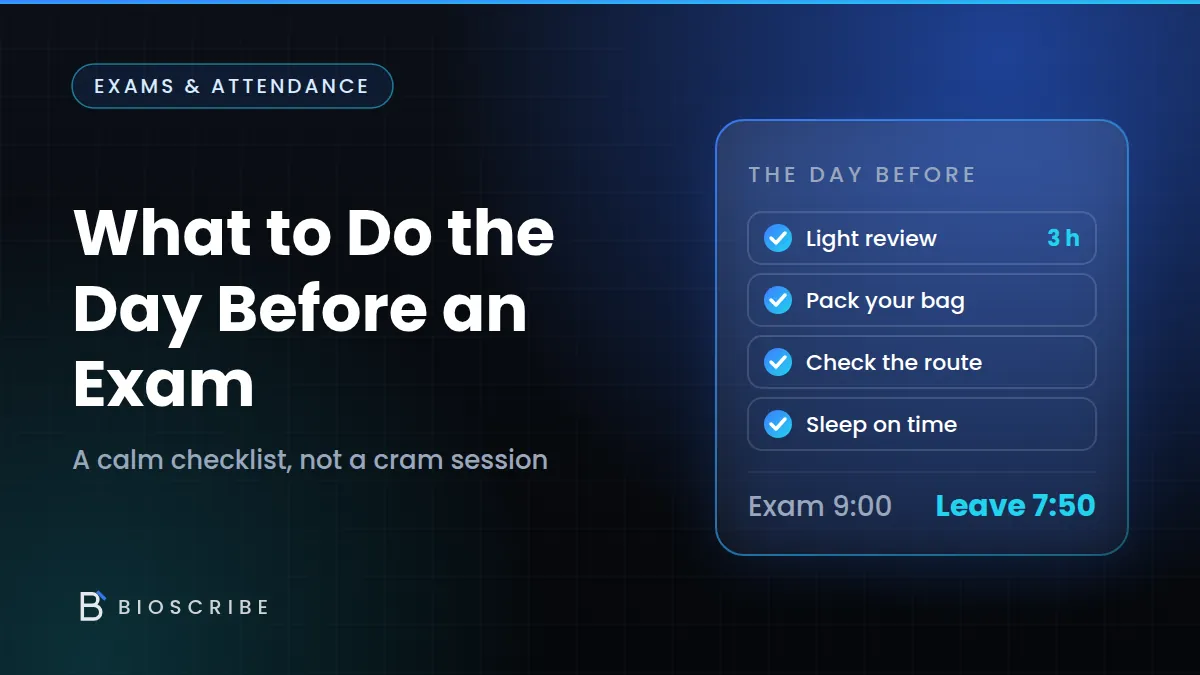
Short answer: review lightly for about three hours, make a one-page sheet of formulas and mistakes, plan your exam timing, check your logistics, and stop studying early enough to sleep on time.
What the Day Before Is For
By the day before an exam, most of the learning is done. What remains is to keep what you know available, remove avoidable problems and arrive rested. Trying to learn a lot of new material now is rarely effective and often raises anxiety. A better aim is to make the day calm and predictable, so that the exam tests what you know and not how you coped with a bad night.
Do Not Start New Topics
It is tempting to use the last day to squeeze in a topic you skipped. Unless that topic is likely to carry many marks and you can learn its basics in an hour, leave it. New, half-learned material crowds out what you know and can leave you feeling less prepared. Spend the time instead on topics you have already studied, since reinforcing them is more likely to add marks than opening a new one.
A Light Review Plan for the Day
Aim for about three hours of review, spread across the day, with plenty of breaks.
| Time | Task | Length |
|---|---|---|
| Morning | Skim your summary notes and key diagrams | 90 minutes |
| Afternoon | Go through your mistake list and re-do two or three questions | 60 minutes |
| Late afternoon | Make or check your one-page sheet | 30 minutes |
| Evening | Pack your bag and check your route, then stop studying | 30 minutes |
The total is 90 + 60 + 30 = 180 minutes of review, plus 30 minutes of preparation. Adjust the times to the hours when you concentrate best.
Make a One-Page Sheet
Put everything you most need to recall on one page: key formulas, definitions you tend to forget, steps for common calculations and the mistakes you have made in practice. Writing it forces you to choose what matters. Read it through in the evening and again on the morning of the exam. Do not carry in anything that is not allowed in the exam room, and follow the rules about notes and materials.

Plan Your Time in the Exam
Many marks are lost to poor timing. Work out in advance how long each section should take. Suppose the paper is 120 minutes for 100 marks, and you want 10 minutes at the end for checking. That leaves 110 minutes, or 1.1 minutes per mark. A section worth 20 marks then gets 22 minutes, and sections worth 40 marks get 44 minutes each. Check: 22 + 44 + 44 + 10 = 120. Write the target finishing times on the sheet so that you can see at a glance whether you are on track.
Check Your Logistics
Prepare everything the evening before. Check the exam time and venue, your identification, pens and pencils, a calculator if allowed (with working batteries), a watch and water. Work out your departure time backwards. If the exam starts at 9:00, the journey takes 40 minutes and you want a 30-minute buffer, you need to leave by 7:50. A buffer matters more than you expect, because delays are common and arriving rushed affects your concentration.
Eat, Move and Sleep
Look after the basics. Eat regular meals, drink water and take a short walk or some light exercise to clear your head. Plan your sleep backwards from the morning. If you need to wake at 6:30 and you usually sleep 8 hours, you should be in bed by 10:30 pm. An all-night session rarely improves recall and often hurts concentration, so protect your sleep as part of the plan. Set more than one alarm.
Prepare Your Mind
Some nerves are normal. Write down anything you are worried about, then next to each item note one small action, such as checking a formula or re-doing a question. Remind yourself of what you have done: the topics covered, the papers completed and the mistakes fixed. If worry becomes overwhelming or lasts for days, talk to someone you trust, such as a friend, a lecturer or a counsellor at your institution.
What If You Feel Unprepared
If you feel unprepared, resist the urge to restart everything. Use your ranking of topics to pick the few that carry the most marks and that you can improve quickly, and spend your review time there. Go through your mistake list and fix the errors that recur. Accept that you cannot cover everything, and decide how you will use partial knowledge in the paper, for example by attempting every question and showing your working. Our guide to the 7-day exam revision plan shows how to rank topics.
The Morning of the Exam
Keep the morning simple. Eat something light, take your bag and leave on time. Read your one-page sheet once, then put it away. Arrive early enough to settle, and avoid discussing the paper with others beforehand, which can create unnecessary doubts. When you sit down, read the instructions carefully, glance at the whole paper and begin with the plan you made.
A Sample Evening
A fixed shape for the evening makes it easier to stop studying on time. Finish revision by about 5:00 pm. Eat dinner at around 6:00. Then spend 30 minutes packing your bag and checking the route, and 20 minutes reading your one-page sheet once. After that, stop. Spend the rest of the evening doing something relaxing, such as talking to a friend or going for a walk, and be in bed by 10:30 pm if you plan to wake at 6:30. Set two alarms.
If Your Exam Is in the Afternoon
A later exam changes the timings, not the approach. If the exam starts at 2:00 pm, the journey takes 40 minutes and you keep a 30-minute buffer, you need to leave by 12:50 pm. Plan a light hour of review in the morning, eat lunch early enough to settle, and avoid starting anything demanding after that. Use the extra morning hours to rest, not to cram. The one-page sheet is the only thing you need to read before you leave.
Common Mistakes to Avoid
- Studying late into the night. Protect your sleep.
- Starting new topics. Reinforce what you already know.
- Leaving logistics until the morning. Prepare your bag and route the evening before.
- Having no timing plan. Decide how long each section gets.
- Comparing yourself with others. It adds worry and no marks.
- Skipping meals and water. Look after the basics.
Check Your Work With BioScribe
BioScribe’s Exam Countdown shows exactly how much time remains before your next exam or deadline. Add your exam date and check it each day, so that the last day never catches you by surprise.
Frequently Asked Questions
Should I study on the day before an exam?
Yes, lightly. Review notes, your mistake list and a one-page sheet for a few hours, then stop in time to rest.
How many hours should I study the day before?
About three hours of light review is a common choice, spread across the day with breaks. Choose a figure that leaves you relaxed, not exhausted.
Is it better to sleep or study late the night before?
Sleep is usually the better choice. Tired recall and concentration can cost more marks than an extra hour of study adds.
What should I bring to the exam?
Check your institution’s instructions. Common items are identification, pens and pencils, an approved calculator, a watch and water.
What if I forget something during the exam?
Move on to a question you can answer and return later. Showing your working on partial answers can earn marks.
Conclusion
The day before an exam is for light review, a one-page sheet, a timing plan, logistics and sleep. Keep it calm, avoid new topics and prepare as much as you can the night before. For help deciding when to start preparing, see our guide on how many days you should study before an exam.