Short answer: estimate the hours each exam needs, then check that the hours needed before each exam date do not exceed the hours you will have by then. Use leftover hours for review.
Why Equal Time Does Not Work
When several exams are close together, the easy plan is to split your hours equally. It feels fair, but it ignores two things: how much work each subject needs and when each exam falls. An easy subject gets time it does not need, while a hard one runs short. This guide replaces the equal split with a method based on workload and deadlines, using one example with three exams that you can adapt.
Step 1: Estimate the Hours Each Exam Needs
For each subject, count the topics and estimate the hours per topic, which depends on difficulty and on how well you already know it. In the example:
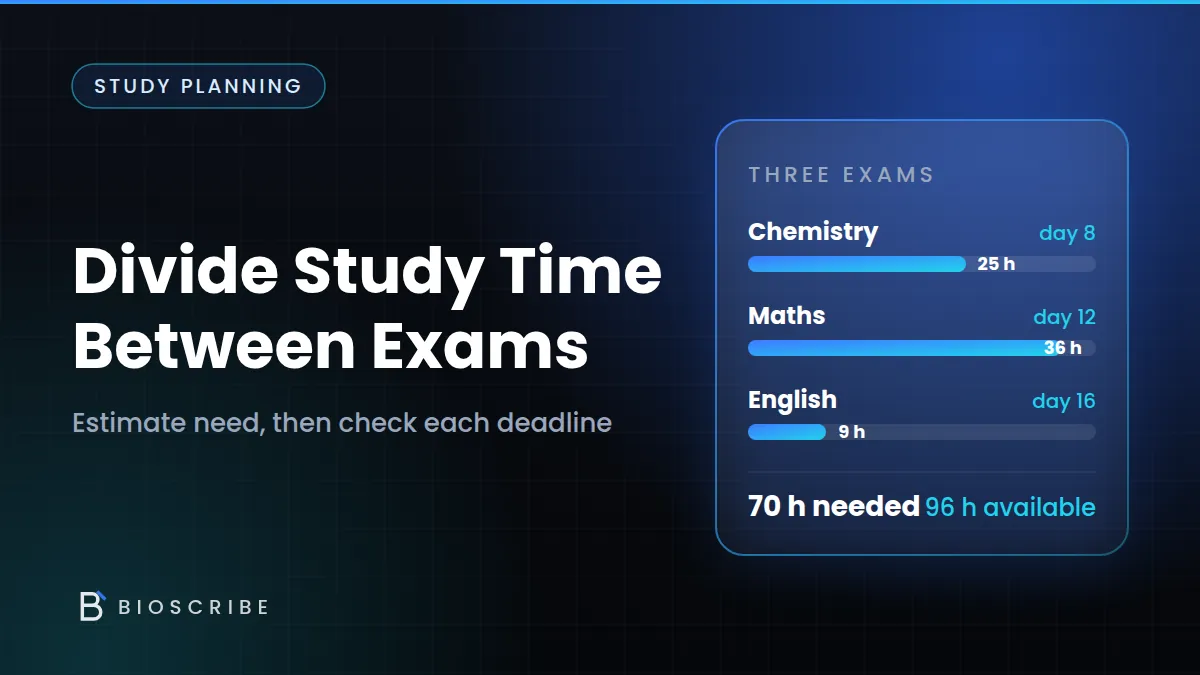
- Chemistry: 10 topics at 2.5 hours each is 25 hours.
- Maths: 12 topics at 3 hours each is 36 hours.
- English: 6 topics at 1.5 hours each is 9 hours.
The total is 25 + 36 + 9 = 70 hours. Time one topic to see whether your per-topic estimates are realistic. For a way to rank topics within a subject, see our guide on building a revision timetable you can actually follow.
Step 2: List the Exam Dates and Your Daily Hours
Write the exam dates as days from today. Chemistry is on day 8, Maths on day 12 and English on day 16. Then decide how many hours you can honestly study each day. Suppose it is 6 hours. By day 8 you will have 6 × 8 = 48 hours, by day 12 you will have 72, and by day 16 you will have 96. These cumulative figures are the budget you must stay inside.
Step 3: Check Every Deadline
Add up the hours needed for the exams that fall on or before each date, and compare them with the hours available by then.
| Exam | Day | Hours available by then | Hours needed by then | Spare |
|---|---|---|---|---|
| Chemistry | 8 | 48 | 25 | 23 |
| Maths | 12 | 72 | 61 | 11 |
| English | 16 | 96 | 70 | 26 |
The needed column is cumulative: by day 12 you need Chemistry (25) plus Maths (36), which is 61 hours. Every row has spare time, so the plan is feasible. If any row were negative, you would be short at that deadline.

When the Hours Do Not Fit
Now suppose you can only study 4 hours a day. Then you have 32 hours by day 8, 48 by day 12 and 64 by day 16. The day 12 deadline needs 61 hours but you have only 48, a shortfall of 13. At 5 hours a day you would have 60, which is still 1 hour short. You have three choices: raise your daily hours, cut the work by prioritising the topics with the most marks, or accept a lower target in one subject. The check tells you early, while all three choices are still open.
Step 4: Schedule the Days
With the 6-hour plan, use the earliest-deadline-first rule: work mainly on the exam that comes first, but keep a little contact with the others. Here is one way to spread the 96 hours:
| Days | Chemistry | Maths | English | Review | Total |
|---|---|---|---|---|---|
| 1 to 8 | 25 | 23 | 0 | 0 | 48 |
| 9 to 12 | 0 | 13 | 6 | 5 | 24 |
| 13 to 16 | 0 | 0 | 3 | 21 | 24 |
Maths gets 23 + 13 = 36 hours, English gets 6 + 3 = 9, and the 26 spare hours become review. Because Maths is the hardest subject, it starts early even though its exam is later.
Compare It With the Equal Split
An equal split of the 96 hours would give each subject 32. Chemistry would get 7 hours more than it needs, Maths would get 4 hours less than it needs and English would get 23 hours more than it needs. The equal plan wastes time on the easy subject and leaves the hard one short. That is why it feels fair but works badly.
Exams on Consecutive Days
When two exams are on back-to-back days, treat the first as the deadline for both hours and energy. Finish the main work for the second exam before the first one, so that the evening between them is only light review. Our guide on what to do the day before an exam explains how to use that evening without starting anything new.
Switching Between Subjects
Jumping between subjects every half hour wastes time while you reload what you were doing. Work in blocks of about 90 minutes on one subject, then change. Put the hardest subject in your most alert block. If you have two subjects in one day, use one in the morning and one in the afternoon, and keep the same order from day to day so that the routine becomes automatic.
Tracking and Adjusting
Compare hours done with hours planned at the end of each week. If you are behind on the first exam, move hours from review, not from the later exams. If you are ahead, add practice papers to the subject you feel least sure of. If an exam date moves, redo the deadline check with the new day, since the cumulative figures change. A plan that you re-check weekly rarely fails suddenly.
A Worked Example With Two Exams in Two Days
Back-to-back exams make the deadline check tighter. Suppose subject A is on Monday and needs 18 hours, subject B is on Tuesday and needs 14, and you have four days before Monday at 5 hours a day. By Monday you have 4 × 5 = 20 hours, which covers A’s 18. By Tuesday you have 5 × 5 = 25 hours, but the two subjects need 18 + 14 = 32. You are 7 hours short. The check shows the problem on day one, so you can raise your hours, trim B, or move B’s work earlier.
Counting Shared Topics Once
Subjects often overlap. If part of the Maths and Chemistry estimates cover the same ideas, such as units and graphs, you do not need to study them twice. Suppose 4 hours of the two estimates overlap. Counting the shared material once reduces the total from 70 to 66 hours. Be careful not to over-count the saving, since the second exam may still need its own practice with its own style of question.
Common Mistakes to Avoid
- Splitting hours equally. Estimate need first.
- Ignoring deadlines. Check the cumulative hours before each exam.
- Studying only the exam that is next. Keep some contact with later ones.
- Overestimating daily hours. Use a normal day.
- Leaving no review time. Spare hours should become review.
Check Your Work With BioScribe
BioScribe’s Study Schedule Generator builds a personalized study schedule around your subjects, priorities and exam dates. Enter your three exams and dates to turn the plan above into a schedule.
Frequently Asked Questions
Should I study the hardest subject first?
Start it early, because it needs the most hours. If another exam comes first, make sure the deadline check still works.
How do I split time if two exams are on the same day?
Treat both as the same deadline and add their hours together. Make sure the combined hours fit before that day.
What if one subject is much easier?
Give it fewer hours, as the estimate will show. Keep short, regular contact with it so that you do not forget it.
How often should I re-check the plan?
Once a week, or whenever an exam date or your daily hours change.
What should I do with spare hours?
Use them for review and practice papers, starting with the subject you feel least sure of.
Conclusion
To divide study time between exams, estimate the hours each needs, check the cumulative hours against each deadline, and schedule the earliest exams first while keeping the others warm. Leftover hours become review. Re-run the check whenever a date or your daily hours change. For a longer plan, see our guide to the 30-day exam study plan.