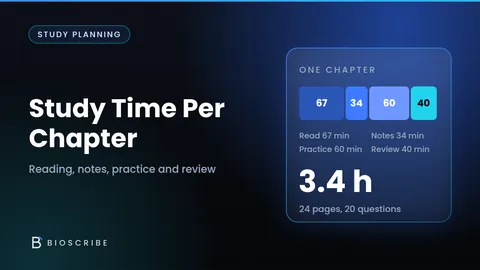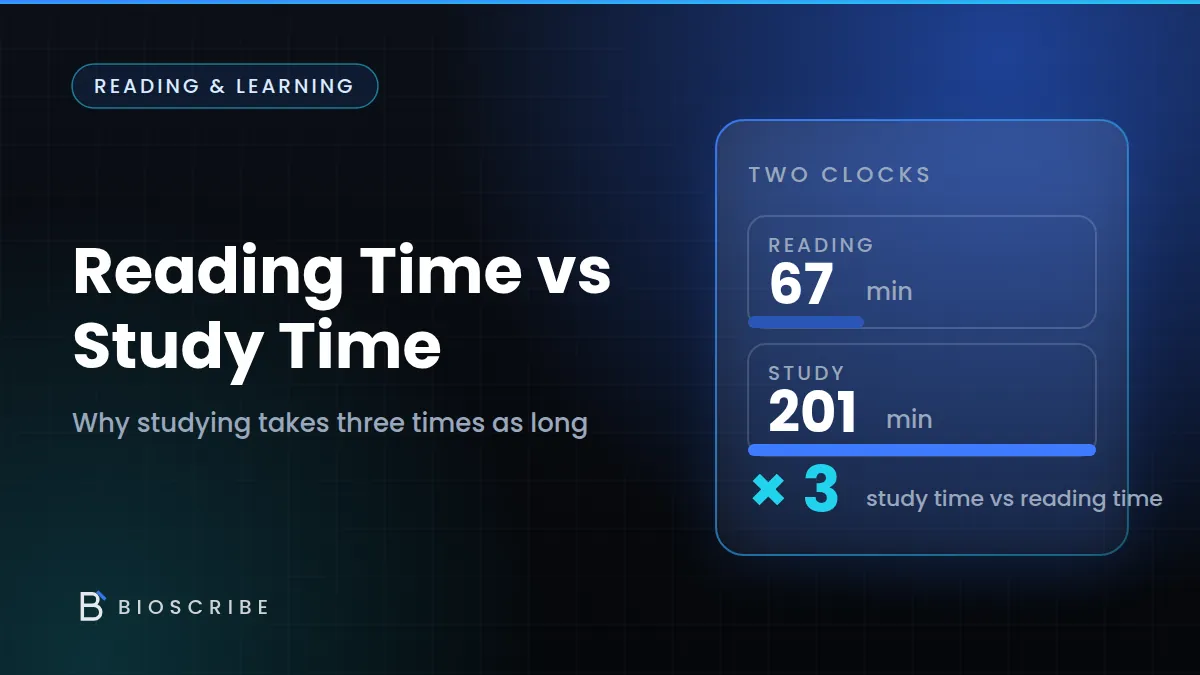
Short answer: reading time covers reading the words. Study time adds notes, practice and review. For one 24-page chapter, reading took 67 minutes and studying took 201, about three times as long.
Two Different Clocks
Reading time and study time are not the same, and mixing them up is one of the commonest planning mistakes. Reading time is how long it takes to get through the words. Study time is how long it takes to learn what the words say well enough to use it. A student who plans an evening around reading time often ends the evening having read the chapter but learned little. The fix is to plan with study time, using reading time only as the first part of it.
The Definitions
- Reading time: the minutes needed to read the text once at your normal pace.
- Study time: the minutes needed to read, take notes, practise with questions and review.
You can estimate the first from the word count and your speed. Our guide on how long it takes to read 1,000 words shows how. The second needs the extra parts added.
A Worked Example
A chapter has 24 pages and 20 practice questions. At 2.8 minutes a page, the reading takes 24 × 2.8 = 67.2 minutes. Studying also needs notes at about half the reading time (33.6 minutes), practice at 3 minutes a question (60 minutes), and a review of about 25% of the total so far (40.2 minutes). The study time is 67.2 + 33.6 + 60 + 40.2 = 201 minutes. Our guide on how to calculate study time per chapter explains the method.
How the Time Splits
| Part | Minutes | Share of study time |
|---|---|---|
| Reading | 67.2 | 33% |
| Notes | 33.6 | 17% |
| Practice | 60 | 30% |
| Review | 40.2 | 20% |
| Total study time | 201 | 100% |
Reading is only a third of the total. Two thirds of the time goes on the parts that turn reading into learning.

The Study Multiplier
Divide the study time by the reading time: 201 ÷ 67.2 = 2.99, so the multiplier for this student and this chapter is about 3. Once you know your own multiplier, you can estimate study time from reading time quickly. It is a shortcut for planning, not a rule, and it changes with the subject. A chapter with many problems needs more practice, so a higher multiplier, while a descriptive chapter may need less.
Quick Conversion Table
| Reading time | Study at 2 times | Study at 3 times | Study at 4 times |
|---|---|---|---|
| 60 min | 120 min | 180 min | 240 min |
| 5 hours | 10 hours | 15 hours | 20 hours |
If your week has 5 hours of reading and your multiplier is 3, you need about 15 hours of study to do it justice. That is a very different plan from 5 hours.
Why Plans Fail When They Use Reading Time Only
Plans fail in a predictable way. The student sees 5 hours of reading and schedules 5 hours. By the end of the week they have read most of it but taken few notes, done no practice and reviewed nothing. On an exam the unreviewed material is hard to recall. Because the planned time was too short, other tasks get squeezed, and the shortfall compounds. Planning with study time, even roughly, avoids this.
Finding Your Own Multiplier
Time one chapter properly, noting the minutes for reading, notes, practice and review. Divide the total by the reading minutes. Try again on a different type of chapter. After two or three, you will have a multiplier for each type, such as 2.5 for descriptive chapters and 3.5 for problem-based ones. Our guide on how long academic reading should take shows how to find the reading minutes first.
When Reading Time Is Enough
Sometimes reading time really is the whole job. When you only need the gist of a background article, or you are reading for pleasure, no notes or practice are needed. Decide in advance which kind of reading you are doing, and plan the time to match. The mistake is not planning only for reading time, it is planning only for reading time when you actually need to learn the material.
Planning a Day or Week With Study Time
Start from the total study time, then divide it across the days. A chapter of 201 minutes is 3.35 hours, and it fits in two sessions of about 100 minutes. Use blocks with breaks, and put practice and review on later sessions so that review is spaced. Our guide on how many hours a student should study per day helps you check that the total fits your day.
Different Subjects, Different Multipliers
The multiplier depends on the subject. Take a problem-based chapter with 50 minutes of reading, 25 minutes of notes and 120 minutes of practice. The subtotal is 195 minutes, and a 25% review brings it to 243.75, a multiplier of 243.75 ÷ 50 = 4.9. A descriptive chapter with 60 minutes of reading, 30 of notes and 20 of practice has a subtotal of 110, or 137.5 with review, a multiplier of 2.3. The same chapter length can need very different study time.
Using Both Numbers in One Plan
You can combine the multipliers in a week. Suppose your list has two descriptive chapters and one problem-based chapter, with 60, 60 and 50 minutes of reading. The study times are 137.5, 137.5 and 243.75 minutes, which total 518.75 minutes, or about 8.6 hours. Only 170 minutes of that is reading. Showing both numbers, 2.8 hours of reading and 8.6 hours of study, makes it clear why the week feels much busier than the reading list suggests.
What a Reading Time Estimate Gives You
A reading-time estimate is the first input, not the final answer. It gives you a quick, objective starting point from the word count, so you do not rely on guesswork. From there, apply your multiplier for the type of chapter, then fit the result into your timetable. The tool does the first step. The judgement about notes, practice and review is yours, and it improves each time you compare your estimate with what actually happened.
Common Mistakes to Avoid
- Planning with reading time alone. Add notes, practice and review.
- Using someone else’s multiplier. Measure your own.
- Treating every chapter the same. Problem-heavy chapters need more.
- Forgetting review. It is a fifth of the time in the example.
- Not updating the multiplier. Check it after each new type of chapter.
Check Your Work With BioScribe
BioScribe’s Reading Time Calculator estimates how long reading-heavy topics will take. Use it for the reading part, then apply your own multiplier to get the study time.
Frequently Asked Questions
What is the difference between reading time and study time?
Reading time is the time to read the text once. Study time also includes notes, practice questions and review.
How much longer is study time than reading time?
In the example it was about three times as long. Your multiplier depends on the subject and your study method.
Do I need to include review in study time?
Yes. Review is where much of the learning is fixed, and it was about a fifth of the time in the example.
Can I use the same multiplier for every subject?
Not safely. Problem-based subjects need more practice, so measure the multiplier for each type of chapter.
When is reading time enough?
When you only need the gist or are reading for interest, so there is no need for notes or practice.
Conclusion
Reading time is how long the words take to read, and study time is how long it takes to learn from them. In the worked example, the chapter took 67 minutes to read and 201 minutes to study, a multiplier of about 3. Measure your own, plan with study time when you need to learn, and use reading time only as the first step.