Short answer: time per chapter = reading + notes + practice + review. Measure your own minutes per page, then add about half again for notes, 3 minutes a question for practice and 25% for review.
Why Guessing Chapter Time Fails
Most students underestimate how long a chapter takes, because they count only the reading. Real study also includes notes, practice questions and review. If you plan two hours for a chapter that needs three and a half, every later date slips. Estimating the time from your own measurements fixes this, and the calculation takes only a few minutes.
Step 1: Measure Your Reading Speed in Minutes per Page
Time yourself on a few pages of the kind of material you study. Suppose you read 5 pages in 14 minutes and, on another day, 3 pages in 9 minutes. Pool the readings: (14 + 9) ÷ (5 + 3) = 23 ÷ 8 = 2.875 minutes per page. For simplicity, this guide uses 2.8, which is the first measurement alone (14 ÷ 5). Averaging minutes and pages together, as here, is the weighted method explained in our guide on how to calculate a weighted average.
Step 2: Estimate the Four Parts of Study
- Reading: pages × minutes per page.
- Notes: about half of the reading time, if you write short notes.
- Practice: number of questions × minutes per question, for example 3 minutes each.
- Review: about 25% of the total of the first three parts.
These ratios are starting points. Change them after you have timed a real chapter.
Worked Example: A 24-Page Chapter
A chapter has 24 pages and 20 practice questions.
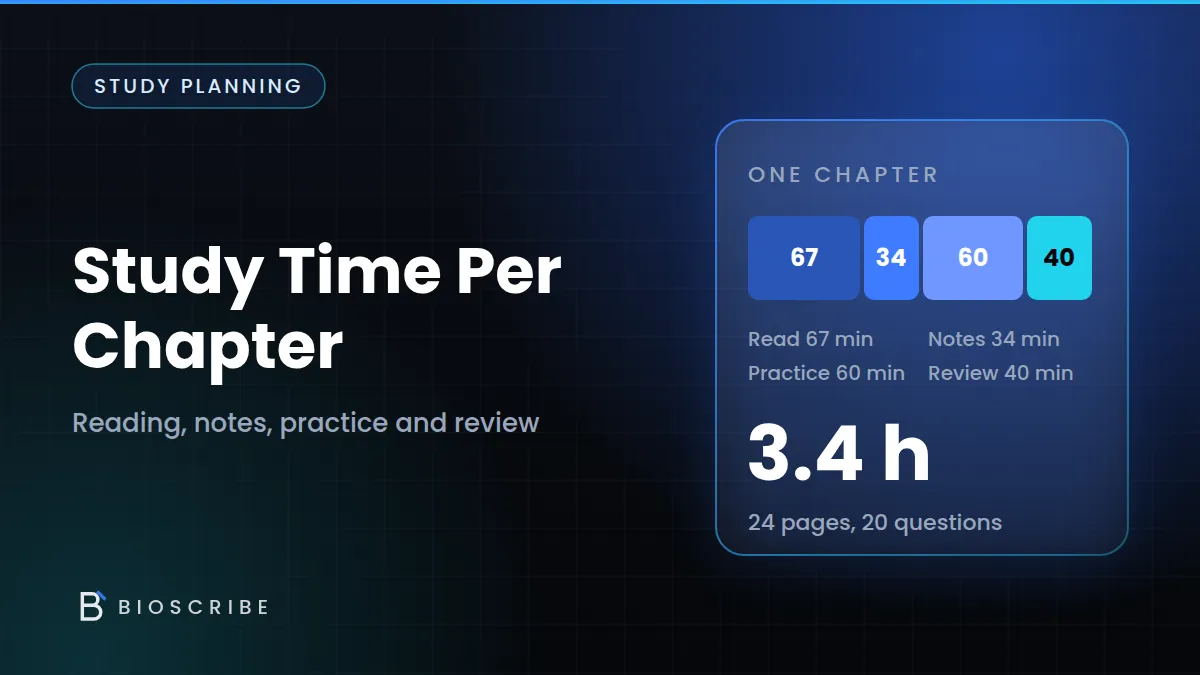
- Reading: 24 × 2.8 = 67.2 minutes.
- Notes: 67.2 × 0.5 = 33.6 minutes.
- Practice: 20 × 3 = 60 minutes.
- Subtotal: 67.2 + 33.6 + 60 = 160.8 minutes.
- Review at 25%: 160.8 × 1.25 = 201 minutes, or about 3.35 hours.
A student who planned only the 67 minutes of reading would be out by more than two hours.
A Table for a Whole Book
Here are four chapters with different lengths, using the same speed and ratios:
| Chapter | Pages | Questions | Reading | Notes | Practice | Total with review |
|---|---|---|---|---|---|---|
| 1 | 24 | 20 | 67.2 | 33.6 | 60 | 201 |
| 2 | 18 | 15 | 50.4 | 25.2 | 45 | 150.8 |
| 3 | 30 | 25 | 84 | 42 | 75 | 251.3 |
| 4 | 20 | 10 | 56 | 28 | 30 | 142.5 |
All times are in minutes. The four chapters total 201 + 150.75 + 251.25 + 142.5 = 745.5 minutes, or about 12.4 hours.

Adjusting for Difficulty
The chapters are not equally hard. If chapter 3 is dense and new to you, multiply its time by a difficulty factor such as 1.5. That gives 251.25 × 1.5 = 376.9 minutes, or about 6.3 hours instead of 4.2. If a chapter is familiar, you can use 0.8. Apply the factor to the total, not to each part, so that the arithmetic stays simple.
Turning Hours Into Days
Divide the total by the time you can give per day. At 2 hours a day, 745.5 minutes is 745.5 ÷ 120 = 6.2 days, so plan for 7 study days. Add a buffer day or two for slow days. If a deadline is fixed, work backwards: with 5 study days available, you need 745.5 ÷ 5 = 149 minutes a day, which is about 2.5 hours. Our guide on how many hours a student should study per day helps you decide whether that is realistic.
Splitting a Chapter Across Sessions
A 3.35-hour chapter does not have to be done at once. A common pattern is to read and take notes in one session, practice in a second, and review the next day. Splitting reduces fatigue and spaces the review. Our guide on how the Pomodoro technique works for students shows how to time the sessions in short focused rounds.
Updating the Estimates
After each chapter, compare the actual time with the estimate and adjust. If notes took 70% of reading time instead of 50%, change the ratio. If practice took 4 minutes a question, change that. Two or three chapters are enough to make your estimates accurate. A personal ratio is worth more than any general rule, because reading speed and note style differ a great deal between students.
What Not to Include
Keep the estimate for study time, not for everything around it. Travel, breaks and setting up are separate. If you count a break after each hour, add it to the schedule later. Also leave out material the course does not examine, such as optional extension reading, unless you want it. A narrow, honest estimate is easier to meet than a broad, vague one.
When a Chapter Has Few Practice Questions
Some chapters end with only a handful of questions. In that case, count what is there and add your own. Suppose a chapter has 8 short questions at 3 minutes each, which is 24 minutes, and 2 past-paper questions at 12 minutes each, another 24 minutes. The practice time is 48 minutes. If you want more practice, write questions from the headings or use a past paper. The estimate should reflect the practice you will really do.
Planning a Week of Chapters
Once you have the total, spread it across the days you have. The four chapters need 745.5 minutes, and over 7 days that is 745.5 ÷ 7 = 106.5 minutes a day, a little under two hours. Keep each chapter’s reading and notes together, and put practice and review on a later day or later in the same day. If a chapter needs more than a single day, split it at a natural point, such as after the notes.
Checking the Estimate Against Reality
Time the first chapter properly and compare. If you planned 201 minutes and it took 240, your estimates are 240 ÷ 201 = 1.19 times too low. Use 1.2 as a correction on the remaining chapters: the other three total 745.5 − 201 = 544.5 minutes, and 544.5 × 1.2 = 653.4. The revised total is 240 + 653.4 = 893.4 minutes, or about 14.9 hours. It is better to find this out after one chapter than at the end of the week.
Using Chapter Estimates for Revision
The same numbers help later. A revision pass usually takes less than first study. If you allow about 40% of the original time, revising chapter 1 takes 201 × 0.4 = 80.4 minutes. Adding up the revision time for each chapter shows how many hours your revision plan needs. Our guide on how many days you should study before an exam shows how to convert these hours into days.
Common Mistakes to Avoid
- Counting only reading time. Add notes, practice and review.
- Using someone else’s reading speed. Measure your own.
- Treating all chapters as equal. Adjust for difficulty.
- Planning without a buffer. Add a spare day or two.
- Never updating the estimate. Compare estimate and actual after each chapter.
Check Your Work With BioScribe
BioScribe’s Study Time Calculator helps you turn the days you have into study hours. Use it to compare the hours your chapters need with the time you have.
Frequently Asked Questions
How long should I spend on one chapter?
It depends on its length, difficulty and your reading speed. Use the formula with your own minutes per page rather than a fixed number.
How do I measure my reading speed in pages?
Time yourself on several pages of the material you study, then divide total minutes by total pages. Repeat on different days.
Should I include review in the chapter time?
Yes. Review is where much of the learning is fixed, and leaving it out makes every plan too short.
What if the chapter has no practice questions?
Write your own questions from the headings, or replace the practice time with extra recall time. Keep some active practice in the estimate.
How do I plan time for several chapters?
Estimate each, add them up, and divide by your daily hours. Add a buffer day for every five or so study days.
Conclusion
To calculate study time per chapter, measure your minutes per page, then add notes, practice and review. The 24-page example needs about 3.35 hours, not the 67 minutes the reading alone suggests. Adjust for difficulty, convert hours into days with a buffer, and update your ratios after each chapter so that the plan becomes accurate.