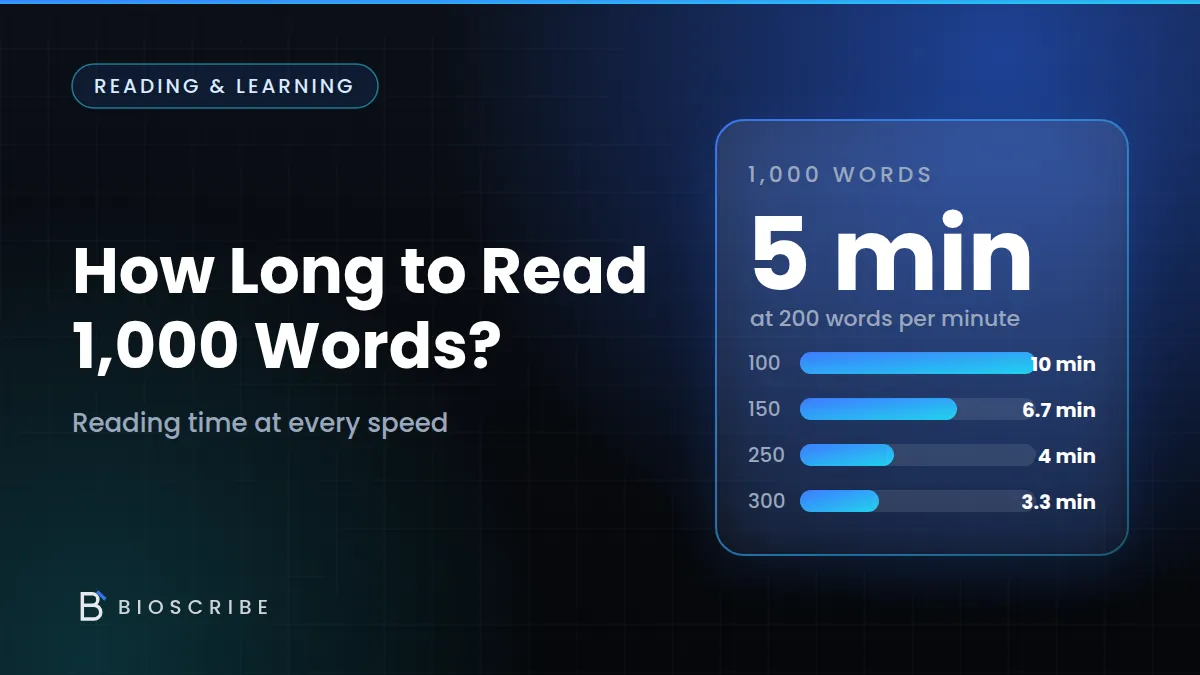
Short answer: reading time = words ÷ words per minute. At 200 words per minute, 1,000 words take 5 minutes. At 250 it takes 4 minutes, and at 120 for dense study material, about 8 minutes 20 seconds.
The Short Answer Depends on Your Speed
There is no single time for reading 1,000 words, because people read at different speeds and different texts demand different speeds. Commonly quoted figures for ordinary adult reading fall somewhere around 200 to 300 words per minute, which puts 1,000 words at roughly 3 to 5 minutes. Study material is usually slower. The reliable way to answer the question for yourself is to use a formula with your own measured speed, and this guide shows how.
The Formula
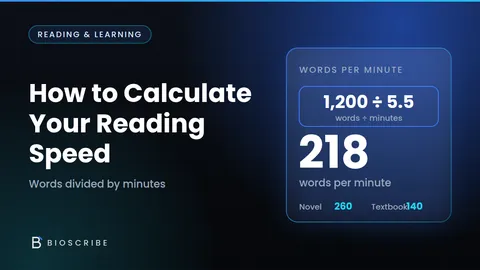
Count the words, divide by your speed, and you have the time in minutes. If you want minutes and seconds, convert the decimal part: 0.33 of a minute is about 20 seconds. Our guide on how to calculate your reading speed explains how to measure your own figure.
Step-by-Step Example
Take a 1,000-word passage and three different speeds.
- At 200 words per minute: 1,000 ÷ 200 = 5 minutes.
- At 250 words per minute: 1,000 ÷ 250 = 4 minutes.
- At 300 words per minute: 1,000 ÷ 300 = 3.33 minutes, or about 3 minutes 20 seconds.
A faster reader saves a minute or two per 1,000 words, which adds up over a long reading list.
Reading Time at Common Speeds
| Speed (words per minute) | 1,000 words | 5,000 words | 10,000 words |
|---|---|---|---|
| 100 | 10 min | 50 min | 100 min |
| 150 | 6.7 min | 33.3 min | 66.7 min |
| 200 | 5 min | 25 min | 50 min |
| 250 | 4 min | 20 min | 40 min |
| 300 | 3.3 min | 16.7 min | 33.3 min |
The time scales in a straight line with the number of words, so you can combine the columns. For 6,000 words at 200 words per minute, add 5,000 words (25 minutes) and 1,000 words (5 minutes) to get 30 minutes.
Why Study Material Is Slower
The speeds in the table are for ordinary, familiar text. Study material is harder. It contains unfamiliar terms, long sentences, formulas and diagrams, and you often reread a paragraph to follow it. A student who reads a novel at 250 words per minute might read a dense textbook at 120. At 120 words per minute, 1,000 words take 1,000 ÷ 120 = 8.33 minutes, or about 8 minutes 20 seconds, which is 4 minutes more than the novel. Always use a speed measured on the material you will actually read.

Converting Pages to Words
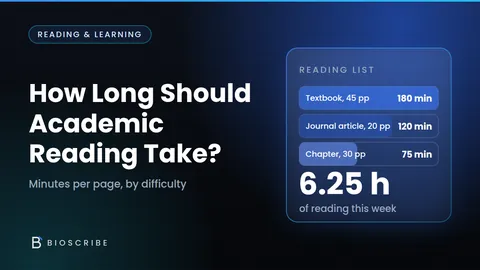
Most readings are given in pages, not words. Page length varies with font, margins and diagrams, so count a sample. Suppose three pages contain 380, 410 and 395 words. The mean is (380 + 410 + 395) ÷ 3 = 395 words a page. A 24-page chapter is then about 395 × 24 = 9,480 words, and at 200 words per minute it takes 9,480 ÷ 200 = 47.4 minutes. Pages with many diagrams or tables hold fewer words, so sample pages from the part you are reading.
Counting Words Quickly
For digital text, select the passage and use a word counter in your word processor or an online tool. For printed text, count the words in three full lines, divide by three to get words per line, then multiply by the lines on a page. A rough count is enough, since your reading speed is itself an estimate. If you need a figure for a whole book, sample several pages and multiply, as in the example above.
Reading Is Only Part of the Time
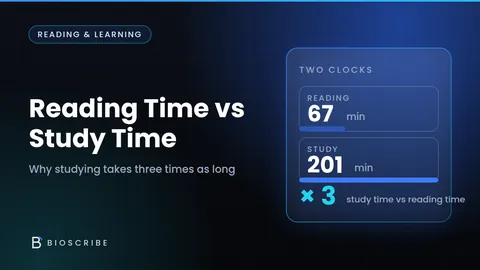
The time to read 1,000 words is not the time to study them. Taking notes, answering questions and reviewing add much more. For one student, a 24-page chapter took about 67 minutes to read and 201 minutes to study. Our guide on reading time vs study time explains the difference, and our guide on how to calculate study time per chapter shows how to estimate the full time.
Planning a Reading List
Once you can estimate reading time, you can plan a list. Suppose your readings total 60,000 words and you read at 200 words per minute. The reading time is 60,000 ÷ 200 = 300 minutes, which is 5 hours. Over 10 days, that is 30 minutes a day. If the material is dense and your speed is 120, the same list takes 500 minutes, about 8.3 hours, so check your speed on the material before you commit to a schedule.
Reading Aloud and Reading on Screen
Reading aloud is slower than reading silently, so do not use a spoken pace for silent reading. Screens can also change speed. Some people read more slowly on a screen, especially for long texts, so measure both if you use both. When you plan, use the speed that matches how you will read, and keep a margin for tired days, when speed drops.
Using Your Result for a Daily Plan
Translate the reading time into blocks. A 47-minute chapter fits one focused session, while a 5-hour list needs several. If you use short focused rounds, 47 minutes is two rounds of 25 minutes. Our guide on how the Pomodoro technique works for students shows how to plan rounds. Always add time for a short break, and avoid scheduling long reading right after a heavy class.
Reading Time for Common Lengths
The same formula covers any length. A 2,500-word essay at 200 words per minute takes 2,500 ÷ 200 = 12.5 minutes. An 8,000-word article takes 40 minutes, and a 90,000-word novel takes 450 minutes, which is 7.5 hours. These are reading times only. For study reading, use a slower speed and add time for notes. Having a rough feel for common lengths helps you judge a reading list at a glance.
What a Small Slowdown Costs
Small differences in speed add up over long readings. If your speed drops from 200 to 180 words per minute because the material is harder, 10,000 words take 10,000 ÷ 180 = 55.6 minutes, instead of 50. That is 5.6 minutes more for a modest slowdown. Over a reading list of 60,000 words, the same change adds more than half an hour, which is why a measured speed matters.
Common Mistakes to Avoid
- Using a speed for easy text on hard material. Measure on your study material.
- Counting pages instead of words. Sample the words on a page.
- Forgetting notes and review. Reading time is only part of study time.
- Using a spoken pace. Silent reading is faster.
- Planning with no margin. Speed drops when you are tired.
Check Your Work With BioScribe
BioScribe’s Reading Time Calculator estimates how long reading-heavy topics will take. Enter your word count and speed to check the times above, then try your own readings.
Frequently Asked Questions
What is a normal reading speed?
Commonly quoted figures for ordinary text are around 200 to 300 words per minute, but speeds vary a lot. Study material is usually slower, so measure your own.
How long does it take to read 10,000 words?
At 200 words per minute it takes 50 minutes. At 250 it takes 40, and at 150 it takes about 67.
How many words are on a page?
It varies with font, margins and diagrams. Count the words on a few typical pages and take the mean.
Does reading time include understanding?
No. Reading time covers only reading the words. Understanding, notes and practice take additional time.
How do I read faster?
Focus on understanding first, remove distractions and practise regularly. Check any speed gain with questions on what you read.
Conclusion
To find how long 1,000 words take, divide by your reading speed: 5 minutes at 200 words per minute, 4 at 250 and about 8 for dense material at 120. Convert pages to words with a sample, add time for notes and review, and plan your reading list in blocks. A measured speed on your own material is worth far more than any average.