Short answer: reading speed = words read ÷ minutes taken. Time yourself on a passage of known length, divide, and repeat on several samples for an accurate figure.
What Words Per Minute Means
Words per minute, often written WPM, is the number of words you read in one minute. It is the standard way to describe reading speed, and it is the input you need for any reading-time estimate. A measured WPM turns “this reading will take ages” into a number you can plan with. It takes about ten minutes to measure, and the result is more useful than any average someone else quotes.
The Formula
Convert time to minutes first. If you took 5 minutes 30 seconds, that is 5.5 minutes. If you took 4 minutes 15 seconds, that is 255 seconds, or 255 ÷ 60 = 4.25 minutes.
Step 1: Choose a Passage
Choose text of the kind you want to measure. If you want to plan for textbook chapters, use a textbook passage, not a news article. Pick a passage of at least 600 to 1,000 words, since a very short sample is dominated by how quickly you start. Make sure you have not read it before, and that it is at a typical difficulty for your course.
Step 2: Count the Words
For digital text, paste the passage into a word counter, or select it and read the count. For printed text, count a few full lines, find the mean words per line, and multiply by the number of lines. An exact count is not necessary, but a wildly wrong one will spoil the result. Write the count down before you start reading.
Step 3: Time Your Reading
Use a timer. Read at your natural pace, as you would when studying, and stop the timer at the end. Do not rush to improve your score, and do not stop to take notes, because the aim is to measure plain reading. Afterwards, check that you understood the passage by summarising it in two or three sentences. If you cannot, the figure is too fast to be useful.
Step 4: Divide
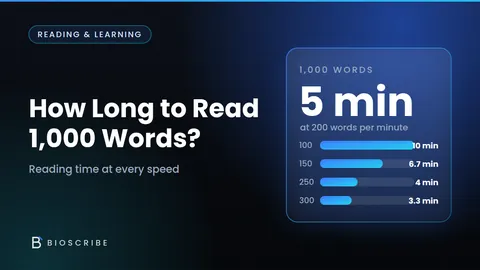
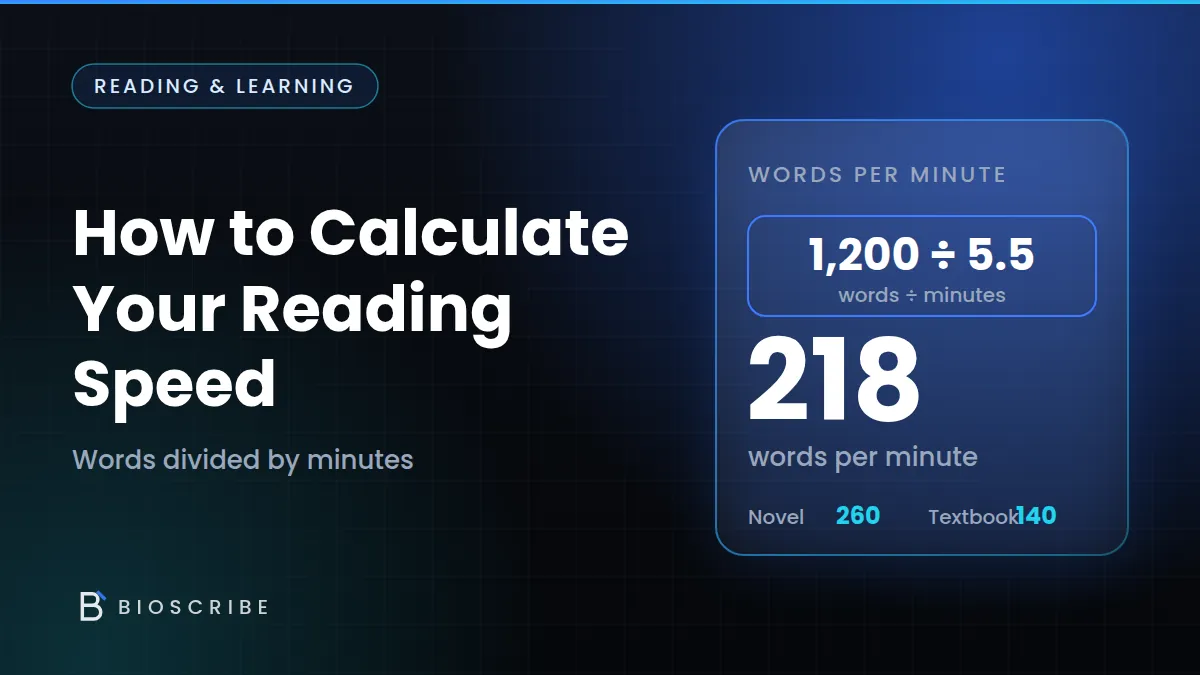
Suppose a passage has 1,200 words and you read it in 5 minutes 30 seconds, which is 5.5 minutes. Your speed is 1,200 ÷ 5.5 = 218 words per minute. You can use it to estimate any reading. For example, our guide on how long it takes to read 1,000 words shows the time at different speeds.
Use Several Samples
One sample can mislead, because you may be unusually alert or tired. Take three, and combine them by adding the words and adding the times. Suppose you read 600 words in 3 minutes, 800 words in 3.5 minutes and 700 words in 3.5 minutes. The total is 2,100 words in 10 minutes, so your speed is 2,100 ÷ 10 = 210 words per minute. This pooled method gives longer samples more weight, which is the weighted approach described in our guide on how to calculate a weighted average. Averaging the three separate speeds gives a similar result here, but pooling is more reliable.

Reading Speed Differs by Material
You do not have a single speed. You read a novel faster than a textbook, and a textbook faster than a research paper. As an example of how much it can differ, imagine measuring 260 words per minute on a novel, 230 on a news article and 140 on a textbook. Measure each type of material you read, and use the matching figure when you plan. If you plan with your novel speed, every study reading will take almost twice as long as expected.
Effective Reading Speed
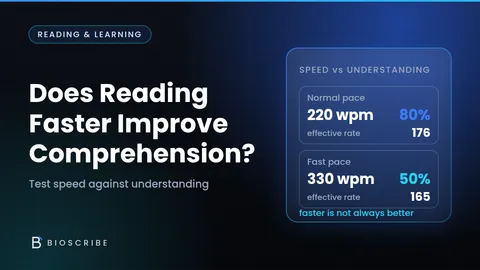
Speed alone does not tell you how much you took in. Effective reading speed multiplies your speed by the share of the passage you understood and could recall. If you read at 240 words per minute and could answer 75% of questions about the passage, your effective speed is 240 × 0.75 = 180 words per minute. Test comprehension with a few questions after each sample, and notice if raising your speed lowers the score. Our guide on whether reading faster improves comprehension explores this.
Paper or Screen
If you read in both formats, measure both. Some people read more slowly on screen, others do not notice a difference. The point of measuring is to plan realistically, so use the figure that matches the way you will read. Light, font size and posture can all change speed, so keep conditions similar between samples if you want to compare them.
Tracking Progress
Re-measure every few weeks, using similar material, and record the results. If your speed rises from 200 to 215 words per minute, that is an increase of 15 ÷ 200 = 7.5%. Improvement tends to come from familiarity with the subject, more reading practice and fewer distractions, not from tricks. Keep an eye on comprehension at the same time, because a faster speed that costs understanding is not an improvement.
Using Your Speed to Plan
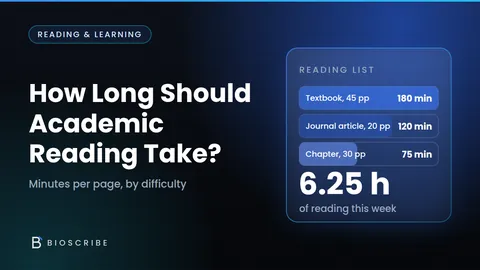
With a measured speed, you can estimate any reading. Divide the words by your speed for the time, then add time for notes and review. Our guide on how long academic reading should take shows how to estimate time by difficulty, and our guide on how to calculate study time per chapter shows how to add the other parts of study.
A Worked Example With Seconds
Suppose you read a 900-word passage in 4 minutes 15 seconds. Convert the time first: 4 minutes plus 15 ÷ 60 = 0.25 minutes gives 4.25 minutes. Your speed is 900 ÷ 4.25 = 211.8 words per minute. A common error is to treat 4 minutes 15 seconds as 4.15 minutes, which would give 216.9 and overstate your speed by about 5 words per minute. Always divide the seconds by 60.
Keeping a Reading Speed Log
A simple log helps you see your pattern. Record the date, the type of material, the words, the minutes, your speed and a comprehension score out of 10. After a month, you can see which materials slow you down, and whether practice has helped. If your speed on textbook passages rose from 200 to 215 words per minute with the same comprehension, that is a real gain of 7.5%. If comprehension fell as speed rose, the gain is not real.
Common Mistakes to Avoid
- Using one short sample. Take several longer ones.
- Measuring the wrong kind of text. Match the material you will read.
- Rushing to get a high score. Read at your natural pace.
- Ignoring comprehension. Check what you understood.
- Forgetting to convert seconds. 4 minutes 15 seconds is 4.25 minutes.
Check Your Work With BioScribe
BioScribe’s Reading Time Calculator estimates how long reading-heavy topics will take. Enter your measured speed to turn any word count into a reading time.
Frequently Asked Questions
How many words should I use to measure my speed?
Use at least 600 to 1,000 words per sample, and take several samples. Short passages give unreliable results.
Should I measure speed on easy or hard text?
Measure on the kind of text you plan to read. Your speed on study material is usually lower than on easy text.
How do I convert seconds to minutes?
Divide the seconds by 60 and add them to the minutes. For 4 minutes 15 seconds, 15 ÷ 60 = 0.25, so the time is 4.25 minutes.
What is effective reading speed?
It is your speed multiplied by the share you understood. At 240 words per minute with 75% comprehension, it is 180.
How often should I re-measure?
Every few weeks is enough, or when your course material changes a lot.
Conclusion
To calculate your reading speed, count the words in a passage, time yourself reading it naturally and divide by the minutes. Use several samples, measure each type of material, and combine your speed with a check on comprehension. A measured speed turns reading lists into plans.