Short answer: reading time = pages × minutes per page, where the minutes per page depend on difficulty. For a dense 20-page article at 6 minutes a page, plan about 2 hours.
Why Academic Reading Is Slower
Academic texts are written for specialists. They pack ideas into long sentences, introduce terms without much explanation and expect you to follow an argument across many pages. Students are often surprised that a 20-page article takes far longer than 20 pages of ordinary reading. Planning for that honestly prevents the common pattern of leaving the reading to the night before. A simple method, based on difficulty, gives a realistic estimate.
Step 1: Count the Pages
Use the pages you are assigned, and exclude parts you will not read, such as long reference lists or appendices. If a chapter has many diagrams, tables or worked examples, those pages may take more time, not less, since you need to study the figures. Note the range exactly, such as “pages 45 to 66”, so that your estimate is for what you will really read.
Step 2: Choose Minutes per Page by Difficulty
Measure your own speed if you can, using our guide on how to calculate your reading speed. As a starting point for planning, you could use figures like these, which you should adjust after timing a few pages:
- Easier material such as an introductory textbook: about 2.5 minutes a page.
- Moderate material such as a standard course textbook: about 4 minutes a page.
- Dense material such as a research article: about 6 minutes a page.
These are examples, not norms. Your subject, your background and the writing style all change them.
Step 3: Multiply
A dense 20-page journal article at 6 minutes a page takes 20 × 6 = 120 minutes, which is 2 hours. A 24-page chapter of a standard textbook at 4 minutes a page takes 24 × 4 = 96 minutes. A 30-page easier chapter at 2.5 minutes a page takes 30 × 2.5 = 75 minutes. Notice how much the difficulty matters. Twenty pages of dense article takes longer than thirty of easy chapter.
A Weekly Reading List
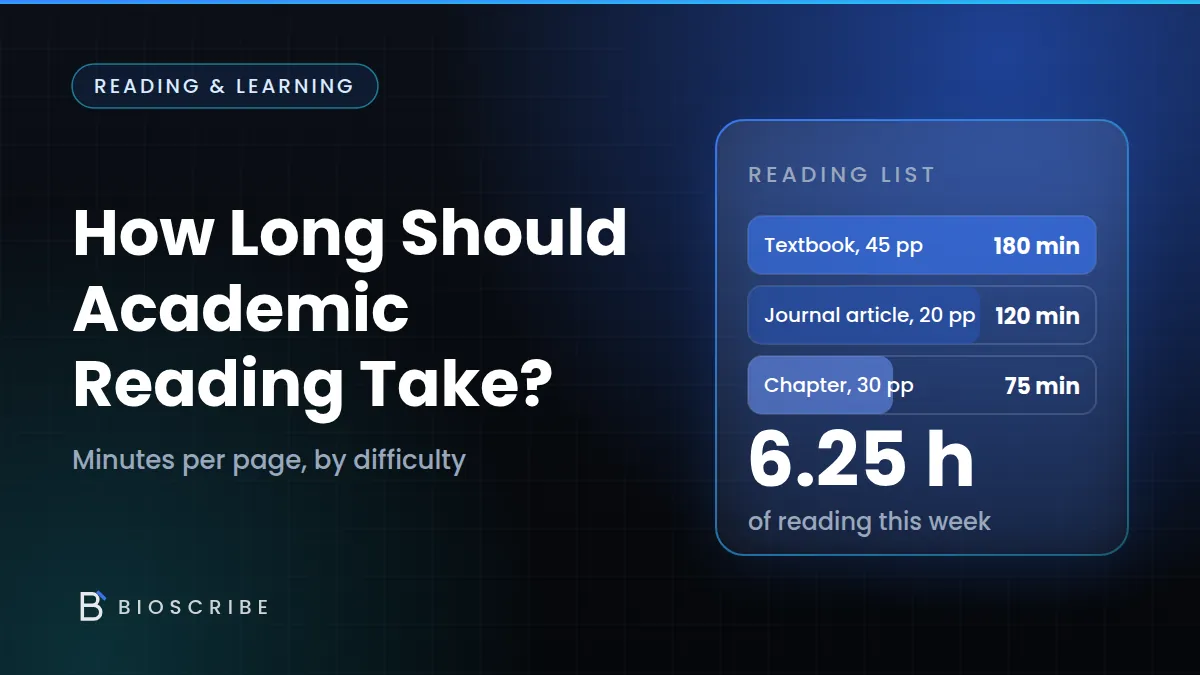
Suppose your week includes three readings. Combine them in a table:
| Reading | Pages | Minutes per page | Time |
|---|---|---|---|
| Textbook section | 45 | 4 | 180 min |
| Journal article | 20 | 6 | 120 min |
| Introductory chapter | 30 | 2.5 | 75 min |
The total is 180 + 120 + 75 = 375 minutes, or 6.25 hours. Spread over five days, that is 375 ÷ 5 = 75 minutes a day. Seeing the total in hours early in the week lets you move other commitments, instead of discovering on Thursday that you cannot finish.

Read in Layers
Dense articles are easier to handle in layers. First, survey the abstract, headings and conclusion to see the argument. Second, read the text carefully. Third, review your notes and the main points. For the 120-minute article, you might spend 10 minutes surveying, 90 minutes reading and 20 minutes reviewing, which adds up to 120. The survey saves time in the reading because you know where the argument is going, and the review fixes the main ideas.
Adding Time for Notes
The times above are for reading. If you take notes, add time. A common allowance is about half of the reading time for short notes, though it depends on your method. For the 120-minute article, that is another 60 minutes. Our guide on how to calculate study time per chapter shows how to add notes, practice and review.
What to Skim and What to Read Closely
Not every reading deserves the same effort. Read closely the texts that will be examined or discussed in detail, and the sections that answer your current question. Skim background material, and read only the abstract, introduction and conclusion of articles that are peripheral. A skim-only version of the 120-minute article might take 25% of the time, which is 30 minutes. Decide in advance which readings get which treatment, so that you spend your time where it counts.
When You Are Behind
If you cannot finish everything, triage. Rank readings by importance and read the top ones fully. Skim the others using the abstract, headings and conclusion. Ask your instructor which parts are essential, since they often know. A partial, deliberate reading is better than a rushed, anxious one. Then rebuild your plan for the following week with a more realistic allowance, using the time you actually took.
Breaking Reading Into Sessions
A long reading is easier in several sessions. Divide a 2-hour article into two or three sittings, with a break and a short recall at the start of each. Our guide on how the Pomodoro technique works for students shows how to use short focused rounds for reading. Schedule demanding readings at your best time of day and lighter ones for tired hours.
A Worked Example With Your Own Speed
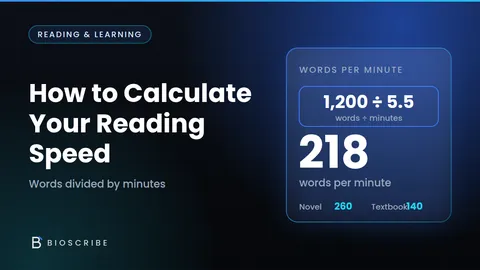
Time yourself on a few pages of the real reading. If 5 pages take 28 minutes, your pace is 28 ÷ 5 = 5.6 minutes a page. A 20-page article at that pace takes 20 × 5.6 = 112 minutes, which is close to the dense-material figure of 120 but more accurate. Repeat on the next reading to confirm. After two or three samples you will have a reliable figure for each kind of text in your course.
Reading for a Seminar vs for an Exam
The purpose changes how long you need. For a seminar, you mainly need the argument, the evidence and some questions to ask, so you can often read the methods and detail more lightly. For an exam, you may need the details. As an example, if close reading of the article takes 120 minutes, seminar preparation might take about 60% of that, or 72 minutes. Ask your instructor what the reading is for, and plan the time accordingly.
Setting a Weekly Reading Budget
Decide how many hours you can give to reading each week, and compare it with your list. If you can spend 5 hours (300 minutes) and the list needs 375, you are 75 minutes short. You have three options: find extra time, skim the least important item, or ask which reading can be dropped. Doing this on Monday leaves time to act. Doing it on Thursday does not.
Common Mistakes to Avoid
- Using one speed for every text. Difficulty changes minutes per page a great deal.
- Leaving reading to the last night. Check the total at the start of the week.
- Reading every text the same way. Skim some and read others closely.
- Forgetting notes. Add time for them.
- Not measuring. Time a few pages to calibrate.
Check Your Work With BioScribe
BioScribe’s Reading Time Calculator estimates how long reading-heavy topics will take. Enter the pages and your minutes per page to plan your weekly reading.
Frequently Asked Questions
How many pages can I read in an hour?
It depends on difficulty and your speed. At 4 minutes a page it is 15 pages, and at 6 minutes a page it is 10.
How long does a journal article take to read?
A dense 20-page article at about 6 minutes a page takes about 2 hours. Measure your own pace, since it varies.
Should I read everything on the reading list?
Not always. Read closely what will be examined or discussed, and skim the rest using the abstract and conclusion.
Is it better to read in one sitting or several?
Several shorter sessions often work better for dense material, with a short recall at the start of each.
How do I plan time for notes?
Add an allowance, for example half the reading time for short notes, and adjust after you see how long yours take.
Conclusion
To estimate academic reading time, count the pages, choose minutes per page by difficulty, and multiply. A weekly list of 375 minutes is 6.25 hours, or 75 minutes a day over five days. Read dense texts in layers, add time for notes, decide what to skim, and recalibrate your figures after each week.