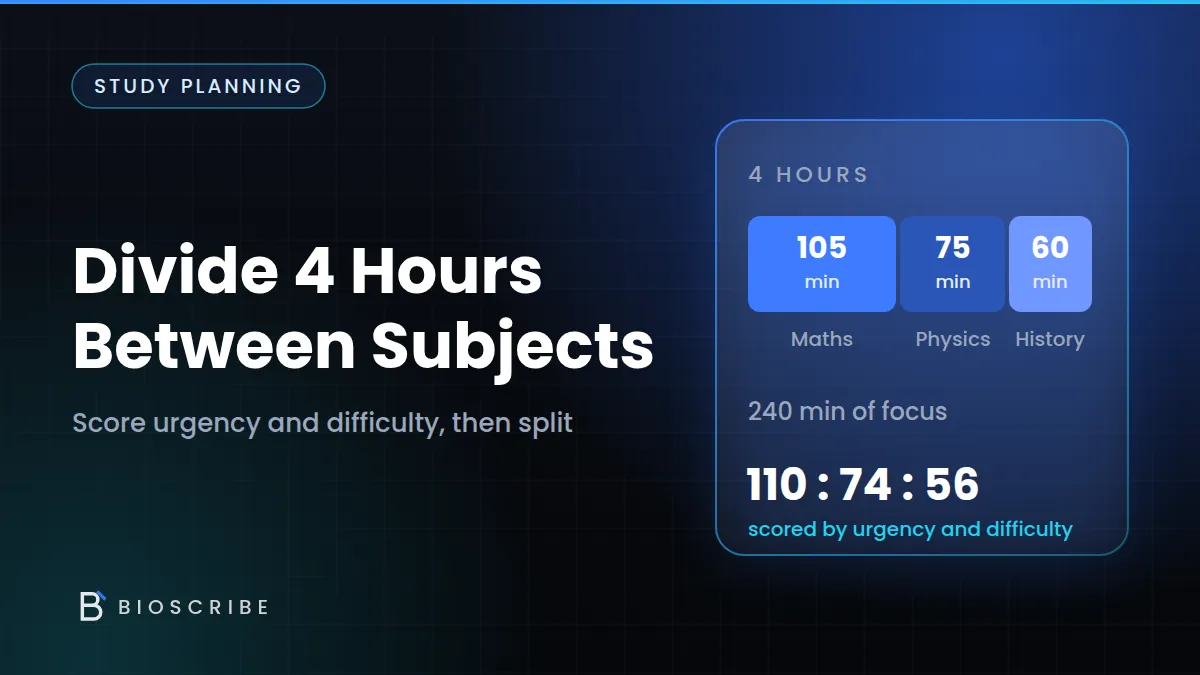
Short answer: score each subject for urgency and difficulty, share the 240 minutes in proportion to the scores, and round to blocks you can time. Do the highest-scoring subject first.
The Problem With “I Will Study Everything”
When you sit down for four hours with several subjects, the natural plan is to start with whichever is on top and see how it goes. Two hours later the favourite subject has taken most of the time and the urgent one is still waiting. Dividing the time in advance prevents this. The method below is simple enough to do in a minute, and it works for any number of subjects.
Step 1: Score Each Subject
Give each subject two scores from 1 to 3. Urgency is how soon the deadline or exam is, with 3 meaning tomorrow. Difficulty is how hard you find the work, with 3 meaning very hard. Add the two. In the example, Maths has a test tomorrow and is hard (3 + 3 = 6), Physics homework is due in three days and is moderate (2 + 2 = 4), and a History reading is due next week and is manageable (1 + 2 = 3).
Step 2: Convert Scores Into Minutes
The scores total 6 + 4 + 3 = 13. Maths gets 240 × 6 ÷ 13 = 110.8 minutes, Physics gets 240 × 4 ÷ 13 = 73.8 and History gets 240 × 3 ÷ 13 = 55.4. Four hours is 240 minutes, and the three shares add up to that.
Step 3: Round to Blocks You Can Time
Exact minutes are awkward to follow, so round to the nearest 15. Maths becomes 105 minutes, Physics 75 and History 60. The total is 105 + 75 + 60 = 240, so nothing is lost. Rounding to 15 minutes keeps the plan simple while staying close to the scores.
Sample Splits for Other Cases
| Situation | Split in minutes |
|---|---|
| Two subjects, one urgent (scores 2 and 1) | 160 and 80 |
| Three subjects (scores 6, 4 and 3) | 105, 75 and 60 |
| Four subjects with different needs | 90, 70, 50 and 30 |
| Four subjects with equal need | 60 each |
The two-subject row comes from 240 × 2 ÷ 3 = 160 and 240 × 1 ÷ 3 = 80. When the scores are equal, the split is equal, which is the only time an equal split is the right answer.

Turning Minutes Into Blocks
A block is an uninterrupted stretch on one subject. Put the highest-scoring subject first, while your attention is strongest, and take a 10-minute break between blocks. Here is the schedule for the three-subject example, starting at 4:00 pm.
| Time | Subject | Minutes |
|---|---|---|
| 4:00 to 5:45 pm | Maths (test tomorrow) | 105 |
| 5:45 to 5:55 pm | Break | 10 |
| 5:55 to 7:10 pm | Physics homework | 75 |
| 7:10 to 7:20 pm | Break | 10 |
| 7:20 to 8:20 pm | History reading | 60 |
The session runs from 4:00 to 8:20, which is 260 minutes: 240 of work and 20 of breaks. Plan for the breaks, because four hours of focus does not mean four hours on the clock.
What to Do Inside Each Block
Decide the task before the block starts, not during it. For Maths the night before a test, that could be 20 practice questions followed by a review of every mistake. For homework, it is finishing the questions. For reading, it is reading and writing five key points. A clear end point makes it easier to start and to know when to stop.
If a Block Runs Over
Blocks often run long. Use a timer and decide in advance what happens when it rings. For an urgent subject, you can borrow up to 15 minutes from the lowest-scoring subject, but not more, because that subject still needs its time. For a non-urgent subject, write down where you stopped and move on. A rule agreed in advance is easier to follow than a decision made while you are frustrated.
When You Have More Than Four Hours, or Fewer
The method scales. With three hours you have 180 minutes, and the shares are 180 × 6 ÷ 13 = 83, 180 × 4 ÷ 13 = 55 and 180 × 3 ÷ 13 = 42, which round to 85, 55 and 40. With five hours the same scores give about 138, 92 and 69. The scores decide the proportions, and the hours decide the totals. Our guide on how many hours a student should study per day helps with the total.
Updating the Scores Each Day
Scores change as the week goes on. A subject with a score of 3 for difficulty can drop to 2 as you master it, and a deadline that was distant becomes urgent. Rescore each evening in a minute, and note what you actually completed in each block. After a week, the notes show whether your time estimates are realistic, which is more useful than any single day’s plan.
A Worked Example With Four Subjects
Add a fourth subject, French, with a score of 2, to the earlier example. The scores are now 6, 4, 3 and 2, a total of 15. The minutes are 240 × 6 ÷ 15 = 96 for Maths, 64 for Physics, 48 for History and 32 for French. These add up to 240. Rounded to the nearest 5 minutes, the plan is 95, 65, 50 and 30, which also totals 240. The more subjects you add, the shorter each block becomes, and below about 30 minutes a block is hard to use well.
Giving Every Subject a Minimum
If you do not want any subject to go untouched, set a floor. With three subjects and a floor of 30 minutes each, 90 minutes are reserved, leaving 150 to share by score. Maths gets 150 × 6 ÷ 13 = 69.2 plus the 30 floor, 99.2 minutes. Physics gets 76.2 and History 64.6. Rounded, that is 100, 75 and 65 minutes, which is 240 in total. A floor keeps low-priority subjects alive without letting them take time from the urgent one.
Common Mistakes to Avoid
- Starting with the subject you enjoy. Start with the highest score.
- Planning four hours of work in four hours. Add time for breaks.
- Splitting equally by habit. Score urgency and difficulty first.
- Setting vague tasks. Decide the task for each block in advance.
- Never rescoring. Urgency changes every day.
Check Your Work With BioScribe
BioScribe’s Study Time Calculator helps you turn the days you have into study hours. Use it to see how many hours you have, then split them using the scoring method above.
Frequently Asked Questions
Is it better to study one subject for four hours?
Rarely. Switching between subjects in blocks of an hour or more keeps you fresher, and it lets you cover more than one deadline.
How long should each block be?
Between 45 and 105 minutes works for most students. Shorter blocks suit less demanding work and longer ones suit deep problem solving.
What if I only have two subjects?
Score both and split in proportion, as in the 160 and 80 minute example. If the scores are equal, split the time equally.
Should I include breaks in the four hours?
It is better to count four hours of focused work and add the breaks on top. Otherwise you get less study than you planned.
How do I handle a subject I keep avoiding?
Give it the first block when you are fresh, and set a small, specific task so that starting is easy.
Conclusion
To divide four hours, score each subject for urgency and difficulty, share the 240 minutes in proportion, round to blocks of 15 minutes and do the highest-scoring subject first. Add breaks to the clock time, set a task for each block and rescore every day. For a plan that covers the whole week, see our guide on making a weekly study timetable.