Short answer: work for 25 minutes on one task, take a 5-minute break, and repeat. After four rounds, take a longer break of 15 to 30 minutes.
What the Technique Is
The Pomodoro technique is a way of working in short, timed rounds. You choose a task, set a timer for 25 minutes, work on only that task until the timer rings, then take a 5-minute break. Each 25-minute round is called a pomodoro. After four rounds, you take a longer break. The method is popular with students because it makes starting easy, limits how long you have to concentrate at once, and gives you a way to measure work in units.
The Steps
- Pick one task and write it down, for example “do 10 questions on chapter 4”.
- Set a timer for 25 minutes and work on that task alone.
- When the timer rings, stop and take a 5-minute break away from your desk.
- Repeat. After four rounds, take a longer break of 15 to 30 minutes.
The rules that make it work are to focus on one task per round, to stop when the timer rings, and to take the breaks even when you feel like carrying on.
A Worked Example: Six Rounds
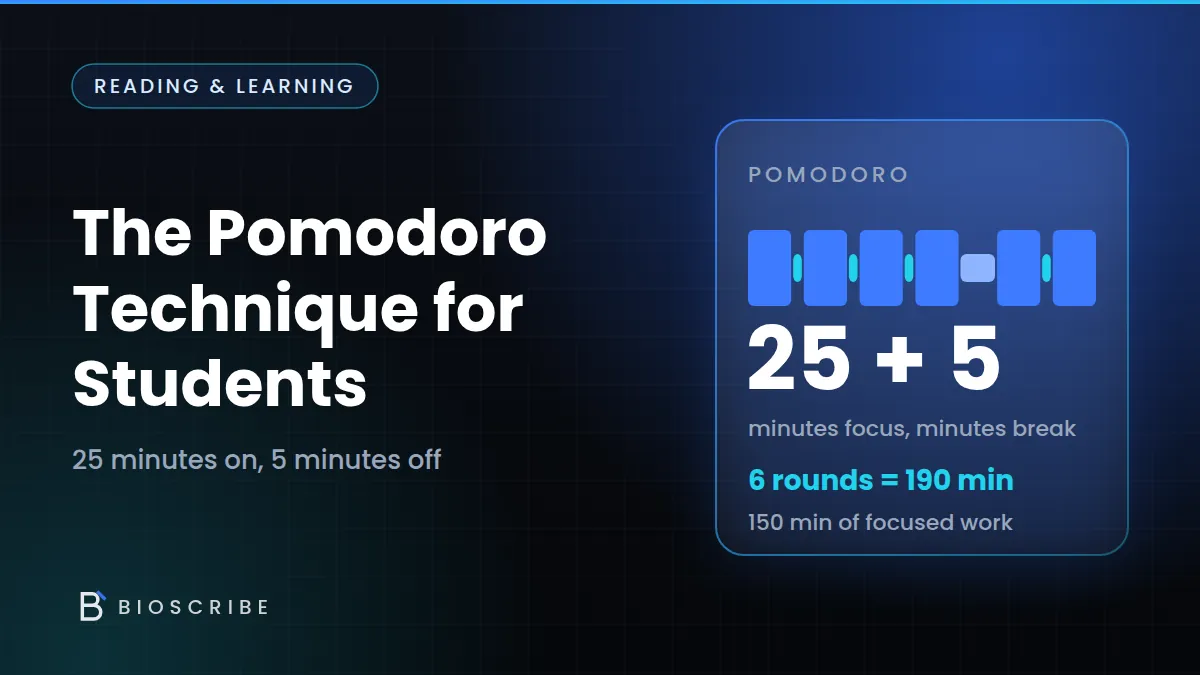
Suppose you plan six pomodoros. The focused work is 6 × 25 = 150 minutes. The breaks are three short breaks of 5 minutes after rounds 1, 2 and 3, a long break of 20 minutes after round 4, and one short break of 5 minutes after round 5. That is 15 + 20 + 5 = 40 minutes of breaks. The whole session lasts 150 + 40 = 190 minutes, which is 3 hours 10 minutes. About 150 ÷ 190 = 79% of the clock time is focused work.

Planning Your Work in Pomodoros
The technique is most useful when you plan in pomodoros, not hours. Estimate each task in rounds, rounding up. A chapter of 24 pages at 2.8 minutes a page takes about 67 minutes of reading, which is 67.2 ÷ 25 = 2.7, so 3 pomodoros. Twenty practice questions at 3 minutes each is 60 minutes, or 2.4, so also 3 pomodoros. Our guide on calculating study time per chapter explains how to get those estimates. If a task takes longer than planned, you learn how to estimate better.
Why It Helps Many Students
Many students find that starting is the hardest part, and a 25-minute commitment is easier to begin than a vague three hours. The timer also creates a small deadline, which can reduce drifting. The regular breaks give you a moment to stretch, drink water and rest your eyes. The technique does not need any equipment beyond a timer, and you can use it for reading, practice questions, writing and revision. Results differ between people, so treat it as an experiment.
Handling Interruptions and Distractions
Distractions will happen. Keep a sheet of paper beside you, and when a thought like “I must check that message” appears, write it down and return to the task. After the round, deal with the list. If you are interrupted by something that cannot wait, many people restart the round afterwards, so that a pomodoro always means 25 minutes of focus. Put your phone out of sight during rounds, since checking it is the most common way a round is lost.
What to Do in the Breaks
Use the short breaks to move, not to scroll. Stand up, stretch, get water or look out of a window. A break spent on a screen often feels like rest but stretches beyond 5 minutes and pulls your attention elsewhere. Use the long break for a proper meal or a short walk. If you notice that you need longer to settle back after a break, shorten the screen time and keep the break the same length.
Adapting the Lengths
The 25 and 5 are a starting point, not a rule. Some tasks need longer to get into, such as writing an essay or working through a hard problem. You could use 40 minutes of work with a 10-minute break, or 50 and 10. For simple review tasks you might use shorter rounds. Try a few patterns for a week each, and keep the one where you finish rounds without struggling and still feel able to start the next.
Using Pomodoros Across the Day
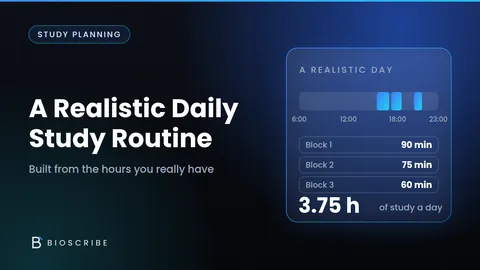
Count the rounds you complete each day. If you aim to study three hours a day, that is 180 ÷ 25 = 7.2, so about 7 focused rounds, plus the breaks. Our guide on how to create a realistic daily study routine shows how to fit the rounds into your day, and our guide on how many hours a student should study per day helps you choose the target. A simple tally of completed rounds is a better measure of effort than time spent at a desk.
When It Works Less Well
The technique suits tasks you can pause and resume. It works less well when stopping at 25 minutes would break deep concentration, such as a long lab experiment or a timed exam practice. In those cases, use longer blocks or no timer. It can also feel rigid if you strictly follow it every day. Use it when it helps and set it aside when it gets in the way.
Pomodoro for Reading and Notes
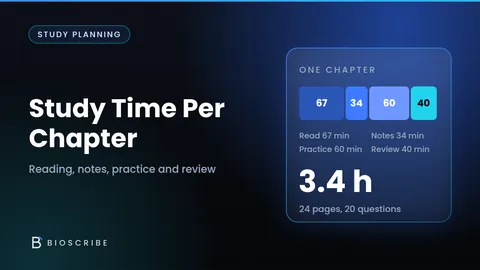
For the 24-page chapter, the estimate was 67 minutes of reading, 34 of notes, 60 of practice and 40 of review. In rounds, that is 3 for reading, 2 for notes (33.6 ÷ 25 = 1.3, rounded up), 3 for practice and 2 for review, a total of 10 rounds. Ten rounds is 250 minutes of focus, more than the 201-minute estimate, because each task is rounded up. To avoid waste, combine small tasks into one round, such as notes and the first questions.
A Sample Evening
Here is the six-round session starting at 6:00 pm. Round 1 runs 6:00 to 6:25 and round 2 runs 6:30 to 6:55. Round 3 runs 7:00 to 7:25 and round 4 runs 7:30 to 7:55. Then a 20-minute long break takes you to 8:15, and round 5 runs 8:15 to 8:40. A 5-minute break leads to round 6 at 8:45 to 9:10. The session ends at 9:10 pm, exactly 190 minutes after it began. Write the task for each round beforehand, so that the break is the only decision you make.
Common Mistakes to Avoid
- Working on several tasks in one round. Choose one.
- Skipping breaks. They are part of the method.
- Spending breaks on a phone. Move instead.
- Using vague tasks. Name what you will finish in the round.
- Never adjusting the lengths. Find the pattern that suits you.
Check Your Work With BioScribe
BioScribe’s Study Time Calculator helps you turn the days you have into study hours. Use it to see how many Pomodoro rounds your time allows.
Frequently Asked Questions
How long is a Pomodoro?
The standard round is 25 minutes of focused work followed by a 5-minute break. You can adjust the lengths if another pattern works better.
How many Pomodoros should I do in a day?
It depends on your target. Three hours of focused study is about 7 rounds of 25 minutes, plus the breaks.
What if I am in the middle of a task when the timer rings?
Stop and take the break, then continue. Stopping at a natural point makes it easier to restart.
Does the Pomodoro technique work for reading?
Yes, if you can pause. Choose a chunk of pages for each round, and write one or two lines of notes in the break.
Can I use 50-minute rounds instead?
Yes. Some students prefer 50 minutes of work with a 10-minute break for demanding tasks. Try different lengths and keep the one that works.
Conclusion
The Pomodoro technique splits study into 25-minute focus rounds with 5-minute breaks and a longer break after four rounds. It makes starting easier, gives you a way to estimate work and keeps breaks regular. Plan tasks in rounds, protect the breaks and adjust the lengths to suit you. For help dividing your hours between subjects, see our guide on dividing 4 hours of study time between subjects.