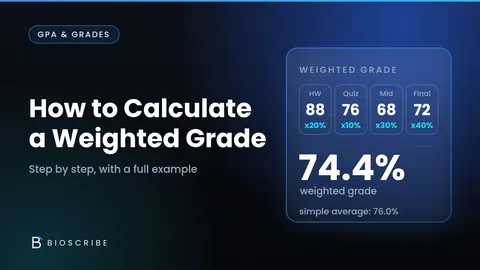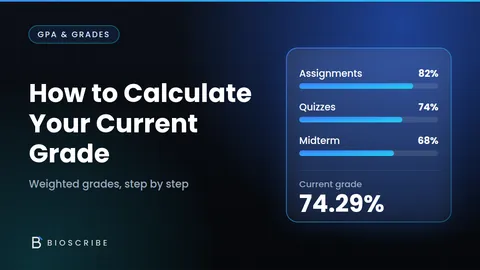
Short answer: a weighted grade is a grade where each component, such as coursework or an exam, counts for a set share of the total. A component worth 40% affects your final result four times as much as one worth 10%.
What a Weighted Grade Is
In a weighted grading system, the parts of a course are not worth the same amount. Your syllabus gives each part a weight, which is its share of the final grade. A final exam might count for 40%, a midterm for 30%, assignments for 20% and quizzes for 10%. Your final grade is then built by multiplying each score by its weight and adding the results. The weights tell you how much each part matters, and that changes how you should read your own scores.
A Simple Example: Same Scores, Different Result
The easiest way to see weighting is to give two students the same two scores in opposite places. Coursework counts for 30% and the exam counts for 70%. Student A scores 90 on coursework and 60 on the exam. Student B scores 60 on coursework and 90 on the exam.
- Student A: (90 × 0.30) + (60 × 0.70) = 27 + 42 = 69.
- Student B: (60 × 0.30) + (90 × 0.70) = 18 + 63 = 81.
A simple average gives both students 75. The weights separate them by 12 points, because the exam carries more than twice the weight of the coursework. When you see a result that surprises you, check the weights before anything else.

How Much Each Component Matters
A quick way to compare components is to ask what a 10-point change in one of them does to your final grade. Multiply 10 by the weight:
| Component | Weight | Effect of a 10-point change |
|---|---|---|
| Assignments | 20% | 2.0 points |
| Quizzes | 10% | 1.0 point |
| Midterm | 30% | 3.0 points |
| Final exam | 40% | 4.0 points |
Ten more marks in the final exam is worth four points on your course grade, while ten more in the quizzes is worth one. Neither is unimportant, but the table shows which improvements are worth the most.
Reading the Weights in Your Syllabus
Weights are usually listed by category, with a note about how many items sit inside each. Five quizzes at 2% each make a 10% category. Each quiz therefore has a weight of 0.02, and skipping one costs at most 2 points of your final grade. If your syllabus lists only categories, ask how items inside a category are combined, because the answer changes your calculation. If it gives no weights at all, ask your instructor instead of guessing. The method itself is covered in our guide on how to calculate a weighted grade.
Why Instructors Use Weights
Common reasons include rewarding the work that best shows what you have learned, spreading a grade across several assessments so that one bad day does not decide everything, and counting skills that develop late in the course more heavily. Weights also let an instructor give practice work a small share so that students can try things without much risk. The details vary by subject and institution, and the syllabus is the only reliable source for yours.
Weighted Grade vs Weighted GPA
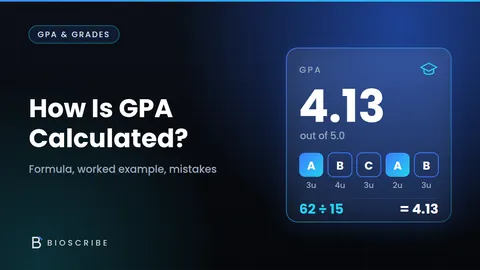
These terms sound alike but describe different things. A weighted grade combines the scores inside one course. A weighted GPA, where an institution uses one, gives extra points to harder courses when it calculates your GPA across courses. For example, a course might count for a little more than the standard scale would give. Do not mix them up. If your institution uses credit units instead, see our guide on how GPA is calculated.
Using Weights to Plan Your Effort
Weights can help you decide where effort pays off. Suppose a course has ten weekly quizzes worth 1% each, a midterm worth 30% and a final worth 40%. Skipping three quizzes costs at most 3 points of your final grade, while a poor result in the final could cost far more. That does not mean the small items are optional. Together they are 10% of the grade, and they often prepare you for the larger assessments. Use the weights to order your priorities, not to ignore anything.
What Weights Do Not Tell You
Weights say how much a component counts, not how hard it is or how long it will take. A 10% assignment may need more time than a 20% test. Some courses also add rules that sit outside the weights, such as a minimum mark you must achieve in the exam. Read your syllabus for these conditions. A good weighted grade can still fail a course if it does not meet a separate requirement.
How Weights Affect Risk
Weights also decide how much one bad result can hurt. Suppose a course has coursework worth 30% and a single exam worth 70%. If you score 90 on coursework and 40 on the exam, your grade is (0.30 × 90) + (0.70 × 40) = 27 + 28 = 55. If the same course were split into three equal assessments and you scored 90, 90 and 40, your grade would be 73.33. The same three performances give very different outcomes, because one heavy exam leaves little room to recover. Courses with spread-out weights are more forgiving of a single bad day.
Three Questions to Ask About Any Course
When you start a course, ask three things. What are the weights, and which components do they cover? Which components have been graded so far? Which upcoming component carries the most weight? The answers tell you where your grade is still open and where it is mostly settled, and they stop you from putting your effort in the wrong place.
Why a Gradebook May Show a Different Number
If a learning platform shows a different grade from yours, look at its settings. Some gradebooks show a running total of points, some use equal weights unless the instructor sets them, and some count ungraded work as zero. Check whether your platform is applying the weights and which assignments it includes. If the number still does not match, ask your instructor how it is calculated, because the official record is the one that counts.
Common Mistakes to Avoid
- Treating all components as equal. The weights decide how much each counts.
- Judging a grade from a simple average. It ignores the weights.
- Assuming a small component does not matter. Small items add up.
- Confusing weighted grades with weighted GPA. They describe different calculations.
- Ignoring separate pass requirements. Check for minimum marks in individual components.
Check Your Work With BioScribe
BioScribe’s Grade Calculator calculates weighted grades and finds the score you need on your final exam. Enter your own components and weights to see how each one affects your result.
Frequently Asked Questions
Is a weighted grade the same as a weighted average?
They use the same idea. A weighted grade is a weighted average applied to the scores in a course, with each score counting by its weight.
Do heavier components always matter more?
For your final percentage, yes, because each point in a heavier component moves your grade more. A small component still counts, though, and some courses require a minimum in each component.
Can weights change during a course?
It is uncommon, but it can happen if an assessment is cancelled or replaced. Ask for any change in writing and recalculate with the new weights.
Is a weighted GPA the same as a weighted grade?
No. A weighted grade combines scores within one course. A weighted GPA, where used, gives extra points to harder courses when your GPA is calculated.
What if my syllabus gives no weights?
Ask your instructor. If marks are simply pooled, use total points earned divided by total points possible, and do not guess weights.
Conclusion
A weighted grade counts each part of a course according to its share of the total. The same scores can produce different grades when the weights differ, and a 10-point change matters most in the heaviest component. Read your weights early, plan around them, and use them to check any grade that looks wrong.