Short answer: percentage change = (new − old) ÷ old × 100. A positive result is an increase and a negative result is a decrease. Always divide by the old value.
What Percentage Change Measures
Percentage change tells you how much a value has gone up or down compared with where it started. It is the standard way to describe an improvement in a test score, a rise in a price or a fall in your weekly study hours. Because it is measured against the starting value, the same absolute change can be a large percentage when the start is small and a small percentage when the start is large. That is why a rise of 10 marks means more on a score of 40 than on a score of 90.
The Formula
A positive result is an increase and a negative result is a decrease. The old value is the starting point, and it is always the number you divide by. Mixing this up is the most common error, so check it before you start.
Step-by-Step: A Percentage Increase
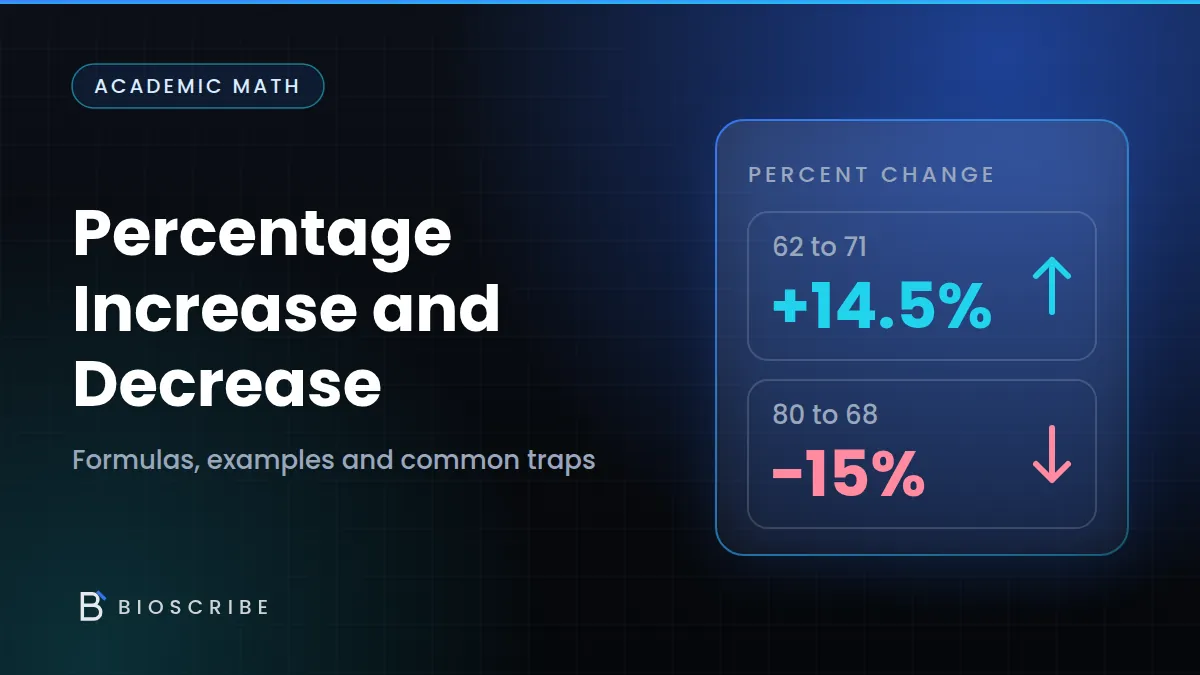
Your score on a test goes from 62 to 71.
- Find the change: 71 − 62 = 9.
- Divide by the old value: 9 ÷ 62 = 0.1452.
- Multiply by 100: 0.1452 × 100 = 14.52% increase.
Step-by-Step: A Percentage Decrease
Your quiz average falls from 80 to 68.
- Find the change: 68 − 80 = −12.
- Divide by the old value: −12 ÷ 80 = −0.15.
- Multiply by 100: −0.15 × 100 = −15%, a 15% decrease.
Quick Reference Table
| Old | New | Change | Percentage change |
|---|---|---|---|
| 40 | 50 | +10 | +25% |
| 50 | 40 | −10 | −20% |
| 200 | 230 | +30 | +15% |
| 230 | 200 | −30 | −13.04% |
Look at the first two rows. The same 10 units give +25% in one direction and −20% in the other, because each is measured against a different starting value.
Why Increases and Decreases Are Not Symmetric
A 20% increase followed by a 20% decrease does not return you to the start. Begin at 100. A 20% rise takes it to 120. A 20% fall from 120 removes 24, leaving 96. The second percentage is applied to a larger number. To undo a 20% rise you need a fall of 20 ÷ 120 = 16.67%. To undo a 20% fall, from 100 to 80, you need a rise of 20 ÷ 80 = 25%. The same applies to your own results: a quiz average that drops by 20% needs a rise of more than 20% to recover.

Applying a Percentage Change to a Number
Often you know the percentage and need the new value. Multiply the old value by (1 + p) for an increase or (1 − p) for a decrease, with p written as a decimal. If you plan to raise your weekly study hours from 12 by 25%, the new total is 12 × 1.25 = 15 hours. A textbook price of 12,000 that rises 15% becomes 12,000 × 1.15 = 13,800, and a 15% drop would give 12,000 × 0.85 = 10,200. A mark of 65 raised by 8% is 65 × 1.08 = 70.2.
Two Changes in a Row
Successive changes multiply, they do not add. A 10% rise followed by another 10% rise gives 1.10 × 1.10 = 1.21, which is a 21% total increase. A 10% rise followed by a 10% fall gives 1.10 × 0.90 = 0.99, which is a 1% decrease overall. When a report describes several changes, convert each one to a multiplier and multiply them together.
Percentage Points vs Percent Change
Be careful when the values are already percentages. If your attendance rises from 60% to 66%, that is 6 percentage points, but the percentage change is 6 ÷ 60 = 10%. Both are correct, and they answer different questions. Always say which one you mean. Our guide on percentage difference vs percentage change goes into the related measures.
When the Starting Value Is Zero
You cannot calculate a percentage change from zero, because the formula divides by the old value. If a number goes from 0 to 5, describe it as an increase of 5, or say it rose from none. A very small starting value also produces very large percentages, which can mislead, so show the raw numbers alongside the percentage whenever you can.
Where You Will Use It as a Student
You will meet percentage change when you compare test scores across a term, when a report says attendance rose by 12%, and when you check a change in a fee or a book price. It also helps with planning, such as raising your study time by a set percentage. For finding what share one number is of another, rather than how much it changed, see our guide on what percentage one number is of another.
A Worked Example: Weekly Study Time
Suppose you study 8 hours in week 1, 10 in week 2, 9 in week 3 and 12 in week 4. The week-to-week changes are 2 ÷ 8 = +25%, −1 ÷ 10 = −10% and 3 ÷ 9 = +33.33%. The overall change from week 1 to week 4 is 4 ÷ 8 = +50%. If you add the three weekly percentages you get 48.33%, which is not 50%. They do not add because each is measured against a different base. Multiply the multipliers instead: 1.25 × 0.90 × 1.3333 = 1.50, which is the correct 50% rise.
Working Backwards: Finding the Old Value
Sometimes you know the new value and the percentage change and need the starting value. Divide by the multiplier. If a price is 138 after a 15% increase, the old price was 138 ÷ 1.15 = 120. If a score is 96 after a 20% decrease, the original was 96 ÷ 0.80 = 120. A common mistake is to take 15% off the new value, which uses the wrong base and gives the wrong answer.
How to Read Percentage Change in Reports
When a report says that something rose by a percentage, ask three questions. What was the starting value, and over what period? How big is the raw change? Is the starting value small? A rise from 2 to 6 is a 200% increase, but it is only 4 more, and the percentage sounds far more dramatic than the number. Reading both together gives a fair picture, and it protects you from headlines that rely on a very small base.
Common Mistakes to Avoid
- Dividing by the new value. Always divide by the old value.
- Assuming a rise and fall of the same percentage cancel. They do not.
- Adding successive percentages. Multiply the multipliers instead.
- Confusing percentage points with percent. State which you mean.
- Calculating from zero. The formula is undefined there.
- Rounding too early. Round only the final answer.
Check Your Work With BioScribe
BioScribe’s Percentage Calculator handles percentages, percentage changes and score percentages. Enter your old and new values to check the 14.52% example above, then try your own numbers.
Frequently Asked Questions
Can a percentage decrease be more than 100%?
No. A decrease of 100% takes a value to zero, so it cannot go further. An increase can be any size.
Why is the decrease back to the start a different percentage?
Each is measured against a different starting value. A rise from 100 to 120 is 20%, while the fall from 120 back to 100 is 16.67%.
Do I divide by the old value or the new value?
Divide by the old value, which is the starting point of the change.
How do I calculate the percentage change in my grade?
Use the earlier grade as the old value and the later grade as the new value. If both are percentages, say whether you mean percentage points or percent change.
What does a negative percentage change mean?
It means the value fell. The size of the number tells you how much it fell, relative to the starting value.
Conclusion
Subtract the old value from the new value, divide by the old value, and multiply by 100. The sign tells you the direction. Remember that increases and decreases are measured against different bases, that successive changes multiply, and that percentage points are not the same as percent. With those four ideas you can read almost any change in a score, price or percentage correctly.