Short answer: percentage change = (new − old) ÷ old × 100 and has a direction. Percentage difference = |A − B| ÷ ((A + B) ÷ 2) × 100 and has no direction.
Two Measures That Sound the Same
Both measures describe how far apart two numbers are, and both are written as percentages. The difference is in the question they answer. Percentage change asks how much a value has moved from a starting point, so it has a direction and a base. Percentage difference asks how far apart two values are when neither is the starting point, so it has no direction. Using the wrong one gives an answer that is correct for another question.
Percentage Change
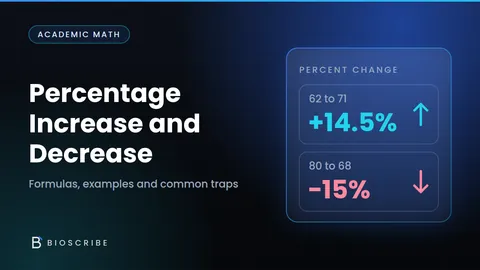
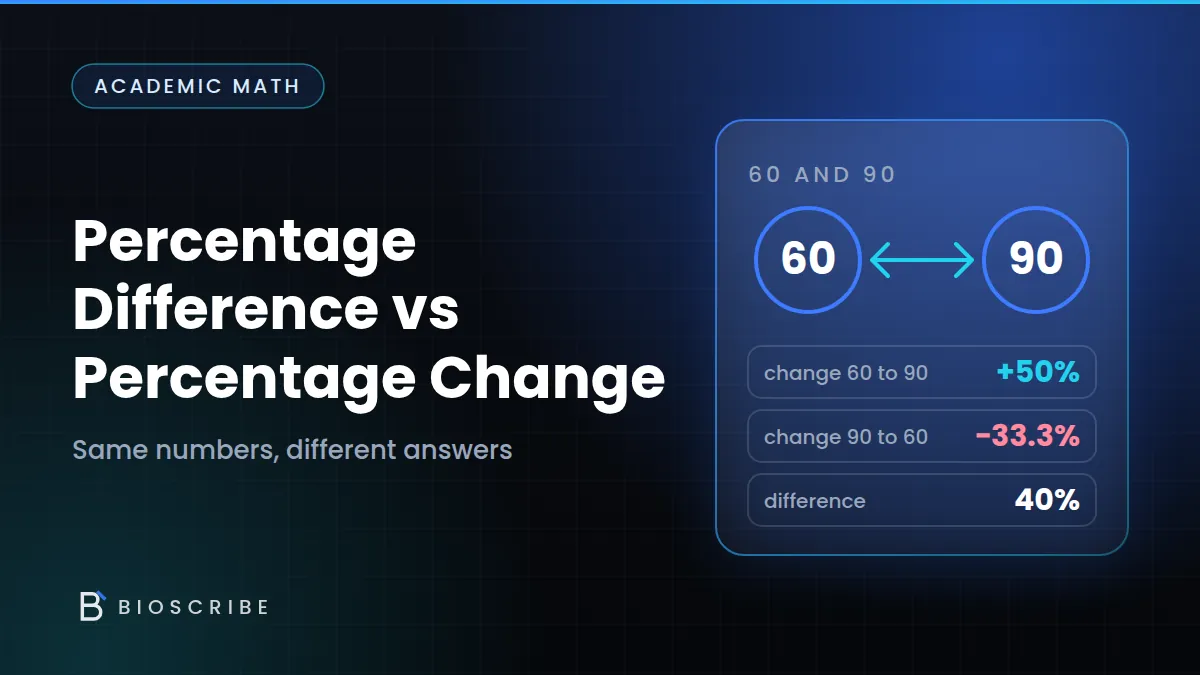
You divide by the old value, so the result depends on which number is the starting point. A score that moves from 60 to 90 has changed by (90 − 60) ÷ 60 = 0.50, which is a 50% increase. A score that moves from 90 to 60 has changed by (60 − 90) ÷ 90 = −0.3333, which is a 33.33% decrease. Our guide to percentage increase and decrease covers this in detail.
Percentage Difference
Percentage difference divides the gap by the average of the two values, so neither number is treated as the starting point. For 60 and 90, the gap is 30 and the average is (60 + 90) ÷ 2 = 75. The percentage difference is 30 ÷ 75 = 0.40, which is 40%. Swap the numbers and you get the same answer, because the formula is symmetric.
Same Numbers, Three Answers
| Measure | Working | Result |
|---|---|---|
| Percentage change, 60 to 90 | 30 ÷ 60 | +50% |
| Percentage change, 90 to 60 | −30 ÷ 90 | −33.33% |
| Percentage difference | 30 ÷ 75 | 40% |
Each answer is correct for its question. They differ because they divide by 60, by 90 and by 75. If someone reports only one of them, make sure you know which.

When to Use Each
Use percentage change when there is a before and an after, such as your score last term and this term, a price last year and this year, or your attendance last month and this month. Use percentage difference when two values are being compared as equals, such as the average scores of two classes, or two measurements of the same thing with no obvious reference. If one value is a clear baseline, such as a target or a standard, treat it as the old value and use percentage change.
A Student Example: Two Scores
Two students score 72 and 84 on the same test. The gap is 12. The percentage difference is 12 ÷ 78 = 15.38%, using the average of 72 and 84, which is 78. Now suppose the first student improves to 84 next time. That is a percentage change of 12 ÷ 72 = 16.67%. You can also say that 84 is 16.67% higher than 72, while 72 is 12 ÷ 84 = 14.29% lower than 84. Four different percentages come from the same two numbers, and each is right for its own wording.
Percentage Points Are Different Again
When the values are themselves percentages, there is a third measure, the percentage point gap. If attendance rises from 80% to 92%, the gap is 12 percentage points. The percentage change is 12 ÷ 80 = 15%, and the percentage difference is 12 ÷ 86 = 13.95%. Write which measure you are using, because a headline that says attendance rose by 12 is describing something quite different from one that says it rose by 15%.
Why Percentage Difference Uses the Average
If you divided by the smaller number, you would get 50% for 60 and 90, and if you divided by the larger, 33.33%. Neither is neutral. The average sits between them, so the answer does not depend on the order of the numbers. That symmetry is the point of the measure. It is useful when you want to describe how far apart two values are without implying that one is the original.
When the Words Mean Something Else
Terminology is not always consistent. Some textbooks and websites use “percentage difference” to mean what others call percentage change, and a few use it for a comparison with a reference value. Check the formula in your own course and use it. If a question gives no formula, say which one you used and show the working, so that your answer is clear even if the reader expected another.
Checking Direction and Sign
A percentage change should be positive when the new value is larger and negative when it is smaller. If your sign is wrong, you probably subtracted in the wrong order. A percentage difference is always positive, because it uses the absolute gap. Both are worth a quick sense check: if the numbers are close together, the percentage should be small, and if one is double the other, the percentage change from the smaller one should be 100%.
A Worked Example With Class Averages
Class A has an average of 68 and Class B has an average of 74, a gap of 6. If you are simply comparing two classes, use percentage difference: 6 ÷ 71 = 8.45%, where 71 is the average of 68 and 74. If Class A was last year’s class and Class B is this year’s, there is a before and an after, so use percentage change: 6 ÷ 68 = 8.82%. The two answers are close here because the values are close, but the wording of the question decides which is right.
A Quick Decision Guide
Ask four questions. Is there a before and an after? If so, use percentage change. Is one value a reference, such as a target or a standard? Use percentage change against it. Are you comparing two values as equals, with no starting point? Use percentage difference. Do you need to say whether the value rose or fell? Only percentage change has a direction. If the answer to every question is no, state clearly what you calculated and show the formula, so the reader can interpret it.
Common Mistakes to Avoid
- Using percentage difference when there is a before and after. Use percentage change.
- Dividing by the wrong number. Percentage change uses the old value, and difference uses the average.
- Treating percentage points as percent. They are different measures.
- Expecting reversible answers for change. A rise and the same fall are different percentages.
- Not saying which measure you used. State the formula or the wording.
Check Your Work With BioScribe
BioScribe’s Percentage Calculator handles percentages, percentage changes and score percentages. Enter your own pair of numbers to compare the change and the difference.
Frequently Asked Questions
Which should I use to compare two groups?
Use percentage difference when neither group is the baseline. If one is a clear reference, use percentage change measured against it.
Why do the two methods give different answers?
They divide by different values. Percentage change divides by the starting value, while percentage difference divides by the average of the two.
Is percentage difference ever negative?
No. It uses the absolute gap, so it is always positive and has no direction.
Does my textbook define percentage difference differently?
Some do. Always check the formula given in your course, because the same term can describe different calculations.
How are percentage points related?
Percentage points are the raw gap between two percentages. A rise from 80% to 92% is 12 points, but a 15% increase.
Conclusion
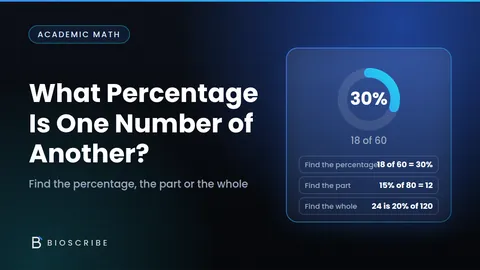
Use percentage change when one value is the starting point, and use percentage difference when two values are being compared as equals. For 60 and 90 you get +50%, −33.33% or 40% depending on the question. Say which measure you mean, show the formula, and keep percentage points separate. For the related idea of finding a share of a total, see our guide on what percentage one number is of another.