Short answer: percentage = (marks you scored ÷ total marks available) × 100. Divide your score by the maximum score, then multiply by 100.
The Exam Percentage Formula
Marks obtained is what you scored after any deductions. Total marks is the maximum possible, the number the paper is marked out of. It is not the pass mark, which is a common mix-up.
Step-by-Step Example
You score 68 out of 80 in a test.
- Divide: 68 ÷ 80 = 0.85.
- Multiply by 100: 0.85 × 100 = 85.
- Result: your score is 85%.
The same steps work for any total. Here are a few more so you can check your own working.
| Score | Working | Percentage |
|---|---|---|
| 45 out of 60 | 45 ÷ 60 = 0.75 | 75% |
| 33 out of 50 | 33 ÷ 50 = 0.66 | 66% |
| 72 out of 90 | 72 ÷ 90 = 0.80 | 80% |
| 27 out of 40 | 27 ÷ 40 = 0.675 | 67.5% |
| 18 out of 30 | 18 ÷ 30 = 0.60 | 60% |
Keep the decimal when a grade boundary is close. A result of 67.5% and one of 68% can fall on different sides of a boundary.

Combining Several Papers or Sections
Say Paper 1 gives you 54 out of 70 and Paper 2 gives you 41 out of 60. Add the marks and the totals separately: (54 + 41) ÷ (70 + 60) = 95 ÷ 130 = 0.7308, or 73.08%.
It is tempting to work out each percentage and average them. Paper 1 is 77.14% and Paper 2 is 68.33%, and their average is 72.74%. The answer differs because the papers have different totals, so the larger paper should count for more. Averaging percentages is only correct when your institution says each paper carries equal weight regardless of its total marks.
When Components Have Different Weights
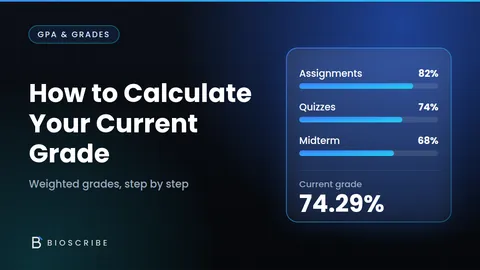
Many courses combine coursework and an exam with set weights. Convert each part to a percentage first, then apply the weights. If coursework is worth 30% and the exam 70%:
- Coursework: 36 out of 50 = 72%.
- Exam: 58 out of 100 = 58%.
- Final: (72 × 0.30) + (58 × 0.70) = 21.6 + 40.6 = 62.2%.
Notice that a strong coursework score did not rescue the result, because the exam carries more weight.
Working Backwards: How Many Marks Do You Need?
To reach 70% on a paper marked out of 120, you need 0.70 × 120 = 84 marks. To reach 65% on a 40-mark test, you need 0.65 × 40 = 26 marks. You can also convert a percentage to a different total: 68% of a 50-mark test is 0.68 × 50 = 34 marks.
Percentage Points vs Percent Change
If your result moves from 62% to 71%, you have improved by 9 percentage points. As a percent change, the improvement is 9 ÷ 62 = 0.145, about 14.5%. Both are correct, but they answer different questions, so say which one you mean.
Common Mistakes to Avoid
- Dividing by the pass mark. Always divide by the total marks available.
- Forgetting to multiply by 100. 0.85 is the decimal. 85% is the percentage.
- Averaging percentages across papers with different totals. Add the marks and the totals instead, unless the papers are equally weighted.
- Rounding too early. Round only your final answer.
- Using the raw score when marks are deducted. If wrong answers lose marks, use the final marked score.
- Mixing up percentage points and percent change. A rise from 62% to 71% is 9 points, not 9%.
Check Your Work With BioScribe
BioScribe’s Percentage Calculator handles percentages, percentage changes and score percentages, so you can check your working in seconds. If your result depends on weighted parts, the Grade Calculator works out weighted grades and the score you need on a final exam.
Frequently Asked Questions
Is a percentage the same as a grade?
No. A percentage is your score out of 100. A grade is the label, such as A or B, that your institution assigns to a range of percentages. Use your institution’s grading table to convert one to the other.
How do I find the percentage if the exam is not out of 100?
The formula works for any total. For 17 out of 25, divide 17 by 25 to get 0.68, then multiply by 100 to get 68%.
How many decimal places should I give?
One or two is usual. Keep the full value while you calculate and round the final answer, following any rounding rule your institution publishes.
Can I convert a percentage back into marks?
Yes. Turn the percentage into a decimal and multiply by the total. For example, 68% of a 50-mark test is 0.68 × 50 = 34 marks.
Conclusion
Divide your score by the total and multiply by 100. For several papers, add marks and totals first. For weighted parts, convert each part to a percentage, then apply the weights. With those three habits you can check any result yourself and know exactly what score a target needs.