Attendance Percentage Explained: How to Calculate, Improve and Plan Your Attendance
Attendance percentages can affect exam eligibility or course progress, yet the arithmetic behind them is easy to get wrong. The calculator above covers six situations. This guide explains the formulas, works through examples and points out where institutions differ.
What Is Attendance Percentage?
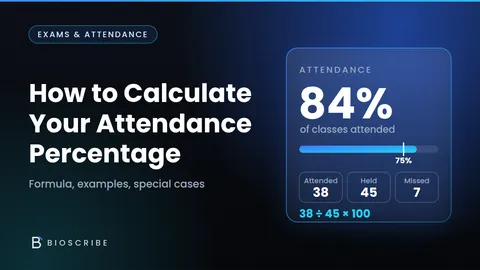
Attendance percentage shows the share of scheduled classes you attended. Schools use it as a simple, consistent measure of participation, and some set minimum levels for exams or course completion. Two numbers determine it: classes attended and classes missed, which together make the total.
Attendance Percentage = Classes Attended ÷ Total Classes × 100
If you attended 42 classes and missed 6, the total is 48 and your attendance is 42 ÷ 48 × 100 = 87.5%.
How to Calculate Attendance Percentage
Add attended and missed classes to get the total, divide attended by the total, then multiply by 100. For 36 attended and 4 missed: total = 36 + 4 = 40, and 36 ÷ 40 × 100 = 90%. The total must include missed classes. Dividing by the number missed, or by the attended count alone, gives the wrong answer. Since this is a percentage calculation, the Percentage Calculator can double-check the division. Our guide How to Calculate Your Attendance Percentage goes through it step by step.
How to Calculate Attendance From Total Classes
Classes Missed = Total Classes − Classes Attended
Sometimes you know the total held rather than the number missed. With 40 classes held and 34 attended, missed = 40 − 34 = 6 and attendance = 34 ÷ 40 × 100 = 85%. With 50 held and 42 attended, missed = 8 and attendance = 42 ÷ 50 × 100 = 84%. Always check that attended is not larger than the total, because that would mean a typing mistake or a miscount.
How Many Classes Can You Miss and Still Have 75% Attendance?
This is the question students ask most. Let A be classes attended, M classes missed so far, x the additional classes you miss, and T the target as a decimal. Attendance stays at or above the target when:
A ÷ (A + M + x) ≥ T
Solving for x: x ≤ A ÷ T − (A + M)
Take 42 attended and 6 missed with a 75% target. x ≤ 42 ÷ 0.75 − 48 = 56 − 48 = 8. So you can miss 8 more classes: 42 ÷ 56 is exactly 75%, and a ninth miss would drop you to 42 ÷ 57 = 73.68%. The answer must be a whole number, so always round down.
The answer depends heavily on how many classes have already been held. A student with 90 attended and 10 missed (90%) can miss up to 90 ÷ 0.75 − 100 = 20 more. A student with 9 attended and 1 missed has the same 90%, but can miss only 9 ÷ 0.75 − 10 = 2. A student sitting exactly on 75%, such as 30 attended and 10 missed, has no spare absences: one more miss gives 30 ÷ 41 = 73.17%. Use Classes I Can Miss mode for your own numbers, or read How Many Classes Can You Miss and Still Have 75% Attendance?
How Many Classes Do You Need to Attend to Reach 75%?
If you are below your target, solve for the number of future classes x that you must attend in a row:
(A + x) ÷ (A + M + x) ≥ T
Solving for x: x ≥ (T(A + M) − A) ÷ (1 − T)
Example with 60 attended, 20 missed and an 85% target: x ≥ (0.85 × 80 − 60) ÷ 0.15 = 8 ÷ 0.15 = 53.33. You cannot attend part of a class, so round up to 54. Check it: 114 ÷ 134 = 85.07%, while 53 classes give 113 ÷ 133 = 84.96%, just short. The article How Many Classes Do You Need to Attend to Reach 75%? covers more cases.
How Does Missing One Class Affect Attendance?
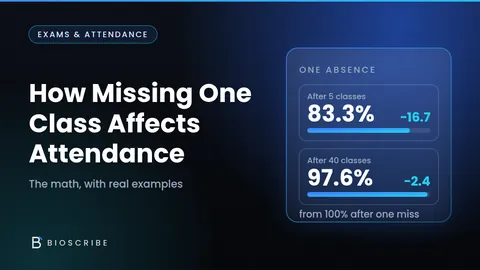
One absence does not always cost the same amount, because the total it is divided into keeps growing. Missing 1 of the first 5 classes leaves 4 ÷ 5 = 80%. Missing 1 of the first 100 leaves 99 ÷ 100 = 99%. The same single absence moved attendance by 20 points in one case and 1 point in the other. That is why early absences feel so costly: there are few classes in the denominator to absorb them. How Does Missing One Class Affect Your Attendance Percentage? explains this further.
Attendance Percentage and Consecutive Classes
Attendance is cumulative, so past absences stay in the total. A student with 30 attended and 20 missed is on 60%. To reach 75% they need x ≥ (0.75 × 50 − 30) ÷ 0.25 = 30 consecutive classes: 60 ÷ 80 = 75%. Attending one or two classes barely moves the figure, because each one adds only a small fraction to a large total.
Attendance Recovery: Can You Raise Your Attendance Quickly?
Recovery gets slower as more classes are held. Someone on 60% after 100 classes (60 attended) needs 60 consecutive classes to reach 75%, double the 30 needed at 50 classes. Attending 2 classes in that position only lifts the figure from 60% to 62 ÷ 102 = 60.78%. Recovery is possible, but it takes sustained attendance, so check early and often. Whether enough classes remain to recover depends on the timetable, which the Academic Date Calculator can help you count.
How to Calculate Future or Projected Attendance
Projected Attendance = (Current Attended + Future Attended) ÷ (Current Total + Future Classes) × 100
With 40 attended and 5 missed, and 10 upcoming classes of which you expect to attend 9: (40 + 9) ÷ (45 + 10) × 100 = 49 ÷ 55 × 100 = 89.09%. Projecting lets you test plans, such as a trip or a busy week, before you commit. The Future Projection mode shows projected attended, missed and total classes at once.
Attendance Requirements and Minimum Thresholds
Targets such as 70%, 75%, 80%, 85% and 90% are often mentioned, but none of them is universally required. Requirements vary by institution, course, department, country, type of assessment and local policy, and exceptions or approved absences may apply. Treat any number you read online, including those in our examples, as an illustration. Check your official academic handbook, course outline or attendance policy for the figure that applies to you.
Attendance vs Absence Percentage
Absence Percentage = Classes Missed ÷ Total Classes × 100
When both use the same total, attendance and absence add up to 100%. With 42 attended and 6 missed out of 48, attendance is 87.5% and absence is 6 ÷ 48 × 100 = 12.5%. That is true only when both are calculated from the same total, so it does not hold if an institution excuses some absences.
Attendance by Lectures, Tutorials or Periods
Institutions count attendance in different ways. Some record lectures, tutorials, practicals, laboratories or clinical sessions separately, and others count individual periods rather than whole classes. A simple class-count calculator treats every session as one equal unit, so confirm how your institution counts before relying on the result.
Common Attendance Calculation Mistakes
- Using missed classes as the denominator: divide by the total, not by the misses.
- Forgetting to include missed classes in the total: total = attended + missed.
- Assuming one absence always costs the same: its effect shrinks as more classes are held.
- Rounding too early: round only the final percentage, and round class counts in the correct direction.
- Treating 75% as “25 classes attended out of 100”: the real total decides what 75% means.
- Confusing attendance with absence percentage: they are complements, not the same number.
- Using the wrong target percentage: confirm the figure in your own policy.
- Ignoring future classes: upcoming sessions change what is possible.
- Assuming all institutions use the same rules: they do not.
- Counting cancelled classes incorrectly: a class that did not take place usually should not be in the total, but check your policy.
Worked Attendance Examples
- Example A: 40 total, 34 attended → 34 ÷ 40 × 100 = 85%.
- Example B: 50 total, 42 attended → 42 ÷ 50 × 100 = 84%.
- Example C (below target): 45 attended, 25 missed is 45 ÷ 70 = 64.29%. For 75%, x ≥ (0.75 × 70 − 45) ÷ 0.25 = 30, and 75 ÷ 100 = 75% confirms it.
- Example D (above target): 80 attended, 10 missed is 88.89%. For 75%, x ≤ 80 ÷ 0.75 − 90 = 16.67, so 16 more misses: 80 ÷ 106 = 75.47%. A seventeenth gives 80 ÷ 107 = 74.77%.
- Example E (projection): 60 attended, 15 missed, 25 upcoming, attend 20 → (60 + 20) ÷ (75 + 25) × 100 = 80%.
How to Maintain Good Attendance
A few habits keep surprises away. Track your attendance regularly instead of estimating, and know your course policy. Record missed classes with dates, and account for holidays and cancelled sessions. Plan around known commitments before the term starts, and check official attendance records when they are available. If a record looks wrong, contact the relevant academic office. Attendance also supports study planning: the Study Schedule Generator can fit revision around your timetable, and Exam Countdown shows how long remains before an assessment. None of this replaces your institution’s own rules, which always take priority.