Short answer: if you miss the next class, your attendance becomes attended ÷ (held + 1) × 100. The fewer classes held so far, the bigger the drop. From 100%, one absence costs about 100 ÷ (held + 1) percentage points.
One Absence Does Not Cost the Same Every Time
Missing a class always lowers your attendance percentage, but by how much depends on how many classes have been held. In the first few weeks, a single absence can knock a large chunk off your percentage. Late in the term it barely registers. Knowing the size of the effect helps you decide when an absence is affordable and when it is risky, and it explains why an early absence can feel so expensive.
The Formula
Points lost = attended ÷ held × 100 − attended ÷ (held + 1) × 100
Missing a class adds 1 to the classes held but nothing to the classes attended. If you start with perfect attendance, the points lost simplify to 100 ÷ (held + 1).
Step-by-Step Example
You have attended 30 of the 40 classes held, which is exactly 75%. You miss the next class.
- Add the class to the total held: 40 + 1 = 41.
- Divide: 30 ÷ 41 = 0.7317, or 73.17%.
- Points lost: 75 − 73.17 = 1.83.
Now compare it with attending that class: 31 ÷ 41 = 75.61%. The class was worth 75.61 − 73.17 = 2.44 points, so missing it cost you more than the 1.83 points you can see, because you also gave up the chance to go up.
One Absence at Different Points in the Term
Here is what one absence does to a student with perfect attendance at different stages:
| Classes held | Attendance after one absence | Points lost |
|---|---|---|
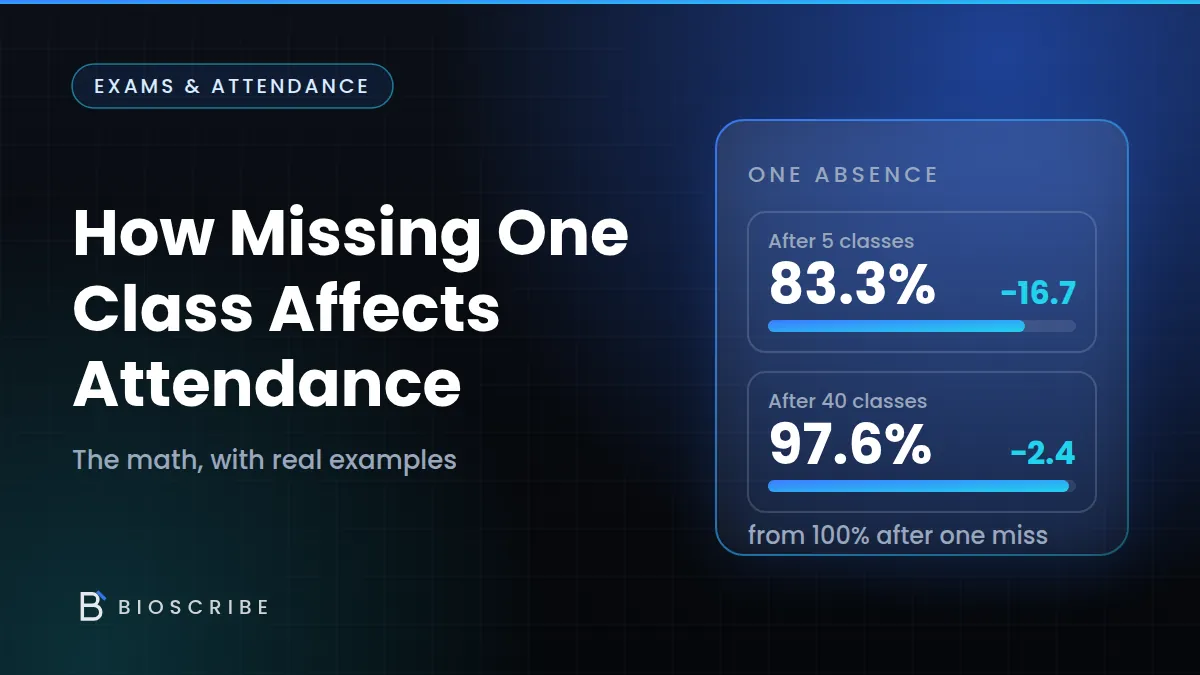
| 5 | 83.3% | 16.7 |
| 10 | 90.9% | 9.1 |
| 20 | 95.2% | 4.8 |
| 40 | 97.6% | 2.4 |
| 60 | 98.4% | 1.6 |
The pattern is simple: the loss shrinks as the denominator grows. After 5 classes one absence costs 16.7 points. After 60 it costs 1.6. An early percentage is therefore fragile, which is no reason to panic, since a low early figure also recovers faster than a low late one.

Why One Absence Is Hard to Undo
Back to the 30 out of 41 record at 73.17%. If you attend the next class, you are at 31 out of 42, which is 73.81%. That is a gain of only 0.64 points. To get back to 75%, use the shortcut from our guide on how many classes you need to attend to reach 75%: 3 × 41 − 4 × 30 = 123 − 120 = 3. After three more classes you have 33 out of 44, exactly 75%. At the 75% line, one absence costs three classes of recovery.
One Absence Against Your Semester Allowance
Another way to see it is as a share of your allowance. If the semester has 40 classes and the requirement is 75%, you can miss 10, so one absence uses 1 ÷ 10 = 10% of your allowance. With 60 classes you can miss 15, and one absence uses 1 ÷ 15 = 6.7%. This view is often more useful than the percentage, and it is the one we use in our guide on how many classes you can miss and still have 75% attendance.
When One Class Counts as Two
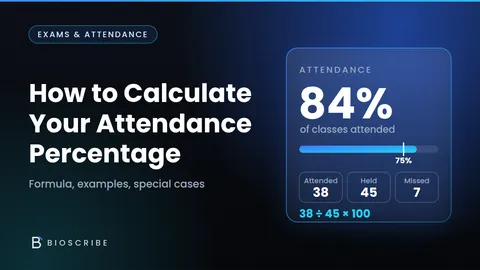
Some institutions count by teaching hours, so a two-hour double session counts as two classes. Missing one of those costs twice as much. Say you have attended 38 of 45 classes, which is 84.44%. Missing a single class leaves you at 38 ÷ 46 = 82.61%. Missing a double session counted as two leaves you at 38 ÷ 47 = 80.85%. Check how your institution counts sessions before you decide that a long lab or workshop is easy to skip.
What to Do After You Miss a Class
Missing one class is not a crisis, and a plan helps. Get the notes or slides within a day or two, while the topic is fresh, and note any task that was set. Check whether your institution lets you document the absence, and keep the document if so. Update your tally and recalculate. If you are close to your limit, treat the next few classes as non-negotiable, because two absences close together cost more than they seem to.
A Quick Mental Estimate
You can estimate the damage without a calculator. From perfect attendance, one absence costs about 100 ÷ (held + 1) points: roughly 3.8 points at 25 classes held and 2.0 at 50. For a record that is already below 100%, the loss is a little smaller. Take 21 attended out of 25 (84%). One absence gives 21 ÷ 26 = 80.77%, a drop of 3.23 points, slightly less than the 3.8 you would lose from a perfect record.
Two Absences in a Row or Spread Out?
Over a whole semester, only the totals matter. Two absences in a 42-class term leave you at 40 ÷ 42 = 95.24%, however they are spread. What changes is the risk at checkpoints. If your institution checks attendance at 15 classes held, two absences in a row before that check leave you at 13 ÷ 15 = 86.67%, while the same two absences after the check leave you at 100% at that moment. If there are checkpoints, find out when they are before you plan any time away.
Planning Around Absences You Already Know About
Some absences are predictable, such as a medical appointment, a wedding or a trip for a competition. Subtract them from your allowance first. In a 40-class term, 3 known absences leave you at 37 ÷ 40 = 92.5% if you attend everything else, and they use 3 of your 10 allowed misses, leaving a reserve of 7 for anything unplanned. Tell your lecturer in advance where you can, and ask whether documented absences are treated differently.
Common Mistakes to Avoid
- Judging the cost by the percentage alone. Look at how many classes you have left to miss.
- Ignoring the denominator. The same absence costs far more early in the term.
- Forgetting double sessions. A lab counted as two classes costs twice as much.
- Assuming one attended class repairs it. It takes several.
- Not recalculating. Update your numbers after every absence.
Check Your Work With BioScribe
BioScribe’s Attendance Calculator works out your current attendance and shows how many classes you can miss or need to attend. Enter your own totals, then try adding one absence to see how your percentage changes.
Frequently Asked Questions
Does missing the first class matter more than later ones?
In percentage terms, yes. Early in the term, one absence is a large share of the total, so it moves the figure more. It is not more important for your learning, and it uses the same single unit of your allowance.
How many percentage points does one absence cost?
From 100%, about 100 ÷ (classes held + 1). At 20 classes held that is about 4.8 points. At 60 it is about 1.6.
Is arriving late the same as missing a class?
Not always. Some institutions count late arrivals as present, while others treat several late arrivals as one absence. Check your policy and count accordingly.
Can one excused absence be removed from my record?
Some institutions remove documented absences from the total or count them as attended. Ask how yours works and keep any evidence.
Should I skip a class early so I have more room later?
No. An absence uses up your allowance whenever it happens, and classes missed early are not given back. Keep your allowance for emergencies.
Conclusion
One missed class lowers your attendance by roughly 100 divided by the classes held, plus one. Early absences cost the most and are slowest to repair relative to their size, while late ones barely move the figure. Track your allowance as well as your percentage, and treat each absence as a small withdrawal you will have to repay.