Short answer: not by itself. Faster reading can lower understanding, so judge a speed by your effective rate: words per minute multiplied by the share you understood.
The Short Answer: Not By Itself
Many students assume that reading faster means learning faster. The two are related but separate. Reading speed measures how many words your eyes pass over per minute. Comprehension measures how much meaning you take from them. Pushing the first higher can leave the second behind, particularly with difficult material. The sensible question is not “how fast can I read?” but “how fast can I read and still understand?”
Speed and Comprehension Are Separate Measures
You can read quickly and understand little, as when you skim a page for a name. You can read slowly and understand a lot, as when you work through a proof line by line. Neither speed is better in general. The right pace depends on the purpose and the material. For a passage you need to learn, understanding matters more than speed, and a pace that feels hurried is usually too fast.
The Effective Reading Rate
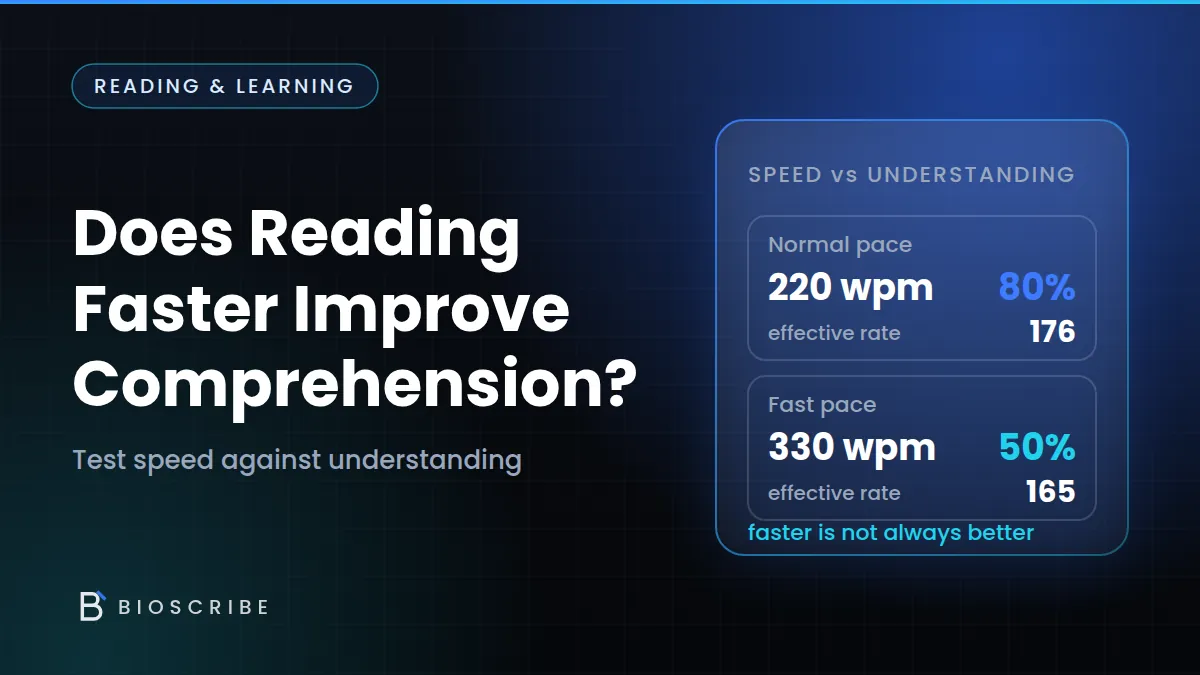
This puts speed and understanding in a single figure. Reading at 220 words per minute with 80% comprehension gives 220 × 0.8 = 176 effective words per minute. Reading at 330 words per minute with 50% comprehension gives 330 × 0.5 = 165. The faster pace delivers less understanding per minute. A faster speed only helps if comprehension does not fall by more than the speed rises.
A Simple Test You Can Run
- Choose two similar passages of about 1,000 words on a topic you have not studied.
- Read the first at your normal pace and time yourself.
- Read the second as fast as you can while still following it, and time yourself.
- Answer 10 questions about each, without looking back.
- Work out the effective rate for both.
Write your questions before you read, so that you do not write them to suit what you remember.
Example Results
| Pace | Words per minute | Questions right | Comprehension | Effective rate |
|---|---|---|---|---|
| Normal | 220 | 8 of 10 | 80% | 176 |
| Fast | 330 | 5 of 10 | 50% | 165 |
In this example, reading 50% faster cost 30 points of comprehension, and the effective rate went down. Your own results will differ, and that is the point of running the test.

Why Faster Can Cost Understanding
When you speed up, you tend to pause less, reread less and spend less time on difficult sentences. For easy text, that is fine. For hard text, the pauses and rereads are where understanding is built. You also have less time to connect new ideas to what you already know. A reader who slows down for a hard paragraph and speeds up for an easy one often does better than one who keeps a single fast pace.
When Reading Faster Is Fine
Faster reading is a good choice when the material is familiar or easy, when you only need the gist, or when you are deciding whether a text is worth reading carefully. For example, you may skim the introduction, headings and conclusion of an article to decide if it is relevant. Skimming is a separate skill from careful reading, and it is useful for choosing what to read, not for learning what you chose.
Skimming vs Careful Reading
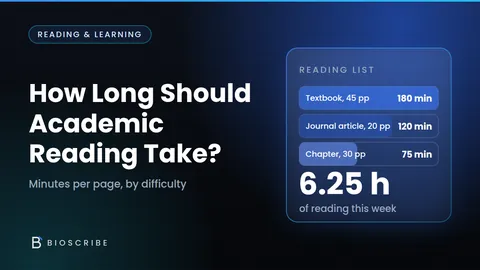
Use skimming to survey and careful reading to learn. A common pattern for a difficult text is to survey it first by reading headings and summaries, then read it carefully, then review. The survey costs a few minutes, and it makes the careful reading easier, because you already know where the argument is going. Our guide on how long academic reading should take shows how to budget time for each stage.
What Tends to Improve Both
Several habits help both speed and understanding, though results vary between people. Knowing the subject makes reading easier, so building background knowledge pays off. Reading with a question in mind keeps attention on what matters. Stopping at the end of each section to recall the main point, without looking, strengthens memory. Removing distractions helps, and so does reading when you are alert. These work by improving how you read, not by pushing your eyes along faster.
Be Cautious About Speed-Reading Claims
Courses and apps sometimes promise to double or triple your speed with no loss of understanding. Be sceptical, and test any method on yourself using the effective-rate calculation above. If a technique truly works for you, your effective rate will rise on new material, not just your words per minute. Keep the trial fair by using fresh passages of similar difficulty and writing the questions in advance.
Matching Pace to Purpose
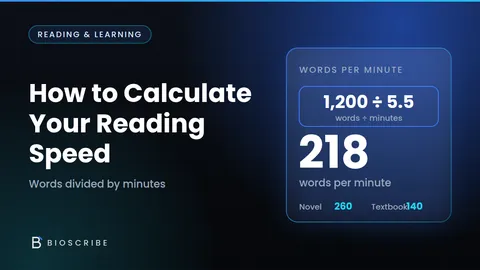
Choose your pace by purpose. For a first look at a chapter, go quickly. For material you will be examined on, go at the pace where you can summarise each section accurately. For a proof or a calculation, slow right down. You can measure your normal pace using our guide on how to calculate your reading speed, and you can use it to plan, knowing that the figure for careful reading is lower than for skimming.
A Study Example: A 6,000-Word Article
Take a 6,000-word article. Read carefully at 150 words per minute, it takes 6,000 ÷ 150 = 40 minutes. Read quickly at 300 words per minute, it takes 20 minutes. Suppose you answer 85% of questions after the careful read and 55% after the quick one. The effective rates are 150 × 0.85 = 127.5 and 300 × 0.55 = 165 words per minute. By this measure the quick read is more efficient, which shows that the effective rate is a guide, not the whole story.
Set a Comprehension Target First
The effective rate does not tell you whether 55% understanding is enough. If you need 85%, the quick read does not deliver it, however efficient it looks. Decide how well you need to understand a text, then choose the fastest pace that reaches that level. For a background reading, 55% may be fine. For the core text of an exam, it is not. The target comes from the purpose, and the pace follows from the target.
Common Mistakes to Avoid
- Measuring speed without checking understanding. Use the effective rate.
- Using one pace for everything. Match pace to purpose and difficulty.
- Skimming material you need to learn. Skim to choose, read to learn.
- Believing unverified claims. Test any method on yourself.
- Ignoring recall. Summarise each section without looking back.
Check Your Work With BioScribe
BioScribe’s Reading Time Calculator estimates how long reading-heavy topics will take. Use your careful-reading speed, not your skimming speed, for anything you need to learn.
Frequently Asked Questions
Does speed reading work?
Claims of large speed gains without any loss of understanding should be tested. Use the effective reading rate on fresh passages to see if a method helps you.
What is a good comprehension score?
It depends on your purpose. For material you will be examined on, aim to answer most questions correctly at the pace you choose.
Should I reread difficult passages?
Yes. Rereading hard sentences is a normal part of careful reading and usually improves understanding.
Is skimming bad?
No. It is useful for choosing what to read and getting the gist. It is not a replacement for careful reading when you need to learn.
How can I test my comprehension?
Write questions before you read, answer them afterwards without looking back, and score yourself.
Conclusion
Reading faster does not improve comprehension by itself, and it can reduce it. Judge any speed by the effective reading rate, test yourself with questions, and match your pace to your purpose. Skim to decide what to read, read carefully to learn, and build the habits that improve both speed and understanding.