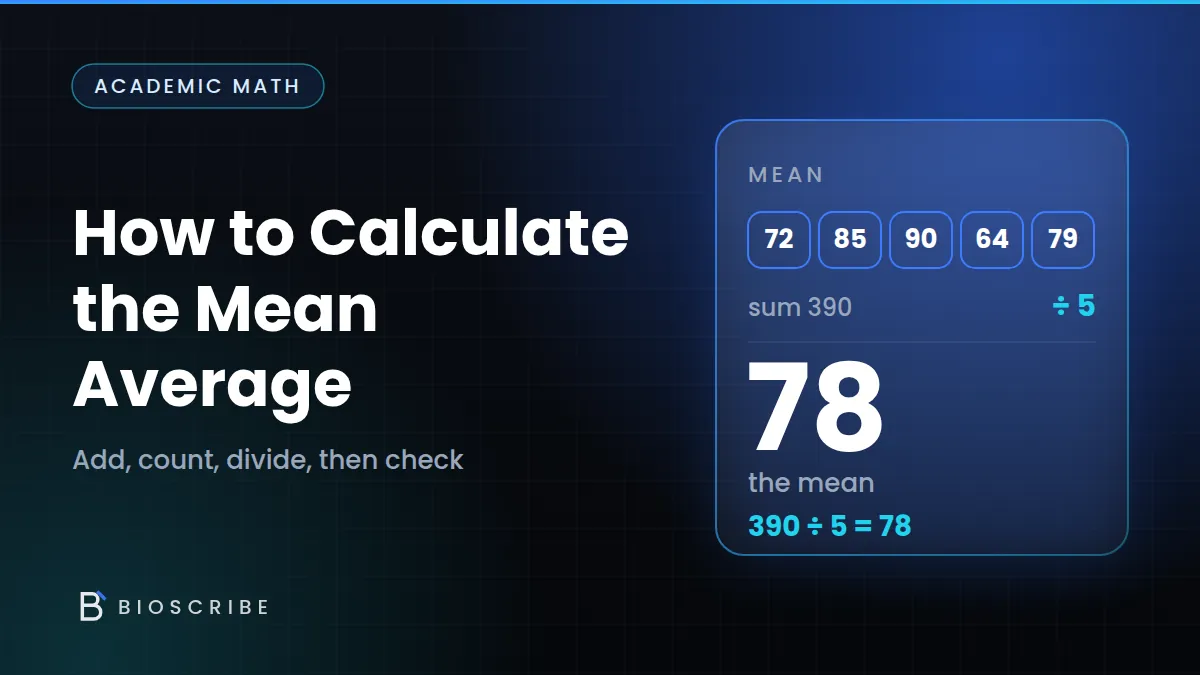
Short answer: mean = sum of all values ÷ number of values. Add the values, count them, and divide the total by the count.
What the Mean Is
The mean is what most people mean by “average”. It is the value you get if you share the total of a set of numbers equally among all of them. For a student, it answers everyday questions: what is my average quiz score, how many hours do I study each week on average, or what is the average mark in my class? Because it uses every value in the set, the mean reflects the whole data, which is both its strength and its weakness, as later sections show.
The Formula
Add the values, count them, and divide the total by the count. The count matters. If you miss one value when adding or counting, the answer will be wrong, so it helps to write the values in a list before you start.
Step-by-Step Example
Your five quiz scores are 72, 85, 90, 64 and 79.
- Add the values: 72 + 85 + 90 + 64 + 79 = 390.
- Count the values: there are 5.
- Divide: 390 ÷ 5 = 78.
Your mean quiz score is 78. Notice that no single score equals 78, which is normal. The mean is a summary, not one of the values.
Checking Your Answer
Three quick checks catch most errors. First, the mean must lie between your lowest and highest values, which is 64 to 90 here. Second, multiply the mean by the count and you should get the original sum back: 78 × 5 = 390. Third, ask whether the answer looks reasonable. Most of the scores are in the high 70s and 80s, so a mean near 78 makes sense, while 58 or 98 would not.
Adding a New Score
You do not need to start again when a new result arrives. Keep the running total and the count, then add the new score to the total and add one to the count. If your sixth quiz is 95, the new mean is (390 + 95) ÷ 6 = 80.83. The running mean after each quiz looks like this:
| After quiz | Score | Running total | Mean |
|---|---|---|---|
| 1 | 72 | 72 | 72.00 |
| 2 | 85 | 157 | 78.50 |
| 3 | 90 | 247 | 82.33 |
| 4 | 64 | 311 | 77.75 |
| 5 | 79 | 390 | 78.00 |

Finding the Score You Need for a Target Mean
Suppose you want a mean of 80 after a sixth quiz. A mean of 80 over 6 quizzes means a total of 80 × 6 = 480. You already have 390, so the next quiz must supply 480 − 390 = 90. If the answer is above the maximum score, the target cannot be reached with one more quiz, and you will need to spread it over several.
How a Single Low Score Affects the Mean
The mean is sensitive to extreme values. If you miss the sixth quiz and score 0, the mean becomes 390 ÷ 6 = 65, a fall of 13 points from 78 in one step. A single very low or very high value can pull the mean away from what is typical. When that happens, the median may describe typical performance better. Our guide to mean vs median vs mode explains when to use each.
Combining Means From Different Groups
Be careful when you combine averages from groups of different sizes. Class A has 20 students with a mean of 70, and Class B has 30 students with a mean of 80. Averaging the two means gives 75, which is wrong. The class totals are 70 × 20 = 1,400 and 80 × 30 = 2,400, so the combined mean is 3,800 ÷ 50 = 76. The larger class counts for more. This is a weighted average, covered in our guide on how to calculate a weighted average.
Mean of Percentages vs Pooled Marks
The same issue appears with tests that have different totals. You score 18 out of 20 (90%) and 40 out of 50 (80%). Averaging the percentages gives 85%. Pooling the marks gives (18 + 40) ÷ (20 + 50) = 58 ÷ 70 = 82.86%. Which to use depends on your syllabus, and our guide on calculating your average test score explains the choice.
Rounding and Reporting
Keep the decimals while you calculate and round only the final answer. A mean of 80.83 can be reported as 80.8 or 81, depending on the precision you need. Check whether your institution rounds to a whole number, and whether it rounds up at a boundary. Always say what the mean is of, for example “mean quiz score”, because a number without a description is hard to interpret.
Calculating a Mean in a Spreadsheet
In a spreadsheet, put the values in a column and use =AVERAGE(B2:B6). The function ignores empty cells and text, which is helpful if a test has not been taken yet, but it counts a zero as a real score. If a missed test is blank, it is left out, and if it is entered as 0, it is included. Be deliberate about which one you mean.
A Second Example With Decimals
Scores are not always whole numbers. Suppose your five lab marks out of 10 are 7.5, 8, 6.5, 9 and 7. The total is 7.5 + 8 + 6.5 + 9 + 7 = 38, and there are 5 marks, so the mean is 38 ÷ 5 = 7.6. Decimals change nothing about the method. Keep them all through the addition and round only at the end, otherwise a small rounding error in each mark can add up to a visible one in the mean.
Using the Mean to Track a Habit
The mean is useful beyond marks. If you studied 12, 15, 9 and 14 hours in four weeks, the total is 50 and the mean is 50 ÷ 4 = 12.5 hours a week. If your goal is 14 hours, you are 1.5 hours short each week, which is 14 × 4 − 50 = 6 hours over the month. Turning a mean into a total gap makes the shortfall easier to act on than a decimal alone.
Common Mistakes to Avoid
- Dividing by the wrong count. Count every value you added.
- Averaging averages from groups of different sizes. Use the totals.
- Treating a zero as missing. A zero lowers the mean, and a blank does not.
- Rounding too early. Round only the final answer.
- Ignoring outliers. A very low or high value can distort the mean.
Check Your Work With BioScribe
BioScribe’s Average Calculator finds the average of a set of scores. Enter the five quiz scores above to check the mean of 78, then try your own numbers.
Frequently Asked Questions
Is the mean the same as the average?
In everyday use, yes. “Average” usually means the mean. Strictly, the median and mode are also averages, so say which one you mean.
Can the mean be a number that is not in my data?
Yes. The mean is a summary of the whole set, so it is often a value that none of the scores equals exactly.
Does a zero count in the mean?
Yes. A zero is a real value and lowers the mean. A blank or missing value is left out, so enter it deliberately.
How many decimal places should I use?
Keep the full value while calculating and round the final answer, usually to one or two decimal places, following your institution’s rule.
How do I find the mean from a total and a count?
Divide the total by the count. If the total is 390 and there are 5 values, the mean is 390 ÷ 5 = 78.
Conclusion
To calculate the mean, add the values and divide by how many there are. Check that the answer lies between the lowest and highest values, keep a running total so that new scores are easy to add, and use the formula backwards to find the score you need for a target. For groups of different sizes or values that count differently, use a weighted average.