Short answer: weighted average = sum of (value × weight) ÷ sum of weights. The weights can be minutes, students, units or any measure of how much each value counts.
What a Weighted Average Is
An ordinary mean treats every value as equal. A weighted average does not. Each value has a weight that says how much it counts, and values with larger weights have more influence on the result. You need one whenever the values represent different amounts of something: classes of different sizes, study sessions of different lengths, or items bought in different quantities. For course grades specifically, see our guide to calculating a weighted grade. This guide covers the general method.
The Formula
Multiply each value by its weight, add the results, then divide by the total weight. Dividing by the total weight means the weights do not have to add up to 1 or to 100%. Any consistent unit works.
Step-by-Step: Reading Speed Across Sessions
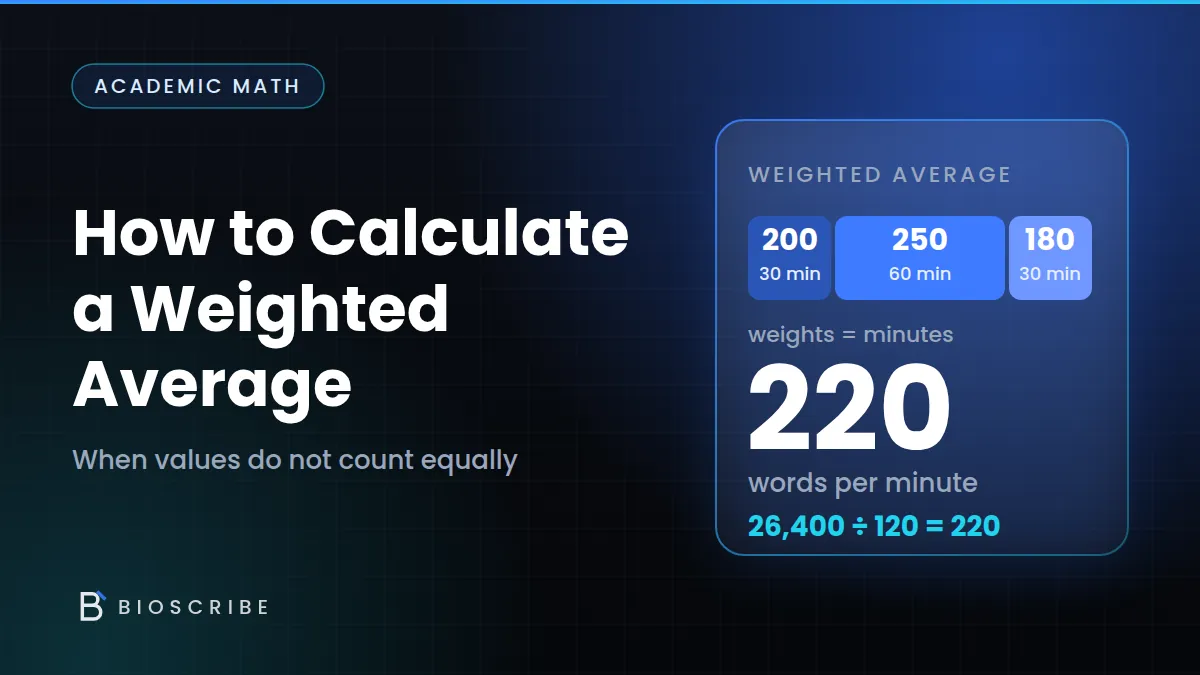
You read in three sessions: 30 minutes at 200 words per minute, 60 minutes at 250, and 30 minutes at 180. What is your average speed?
- Words read in each session: 30 × 200 = 6,000; 60 × 250 = 15,000; 30 × 180 = 5,400.
- Total words: 6,000 + 15,000 + 5,400 = 26,400.
- Total weight (minutes): 30 + 60 + 30 = 120.
- Divide: 26,400 ÷ 120 = 220 words per minute.
A simple average of the three speeds, (200 + 250 + 180) ÷ 3 = 210, is lower, because it counts the short sessions as much as the long one. The weighted answer is correct, since it matches the total words divided by the total time.
Weights Do Not Need to Add Up to 1
People often think weights must be percentages. They do not. Suppose three values are 80, 70 and 90 with weights 2, 3 and 5. The weighted sum is 2 × 80 + 3 × 70 + 5 × 90 = 160 + 210 + 450 = 820. The total weight is 2 + 3 + 5 = 10, so the weighted average is 820 ÷ 10 = 82. The simple average would be 80. If the weights were 20%, 30% and 50%, you would get the same 82, because dividing by the total weight cancels the scale.

Combining Group Averages
When you combine the averages of groups, the weights are the group sizes. A class of 20 students has a mean of 70, and a class of 30 has a mean of 80. The weighted average is (70 × 20 + 80 × 30) ÷ (20 + 30) = 3,800 ÷ 50 = 76, not 75. Using sizes as weights gives the same answer as pooling all 50 scores, which is the test of a correct method.
Averages From a Frequency Table
A frequency table is a weighted average in disguise. Suppose 3 students scored 5, 5 students scored 6 and 2 students scored 7 on a short quiz. The values are the scores, and the weights are the frequencies. The total is 3 × 5 + 5 × 6 + 2 × 7 = 15 + 30 + 14 = 59, and there are 10 students, so the mean is 59 ÷ 10 = 5.9. You never need to write out all ten scores.
Average Price or Cost
You buy 2 books at 1,500 each and 3 books at 2,000 each. The average price per book is (2 × 1,500 + 3 × 2,000) ÷ 5 = 9,000 ÷ 5 = 1,800. A simple average of the two prices would be 1,750, which ignores that you bought more of the dearer book. Whenever you average a rate, such as a price per item or a speed, weight it by the quantity it applies to.
Choosing the Weights
The weights should be whatever the values stand for. For group averages, use the group sizes. For speeds, use the time or the distance, depending on what you are averaging. For prices, use the number of items. For grades, use the credit units or the percentage given in the syllabus. If you cannot say what a weight represents, ask what each value is an average of, and use that quantity.
Weighted Average vs Weighted Grade
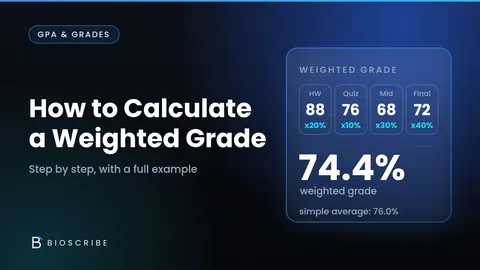
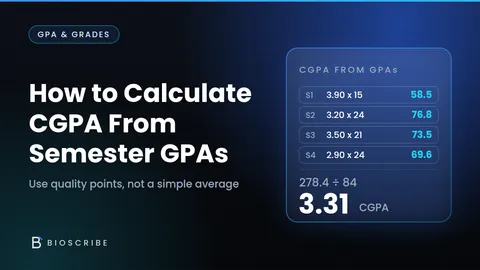
A weighted grade is a weighted average where the weights come from the syllabus. A weighted GPA uses credit units as weights, which our guide on calculating CGPA from semester GPAs explains. The calculation is the same, only the source of the weights changes. If you understand the general method, you can apply it to any of these situations.
Checking Your Result
Three checks help. The weighted average must lie between the smallest and largest values. It should be closer to the values with the largest weights. And if all the weights are equal, it should match the simple mean. In the reading example, 220 lies between 180 and 250, and it is closer to 250, the speed with the largest weight, as it should be.
Doing It in a Spreadsheet
Put the values in column B and the weights in column C. The formula =SUMPRODUCT(B2:B4,C2:C4)/SUM(C2:C4) multiplies each value by its weight, adds the results and divides by the total weight in one step. Make sure both ranges are the same size, and extend them as you add rows.
Average Speed Over Time
Averaging speeds is a common trap. Suppose you travel 1 hour at 60 km/h and 2 hours at 30 km/h. Weighted by time, the average speed is (60 × 1 + 30 × 2) ÷ 3 = 120 ÷ 3 = 40 km/h, which matches the 120 km covered in 3 hours. A simple average of the two speeds, 45 km/h, overstates it. When values are rates, weight them by the quantity they apply to, such as hours spent at each speed.
Attendance Across Courses
The same idea works for attendance. If you attended 90% of 20 classes in one course and 80% of 30 in another, the combined attendance is (0.90 × 20 + 0.80 × 30) ÷ 50 = (18 + 24) ÷ 50 = 84%. Averaging 90% and 80% would give 85%, which ignores that the second course has more classes. Weighting by the number of classes gives the figure you would get by counting every class together.
Common Mistakes to Avoid
- Using a simple average when the values stand for different amounts. Weight them.
- Forgetting to divide by the total weight. That produces a number far too large.
- Using the wrong quantity as the weight. Ask what each value is an average of.
- Averaging averages without weights. Use group sizes or totals.
- Mixing units. Keep the weights in one consistent unit.
Check Your Work With BioScribe
BioScribe’s Average Calculator finds the average of a set of scores. Use it to check the simple averages in this guide, then compare them with the weighted results.
Frequently Asked Questions
Do weights have to add up to 100%?
No. Dividing by the total weight takes care of the scale, so weights of 2, 3 and 5 give the same result as 20%, 30% and 50%.
When is a weighted average different from a simple average?
Whenever the weights are not equal. If every weight is the same, the two give the same answer.
What should I use as the weight?
Use the quantity each value represents, such as the number of students, the minutes spent, the items bought or the credit units.
Is a weighted average the same as a weighted mean?
Yes. The two terms are used for the same calculation.
Can a weighted average fall outside the range of the values?
No. With positive weights it always lies between the smallest and largest value. If it does not, check your arithmetic.
Conclusion
A weighted average multiplies each value by its weight, adds the results and divides by the total weight. Use it whenever values count differently, choose weights that match what each value stands for, and check that the result sits between the smallest and largest values. Once you know the method, group averages, frequency tables, prices and grades are all the same calculation.