Short answer: percentage = part ÷ whole × 100. To find the part, multiply the whole by the percentage as a decimal. To find the whole, divide the part by the percentage as a decimal.
Three Questions, One Idea
Almost every percentage problem asks one of three things. What percentage is this number of that number? What is a given percentage of a number? Or, if this number is a given percentage of something, what is the something? All three use the same relationship between a part, a whole and a percentage. Once you can tell which of the three you are missing, the arithmetic is short.
Question 1: What Percentage Is X of Y?
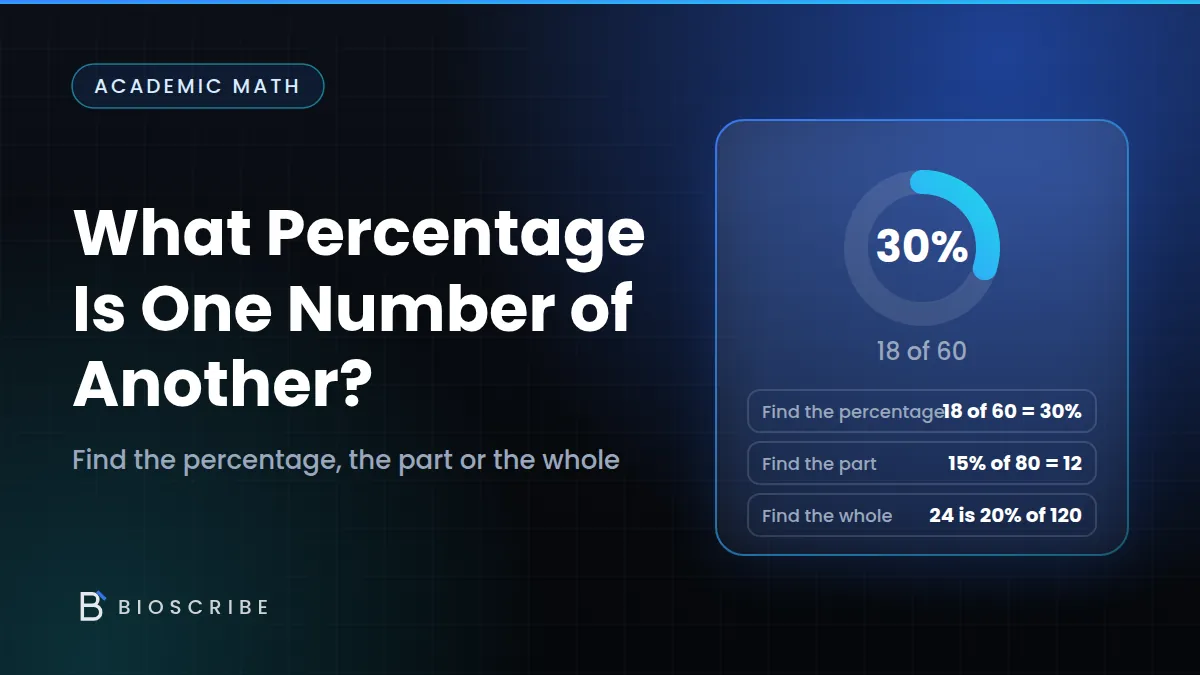
You have covered 18 of the 60 pages of notes. The part is 18 and the whole is 60, so 18 ÷ 60 = 0.30, which is 30%. Or you have revised 14 of 35 topics: 14 ÷ 35 = 0.40, so you are at 40%. The whole is the total that you divide by, and the answer is a share of it.

Question 2: What Is X% of Y?
Turn the percentage into a decimal and multiply. 15% of 80 is 0.15 × 80 = 12. If a final exam is worth 40% of a course and the course has 200 marks in total, the exam is worth 0.40 × 200 = 80 marks. This is the question you answer when you need the weight of an assessment in marks.
Question 3: X Is a Percentage of What Number?
Here you know the part and the percentage, and you want the whole. If 24 is 20% of a number, the number is 24 ÷ 0.20 = 120. If you scored 36 marks and that was 45% of the paper, the paper was out of 36 ÷ 0.45 = 80. Dividing by the decimal undoes the multiplication in question 2.
Which Number Is the Whole?
Most mistakes come from choosing the wrong whole. Look for the words that signal it. The whole usually follows “of” or “out of”, or comes after “than” in a comparison. Swapping the two numbers changes the answer a lot. 20 is 20 ÷ 50 = 40% of 50, but 50 is 50 ÷ 20 = 250% of 20. A percentage above 100 is not an error. It means the part is bigger than the whole you chose.
Summary Table
| You know | You want | Formula | Example |
|---|---|---|---|
| Part and whole | Percentage | part ÷ whole × 100 | 18 of 60 = 30% |
| Whole and percentage | Part | whole × % ÷ 100 | 15% of 80 = 12 |
| Part and percentage | Whole | part ÷ (% ÷ 100) | 24 is 20% of 120 |
Percentages of Percentages
Sometimes you take a percentage of a percentage. If 25% of a course is assessed by coursework and 40% of the coursework is quizzes, then quizzes are 0.40 × 0.25 = 0.10, which is 10% of the course. Multiply the decimals together, and convert back to a percentage at the end.
Using a Proportion
Another way to think about it is as a proportion: part ÷ whole = percentage ÷ 100. If you know any three of the four values, you can find the fourth. For instance, if 12 out of 48 students attended a revision session, then 12 ÷ 48 = p ÷ 100, which gives p = 25. Writing the proportion down is useful when a problem is worded in an unfamiliar way.
Everyday Examples for Students
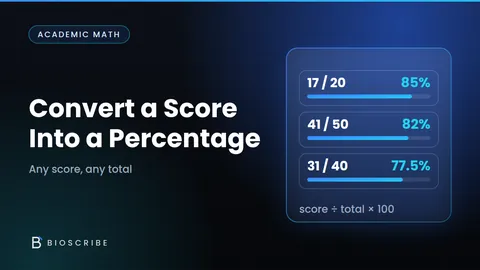
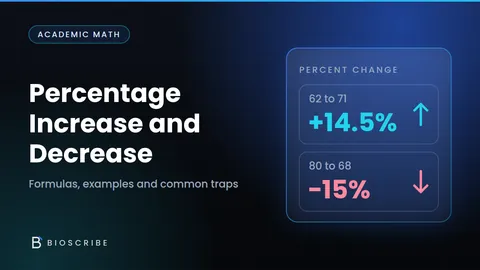
These questions come up often. What percentage of the syllabus have I covered? If you have studied 14 of 35 topics, you are at 40%. What share of my week is study time? 3 hours out of 12 available is 25%. How many marks is a 30% assessment worth in a 150-mark course? 0.30 × 150 = 45. If you want to see how a share changes over time, our guide on percentage increase and decrease covers the next step.
Checking Your Answer Quickly
Use easy percentages to estimate before you calculate. 10% of a number is one tenth of it, so 10% of 80 is 8. 5% is half of that, which is 4, and 15% is 8 + 4 = 12. If your calculated answer is far from your estimate, look for a slip. You can also check the whole and part: the part should be smaller than the whole when the percentage is below 100.
Worked Examples With Student Questions
Here are four more problems, one for each situation. A course is out of 150 marks and coursework is 45 marks, so coursework is 45 ÷ 150 = 30%. You have read 28 of the 40 books on a reading list, which is 28 ÷ 40 = 70%, so 30% (12 books) remain. A paper is out of 70 and you need 60%, so you need 0.60 × 70 = 42 marks. A textbook costs 2,400 and is discounted by 25%, so the discount is 0.25 × 2,400 = 600 and the price is 1,800.
When a Total Is Split Into Groups
If a whole is divided into groups, the percentages should add up to 100. A class of 40 has 22 girls and 18 boys. That is 22 ÷ 40 = 55% and 18 ÷ 40 = 45%, and 55 + 45 = 100. Checking that the shares add up is a simple way to catch a mistake, such as using the wrong whole for one of the groups.
Splitting Your Study Time
The same idea tells you where your time goes. Suppose you spend 5 hours on mathematics, 4 on physics and 3 on chemistry, a total of 12 hours. The shares are 5 ÷ 12 = 41.67%, 4 ÷ 12 = 33.33% and 3 ÷ 12 = 25%, which together make 100%. Seeing the shares may show that one subject is taking far more or less of your week than you intended.
Common Mistakes to Avoid
- Dividing by the wrong number. Identify the whole before you start.
- Forgetting to convert percentages to decimals. 20% is 0.20 in the formula.
- Swapping part and whole. The answer changes dramatically.
- Adding percentages of different wholes. They cannot be added unless the wholes match.
- Rounding too early. Round only the final answer.
Check Your Work With BioScribe
BioScribe’s Percentage Calculator handles percentages, percentage changes and score percentages. Enter a part and a whole to check the 30% example above, then try the other two question types.
Frequently Asked Questions
How do I know which number is the whole?
It usually follows the word “of” or “out of”, or comes after “than” in a comparison. The whole is the number you divide by.
Can a part be larger than the whole?
Yes, and the percentage will then be above 100. For example, 50 is 250% of 20.
How do I find a percentage in my head?
Find 10% by moving the decimal point, then build up. For 15% of 80, take 10% (8) and half of that (4) to get 12.
What is the difference between “percent of” and “percent more than”?
“Percent of” compares a part with a whole. “Percent more than” compares a new value with a starting value, which is a percentage change.
What if I only know the percentage and the part?
Divide the part by the percentage as a decimal. If 36 marks is 45% of the paper, the total is 36 ÷ 0.45 = 80.
Conclusion
Every percentage problem has a part, a whole and a percentage, and one of them is missing. Decide which, use the matching formula, and check the answer against an easy estimate. For turning a score into a percentage specifically, see our guide on converting a score into a percentage.